By Alex Stark
Look Underneath—Why Customer Loyalty, AI, Cash Flow, and the Global Helium Supply Are All Quietly Shifting
I’m coming back from business travel this week on the West Coast. Travel can be a bit of a grind. Rental cars, traffic, crowded airports. But the goodness lies in the camaraderie among friends and colleagues, whether working from the corporate office, visiting operations, or participating in an industry event. I began in the Pacific Northwest and finished in NoCal, with a stop in the beautiful Monterey area.
 Many thanks for the excellent and first-class conference hosted by AWI (Associated Warehouses, Inc.). Mark, Tim, and Aaron, it was great seeing you all. The content was salient and informative, and the many conversations with friends and new acquaintances were dynamic and collaborative.
Grabbing the redeye back East to catch up on some sleep and recharge for next week.
Travel makes staying current a challenge, but as I worked through this week’s industry reading between meetings, I noticed something. Every story I pulled up had the same shape:
A surface that looks fine, and a foundation quietly shifting underneath it.
Customer loyalty. AI momentum. Revenue on its way in. The supply chain itself. Four different stories, four different industries, but the same quiet instruction: look underneath. Here’s what I mean.
1. The Customer You Thought Was Loyal… Isn’t
Tillster released its 2026 Customer Preference Report this week, and the headline finding should give every brand marketer pause: 45% of surveyed consumers said their favorite restaurant brand changed in the last year. That’s up from 33% in 2025. That’s a 12-point swing in 12 months.
On its face, this reads as a restaurant-industry story. I don’t think it is. I think it’s a CX story that applies to nearly every B2C and B2B relationship we manage. Last week, I wrote about Watermark’s 18-year data showing that CX leaders outperform the S&P 500 by 400 points. This week’s Tillster data is the companion lesson: that CX advantage evaporates faster than most brands realize if you stop investing in it.
The most interesting finding for me was buried further down. Price dropped to the fourth-most important factor in deciding where to dine. That’s behind food quality, convenience, and speed. “Cheaper” is no longer the loyalty lever it once was. “Better, faster, and easier” is. Points-based loyalty programs and straight discounts are losing their grip because everyone has them.
In our corner of the world, the equivalent is the customer who’s been with you for a decade, doesn’t complain much, and quietly shops your competitors every time their contract comes up. Loyalty isn’t a trophy you win once. It’s something that gets re-earned in every handoff, every exception, every phone call that does or doesn’t get returned.
This is exactly why Holman’s Extraordinary Service Process isn’t a poster on a wall. Loyalty lives in the small interactions, not in the annual business review deck. If your customer success strategy is weighted 80% toward acquisition and 20% toward retention surprise-and-delight, you’re fishing in the wrong pond.
2. The AI Curve Looks Like a Line… Until You Look Underneath It
Stanford HAI dropped its 2026 AI Index Report this week, and the topline numbers are the ones everyone will quote:
- Organizational AI adoption: 88%
- U.S. private AI investment in 2025: $285.9 billion, more than 23x what China invested
- Generative AI population adoption: 53% in three years, faster than the PC or the internet
- Estimated consumer value of generative AI tools: $172 billion annually by early 2026
Impressive. Now here’s the paragraph that actually stopped me. The United States hosts 5,427 data centers. That total is more than 10x any other country. Plus, almost every leading AI chip running in those data centers is fabricated by a single Taiwanese foundry, TSMC. One company. One island. One geopolitical flashpoint.
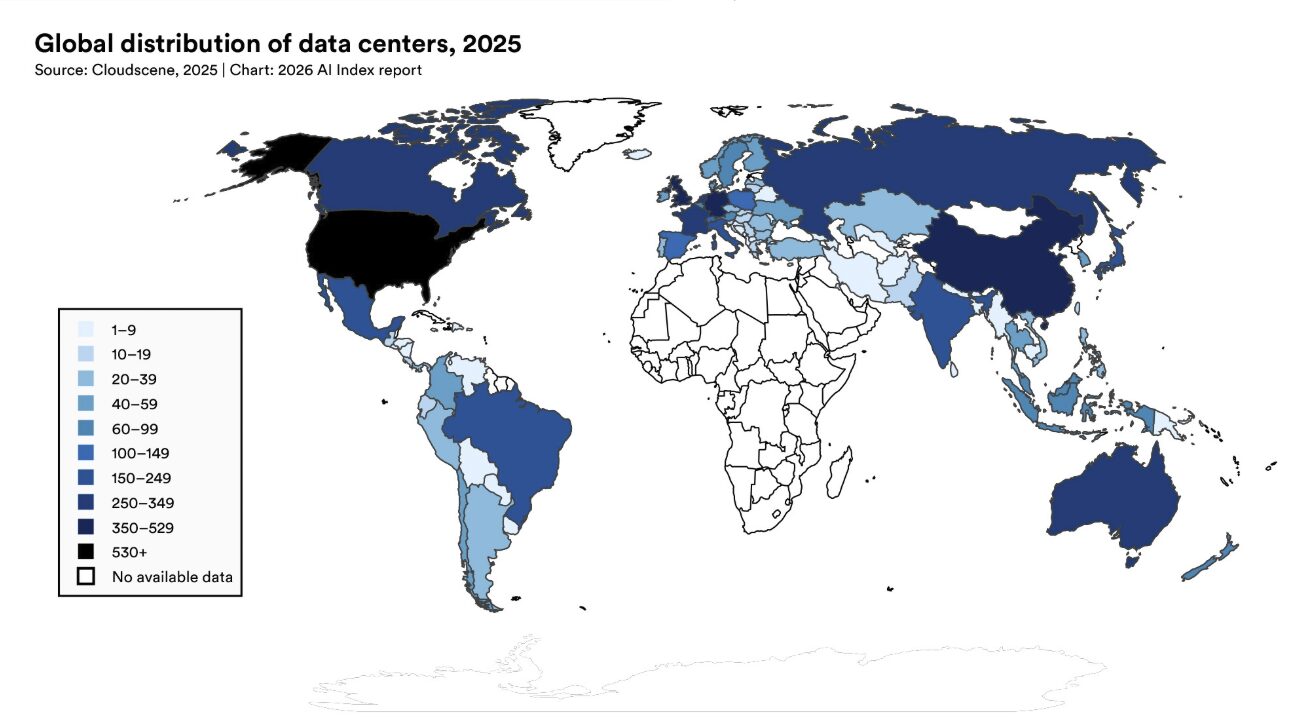
The AI boom is sitting on a supply chain as narrow as any I’ve seen in my career. And that’s before you factor in the compute scarcity I wrote about last week, or the data center backlash before that.
The “Jagged Frontier”
Another finding from the Index that stuck with me: AI models can win a gold medal at the International Mathematical Olympiad, but can only read an analog clock correctly 50.1% of the time. Researchers call this the “jagged frontier.” This term captures the capability advancing wildly unevenly, with state-of-the-art performance on graduate-level problems coexisting with failures on tasks a second-grader handles.
Meanwhile, responsible AI isn’t keeping up. Documented AI incidents jumped from 233 in 2024 to 362 in 2025—a 55% year-over-year increase. Capability benchmarks get reported religiously. Safety benchmarks don’t. Hello, Anthropic Mythos.
The practical takeaway hasn’t changed from last week, but the urgency has. If your AI strategy assumes abundant compute, abundant chips, and steady improvement across every task, your strategy has three unstated dependencies. Build contingency into your roadmap, not just capability. Pilot in two or three high-ROI areas. Document what works. Don’t bet the farm on the smooth part of the curve continuing to be smooth.
3. Late Payments Are Never Really About the Payment
One of the sharpest reframes I read this week came from Nishant Nair, CEO of RecVue, in a SupplyChainBrain piece titled “What Late Payments are Actually Telling You.”
His argument, paraphrased: late payments are almost never a collections problem. They’re the place where operational misalignment finally shows up on the balance sheet. By the time AR is chasing the invoice, the real problem happened three departments ago in contracting, billing, partner settlements, or customer service.
The data backs it up. A 2026 study of finance leaders found that 7% of invoices contain errors and that 54% of disputes take up to 10 days to resolve. That’s not a collections problem, that’s a process problem masquerading as a cash flow problem.
The broader context is sobering. Just 37% of invoices were paid on time in 2025, down from 42% the year before and 54% in 2019. That trend line isn’t reversing on its own.
Your AR Aging Report Is an Operational Diagnostic
This is the reframe worth writing down. Your AR aging report isn’t just a finance document; it’s operational telemetry. Rising DSO, rising disputes, and erratic payment behavior from long-term customers are almost always symptoms of an upstream problem. The question isn’t “How do we collect faster?” It’s “What is our AR trying to tell us?”
Common upstream signals worth investigating:
- Dispute volume ticking up: Probable cause is that contract terms aren’t matching invoicing reality
- Billing cycle delays: Probable cause is that data isn’t flowing cleanly between CRM, ERP, and billing systems
- Erratic payment behavior is a stronger predictor of customer financial distress than consistently slow payment
This one hits the SME thread I’ve been tracking. Smaller businesses get squeezed from both directions: they’re the ones most likely to pay late because they’re under cash pressure, and they’re the most vulnerable when their own customers pay late. Treat the data in your AR system as what it actually is. It’s a window into how your operation is really running.
4. The Supply Chain Vulnerability Nobody Was Watching… Helium
While the market has been watching oil prices and tariff headlines, a completely different shortage has been quietly building. Moody’s Ratings published a report this week warning that disruptions to helium supply from the Middle East conflict could cascade through the entire AI and semiconductor supply chain.
Helium. The stuff in birthday balloons. And what you used to goof around with your friends to make your voice sound like an elf. Here’s what I didn’t know:
- Helium isn’t manufactured. It accumulates over millions of years through radioactive decay and is captured only as a byproduct of natural gas processing.
- There are 14 helium refineries in the entire world.
- Qatar accounts for roughly 30% of global high-purity helium, and Iranian strikes on Qatari LNG infrastructure in March damaged production lines that could take years to rebuild.
- There are no effective substitutes for helium in semiconductor manufacturing.
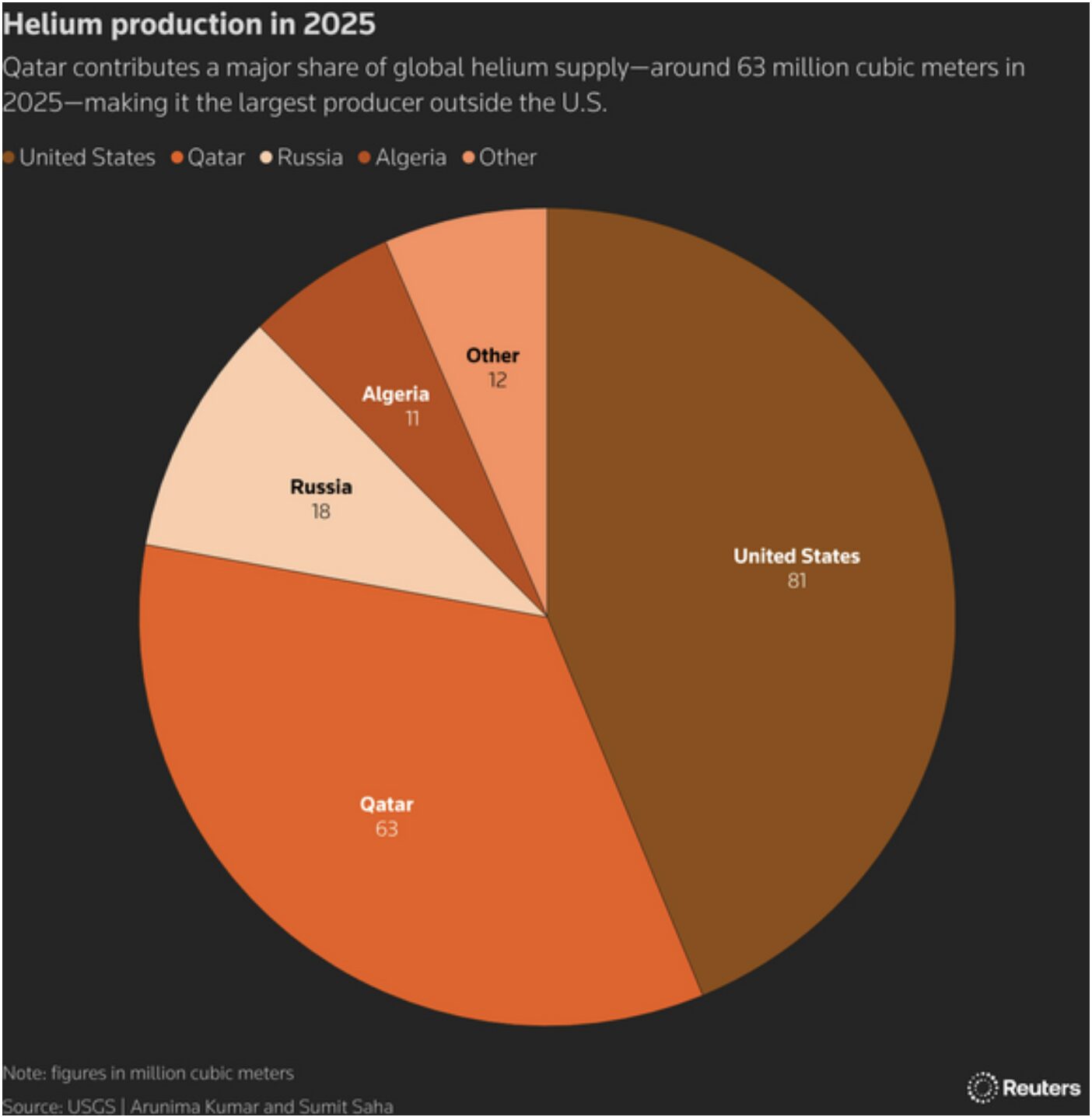
Helium is used at multiple stages of chipmaking, including cooling silicon wafers, leak detection, and photolithography. TSMC, Samsung, and SK Hynix all depend on it. So does every MRI machine on Earth (helium cools the magnets). So do fiber optic cable production, automotive airbag manufacturing, and a long list of industrial processes most of us never think about.
As David Pan of Moody’s put it:
“Helium doesn’t get much attention in the AI supply chain, but it should.”
The Lesson Isn’t About Helium
The lesson is that every operation has a helium. There is likely a single-source input, a single-vendor dependency, a single-region concentration, that nobody has mapped because it’s always just been there. The reason nobody talks about it is the same reason it’s dangerous: it’s invisible until it isn’t.
The companies that come out of the next disruption ahead are the ones running that mapping exercise now, while they still have time to develop alternatives. Not because disruption is coming, but because we’ve all been reminded, again, that it always does, and it rarely comes from the direction you were watching.
One historical footnote from the Moody’s report I can’t stop thinking about. The reason the Hindenburg was filled with hydrogen in 1937 was that the Germans couldn’t get helium. Supply chain disruptions aren’t a new problem. They’re just differently packaged each time.
Bringing It Together… Look Underneath
Four stories, one instruction: look underneath.
- Look underneath your customer relationships because loyalty is quieter and more fragile than it used to be.
- Look underneath your AI strategy because the capability curve sits on a physical foundation of chips, compute, and concentrated supply.
- Look underneath your AR report because the numbers tell you something about how the rest of your operation actually runs.
- Look underneath your supply chain because there is always a helium.
Heritage companies sometimes get accused of being slow to adapt. I’d argue the opposite. 162 years of doing this teaches you to distrust smooth surfaces. Every decade has its “nobody saw it coming” moment, and every one of them had warning signs underneath that somebody saw. Our job is to be the somebody.
One Last Thing…
If the theme of this week’s post left you wanting to actually see some hidden infrastructure, check out Submarine Cable Map. It’s an interactive visualization of every undersea internet cable on Earth. There are roughly 550 lines of fiber optic cable that carry 99% of international data traffic. You’ve been using these every day of your life without ever seeing one.
Oddly fascinating. Click on a cable, and it tells you its name, landing points, and length.
You’re welcome.
What’s Sitting Underneath Your Supply Chain?
At Holman Logistics, we’ve spent 162 years helping shippers see what’s really going on beneath the surface of their operations. That includes customer relationships that need reinvestment, processes that look fine until they don’t, and dependencies most people discover only after it’s too late. If you’d like a partner who asks uncomfortable questions before disruption forces them to, let’s start a conversation.
Remember, it costs nothing to be kind.