U.S. Domestic Economic Items
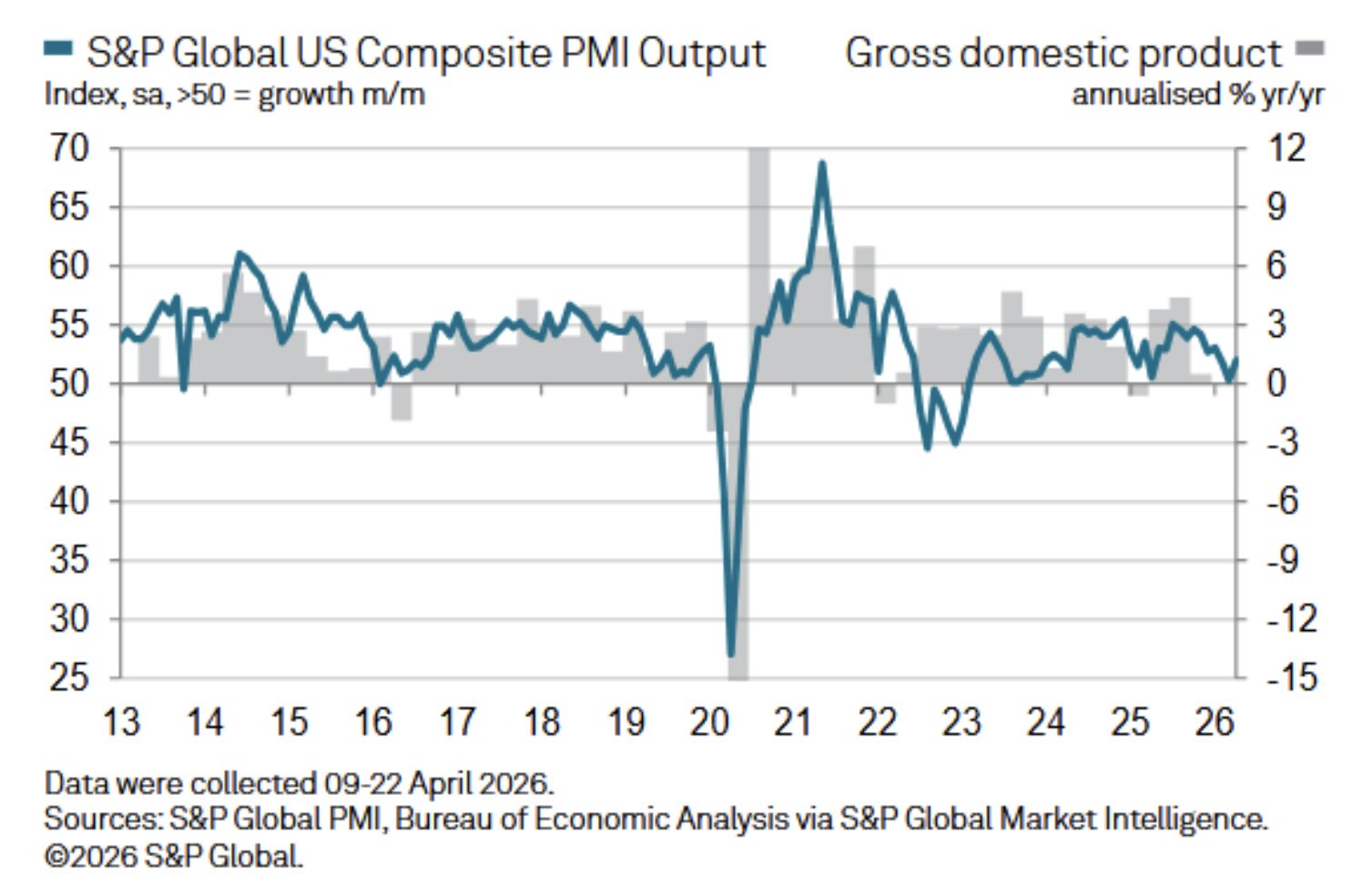
U.S. business activity growth recovered slightly in April after slowing to near-stagnation in March following the outbreak of war in the Middle East. That’s a good sign for the economy, given a tough month of uncertainty, rising fuel prices, and other factors that could easily have slowed things down.
However, the overall pace of expansion remained subdued, most notably in the services economy, where demand faltered. While manufacturing output posted a solid gain, the increase was partly driven by stock building amid concerns about supply availability and price hikes.
Here are some warning signs to watch for.
- Stagflation Concerns: The Services PMI was still at its second weakest reading in the past year, while services’ selling prices hit a 45-month high.
- New Orders: Services rose at the slowest pace in two years, a streak that stretches well before the Middle East conflict. This signals that demand softness has structural roots (cost-of-living squeeze, perhaps some tariff-policy-uncertainty impacts), stuff that the war is amplifying, not creating.
- Employment: This was also the back-to-back worst employment months since late 2024, and companies were reporting a need to cut staffing costs amid uncertain demand and high input prices.
- Read the report for additional details.
The Fed Holds… No Surprise
The Federal Reserve kept interest rates unchanged. It leaned into the notion of higher inflation risk amid fears of rising energy costs for consumers. There were no surprises in this.
The Fed also noted that it is watching labor for signs of softness. Given the uncertainty, if these conditions persist, the market now expects no interest rate cuts in 2026.
This was also the largest number of dissenters in a Fed decision since 1992. That tells us just how difficult it is to forecast the current condition. Again, it isn’t classic stagflation because the magnitudes of inflation and contraction don’t meet the official definition. But directionally, that’s the story the Fed is wrestling with. They see economic conditions in the broader economy as lukewarm, while inflation risks are growing.
That makes it difficult.
Read this week’s Brief for more market insights.