By Alex Stark
Who Shows Up: The Resilient American Consumer, a Black Friday That Lasts All Season, a Coast-to-Coast Railroad on Trial, and Drones Over the Backyard
A colleague and friend participated in Pelotonia’s Night in Columbus, OH, this week. It’s the organization’s year-end celebration, bringing the community together to honor and recognize the efforts of every participant, team, and partner during the outstanding 2026 fundraising season. Seeing the pictures, watching the videos, and hearing firsthand accounts from the event made me reflect on this season of gratitude. Being thankful for our family and friends. Our health and the health of our loved ones. And being grateful for our communities, who always show up and provide a beacon of light even in the seemingly darkest hour.
The final number released during the event is worth reading twice: $31,160,918. That’s a record, and 7% above last year’s total. It’s the first time Pelotonia has cleared $30 million in a single year. Since 2009, it has raised $370 million, with 100% of participant-raised dollars going to cancer research at Ohio State’s Comprehensive Cancer Center (OSUCCC – James). This year’s 13,000+ participants ranged in age from 14 to 94, spanning 46 states and 10 countries, and included a record 1,088 cancer survivors. I like to poke fun at Ohio in this space when I get the chance. Not today.
Best wishes for a wonderful Thanksgiving, however you celebrate. The blog will be on break next week, so we hope to see you back here on December 4th.
Back in October, I wrote that you don’t need to know how the year ends to be thankful for the people who got you this far. That holds up. This week’s reading kept circling the same idea as that Night of Impact… who shows up, and when. Consumers keep showing up to spend. Shoppers are showing up on their own schedule. Rail leaders showed up to argue over a proposed coast-to-coast railroad. And drones are showing up in backyards, invited or not.
Let me know what you’re seeing.
1. The American Consumer Keeps Showing Up
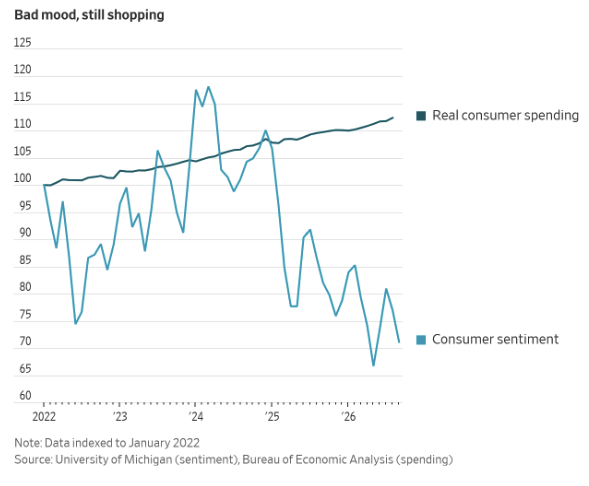
The Wall Street Journal took a close look at the American consumer this week, and it’s a fitting week for it. For most of this year, consumers have told surveys they feel lousy and then gone out and spent anyway.
The numbers bear that out. Bank of America card data shows October spending up 5% from a year ago, with a larger share going to discount stores, big-box retailers, and secondhand shops. Meanwhile, the University of Michigan’s preliminary November sentiment reading came in at 51, up from October’s 48, a five-month low. Still low by the survey’s own standards.
Still spending.
A “K” with a Shorter Leg
You’ve probably heard the economy described as K-shaped, with higher earners on the upper arm and everyone else on the lower. The latest data complicates that picture. The Bank of America Institute found that spending and wage growth “have largely converged across income groups,” and that lower-income households’ card spending rose 5.5% in September, faster than in every group except the top 5% of earners. Wealth is a different story. Of the roughly $84 trillion Americans added to household wealth since 2019, the top 20% of earners captured about $63 trillion. The spending gap has narrowed. The wealth gap hasn’t.
Bank of America’s Lora Monfared described the consumer like this:
People are getting creative… They’re sticking closer to their budgets, or at least they’re trying to. What we’re seeing is that consumers are resilient. They’re still spending, but they’re shifting how they’re spending.”
Back in May, I wrote that the stock market and consumer sentiment were living on two different planets. In September, Bain forecast the first trillion-dollar holiday season, with more than half the growth coming from higher prices. Last week, October CPI ran hot. Put those together, and you get a consumer who shows up, spends carefully, and trades down where they can.
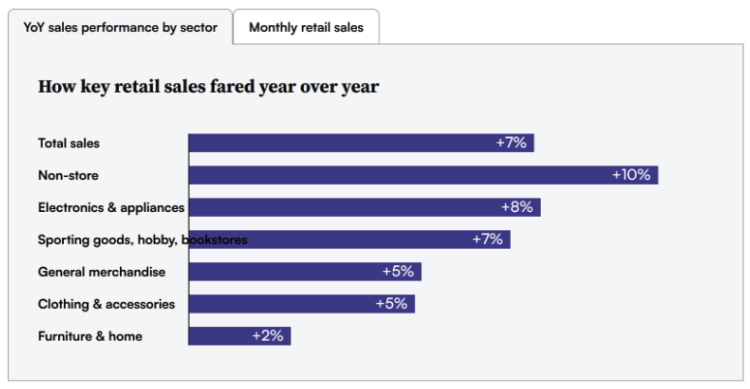
For anyone planning around volume, the playbook seems to be steady demand with sharper choices. Expect volume to hold and the mix to shift toward value.
2. This Year, Every Day is Black Friday
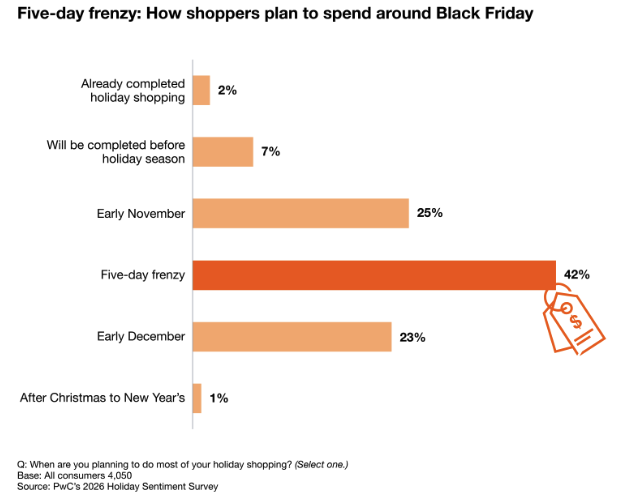
That’s the headline on Retail Dive’s Black Friday preview, and it says a lot. Shoppers started early to stretch their budgets, deals now run for weeks, and the season is stretching later, too. Here’s what the surveys show:
- Timing: 29% of shoppers plan to do most of their holiday buying in early to mid-December, up from 19% last year. Only 17% are focused on Black Friday, down from 25% (Bank of America).
- AI: 72% of Americans don’t plan to use AI tools for holiday shopping, up from 49% last year. Among them, 37% say it takes the personal aspect out of gift-giving (Bank of America).
- P.S. AI: more than half of consumers used generative AI to shop this year, up 8 points (Boston Consulting Group).
- Trust: more than a third say they’ve encountered a holiday-themed scam attempt (Bank of America). Ugh.
Both AI numbers can be true at once. My take is this. People use AI to research and compare prices yet draw the line at letting it pick the gift. Bank of America’s Lori Monfared suggested we could be seeing “a bit of AI fatigue.” That runs counter to the 130% jump in AI-driven retail traffic I wrote about for this season in October. But I understand the tension. New tech tools can be beneficial, yet they can also rob individuals of the personal satisfaction of finding gifts.
Stores still matter, too. Meghann Martindale of Avison Young said it best:
That shared sense of festivity is something you can’t replicate online. You can buy a gift online in minutes. A holiday shopping outing can become a memory.”
A Very Philly Name
A little knowledge drop for the season, with a hometown twist. “Black Friday” didn’t start as a retail term. In the 1950s, Philadelphia police used the term to describe the chaos on the day after Thanksgiving, when shoppers and crowds in town for the Army-Navy game jammed the streets. Not only were Philly police unable to take the day off, but they also had to work extra-long shifts managing crowds and traffic. Merchants tried to seize the day and rebrand it “Big Friday” in 1961, but it didn’t take. The story about stores finally getting “in the black” came along in the 1980s. Leave it to Philly to name the biggest shopping day of the year after a traffic headache.
From the supply chain side, the calendar will be the story. Thanksgiving is November 26th, which leaves just 29 days until Christmas. If more shoppers wait until December, more of the peak lands in fewer days, and the last-mile network feels it in the second and third weeks of the month. Plan your cutoffs and staffing accordingly.
3. One Railroad from Coast to Coast?
Wednesday was the deadline for public comments on Union Pacific’s $85 billion proposed transcontinental merger with Norfolk Southern. FreightWaves rounded up where the industry’s leaders stand. The combined railroad would cover more than 52,000 miles across 43 states, connecting about 100 ports. The Surface Transportation Board (STB) is expected to decide in 2027, and Union Pacific is planning to close in the second half of next year. Who showed up, and where they stand:
- For it: Union Pacific CEO Jim Vena says the merger “will deliver substantial measurable benefits by strengthening the supply chain.” Norfolk Southern CEO Mark George says it’s designed to make truck-to-rail shifts permanent.
- Against it: BNSF CEO Katie Farmer calls it “an anti-competitive transaction between two financially healthy companies.” CPKC CEO Keith Creel wants it rejected outright: “We don’t want a condition. We don’t want a concession.”
- Somewhere in between: CSX is leaning on interline partnerships with other railroads. CN is finalizing an agreement with UP that extends its reach into Mexico in exchange for dropping its opposition.
The First Transcontinental Railroad, Again?
The deal is pitched as the first U.S. transcontinental railroad, which sounds odd if you remember your history. The original, completed at Promontory Summit, Utah, in 1869, was two railroads meeting in the (somewhat) middle. The Union Pacific built track from the West Coast, and the Central Pacific built from the East. Freight moving coast to coast has changed hands ever since, usually at gateways like Chicago, St. Louis, Memphis, and New Orleans. A combined UP and NS would be the first single railroad to run from coast to coast.
That’s the trade-off shippers must weigh. Fewer handoffs can mean faster, more reliable transit times, which supports the merger. Fewer independent railroads can mean fewer competitive options and higher rates, which opposes it. Both can be true and will likely reshape the entire supply chain industry.
4. Amazon’s Drones Have Arrived. So Have the Complaints.
The Wall Street Journal went to Baton Rouge, Louisiana, where Amazon’s Prime Air drones began flying out of a fulfillment center in July. The aircraft weigh about 80 pounds, and some neighbors say they sound like airborne leaf blowers, which is not a compliment.
Retiree and photographer Rick LeCompte says the drones are “stealing the sky” from what he calls the “cloud TV” view over his backyard. His wife, Marcia, counted 18 drones on a single dog walk and compared it to living under an overpass. Not everyone minds, however. Lois Stuckey, an events manager at LSU, likes the service.
Jay Stanley, a senior policy analyst with the American Civil Liberties Union (ACLU), says his group wants clear privacy rules for drones before it supports deliveries. He put it succinctly:
The big outstanding question is do Americans want this?”
How Fast, How Far
Here’s how the service works, based on Amazon’s recent launches. Eligible customers must live within a 7.5-mile radius of a drone site. Packages must weigh less than 5 pounds, and delivery is expected within an hour. When Amazon launched in Stone Mountain, Georgia, on November 15th, the first order arrived 64 minutes after checkout, and the flight itself took about four minutes. Other recent launches include North Randall, Ohio, in September and Nampa, Idaho, in October.
This sits next to two threads from this fall. In October, Amazon passed a million warehouse robots. Additionally, the data center backlash I’ve written about since April now has a partner in the proverbial doghouse. Neighbors like these sites’ convenience in theory but push back when it’s too close for comfort in the backyard.
One thing hasn’t changed. A 64-minute drone delivery only works if the product is already sitting in the right building, close to the customer. The last four minutes depend on everything that happened upstream, and that part of the job is where we spend our days.
Who Shows Up
Consumers keep showing up, carefully. Shoppers are showing up on their own schedule, and Black Friday is turning into a season. Rail leaders showed up to argue about what a coast-to-coast railroad would mean. And Amazon’s drones are showing up in backyards, whether the neighbors asked for them or not.
This leads me back to where I started. The Pelotonia community set a record for cancer research because people keep showing up for each other, year after year. Thank you to everyone who shows up here on Fridays. I don’t take it for granted. See you December 4th.
Bonus #1: A Terrible, Horrible, No Good, Very Bad Week for Technology
It has been a terrible, horrible, no good, very bad week for technology. The string of major outages reads like a who’s who of some of the biggest enterprises: Apple, Microsoft, Chase Bank, United Airlines, the NSA, and the FAA. Thankfully, most of these appear to have stemmed from internal operational and/or infrastructure issues rather than cyberattacks. It’s a disturbing cluster, for sure, but it underscores the fragility of our increasingly interconnected world.
Here’s a refreshing, blunt take on all the recent technological snafus. The writers of this new digital media company (404 Media) are knee-deep experts in the field.
The rundown, for the record. Microsoft’s outage ran from November 12th to 14th and was traced to a network change. The FAA’s nationwide ground stop on November 13th lasted several hours and was linked to a router at a facility in Arkansas. Chase and United had problems on November 16th, and Apple and Marriott on November 17th. The NSA’s internal communications degraded during scheduled maintenance. Every company that cited a cause said it wasn’t a cyberattack.
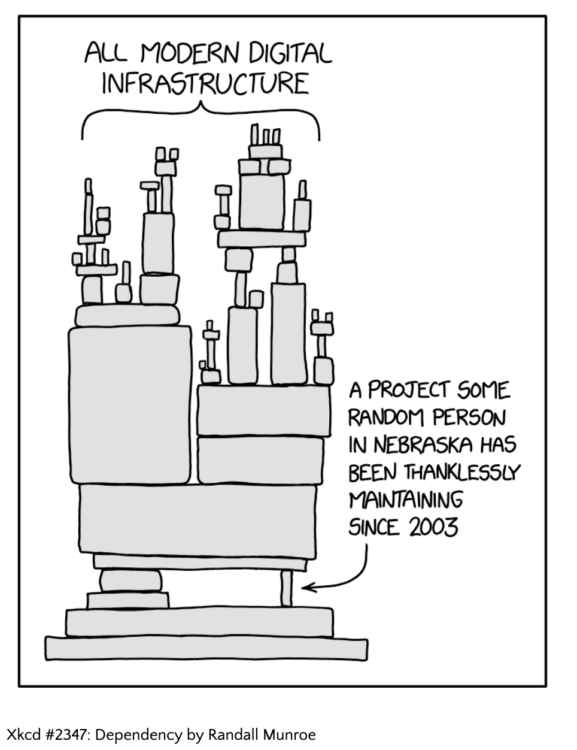
Jason Koebler of 404 Media, the same outlet that reported on the Staples gift card story in October, summed up the feeling: “everything now sort of looks like that XKCD comic of the dependency domino tower.” Same lesson as the CrowdStrike example from October. One small piece fails, and everything stacked on it wobbles.
Bonus #2: TIME’s Best Inventions of 2026
No doubt that once Thanksgiving is done and dusted, the holiday rush will be omnipresent. We’ll be attacked from all sides by the pressure to find something for those special people in our lives. For your consideration, I found this cool, informative list detailing the best inventions of 2026.
TIME’s list runs to 300 innovations this year, so pace yourself. A few that could work as gifts: Brick, a small device that blocks the apps you choose until you tap your phone to it again; Tin Can, a screen-free Wi-Fi “landline” for kids; and a solar-powered flower kit from Thames & Kosmos for young builders.
Bonus #3: Two Diversions
Since we’re on the cusp of Thanksgiving, I have two diversions this week. The first, though not a game, is mentally soothing in a creative way. Zen Garden lets you channel Master Shifu to reach inner peace as you drag your rake and make patterns in the sand. Straightforward and simple.
Raked sand gardens, called karesansui in Japan, have been used for meditation since the 14th century. The patterns are meant to suggest ripples and flowing water. Try concentric circles.
And leave it to Seth Godin (the all-time marketing go-to) to make us all take a moment to realize that, with only ten minutes a day, there are a host of activities we can do better with deliberate consistency. Keep those pistons firing.
Godin also led me to that seven-question quiz back in July, the one that told me I was 1 in 390. He’s a career .400 hitter and HOFer in major league marketing.
You’re welcome.
One Last Thing: When to Serve Thanksgiving Dinner
I saved this article because it fits this week’s theme and tackles the age-old question.. When is the right time to serve Thanksgiving dinner?
One survey of more than 34,000 people found the largest group prefers 2 to 3 p.m., with 4 to 6 p.m. close behind. The experts at Reader’s Digest landed on a 2 to 4 p.m. sweet spot, with 3 p.m. as the “golden hour,” while chefs lean toward 5 p.m. or later for a little more kitchen breathing room. Whatever time you pick, food-safety expert Jason Reese offers the rule worth keeping: “When food sits out for a long time, it gets into the danger zone.” The USDA’s guideline is two hours at room temperature, then into the fridge.
Remember, you can’t please everyone all the time. But it costs nothing to be kind.