By Alex Stark
When the Numbers Aren’t Telling the Whole Story: Consumer Sentiment, AI Jobs, 10-Minute Groceries, and the Pope
Hope everyone had a good Memorial Day weekend. The unofficial start of summer felt earned this year. I participated in an annual 5k (shout-out to the Turtle Trot) with my daughter. She did great. I didn’t die. I then came back to the office Tuesday morning, settled in with coffee, and started working through the week’s reading. By Wednesday, I noticed something a little strange. Everything I was reading seemed to be in mild disagreement with itself.
The stock market is at all-time highs. Consumer sentiment is at all-time lows. AI is supposedly killing white-collar jobs, but unemployment data doesn’t show it. India is delivering milk in 10 minutes, and the companies doing it are burning through cash. And Pope Leo reminded tech CEOs that technology should be “optimized for human dignity, not just efficiency.” He warned that AI power could become concentrated in “the hands of a few.”
Four things to share from my little corner of the supply chain. I’d love to know what you’re seeing and reading, and more importantly, how it impacts your business.
1. The Stock Market and Consumer Sentiment Are Living on Two Different Planets
The WSJ ran a piece this week pulling apart something genuinely strange. The S&P 500 is partying like 1999. The University of Michigan consumer sentiment index dropped to 44.2 in May, the lowest reading on record. Record stock market and record low consumer sentiment in the same month.
What’s driving the split?
- The market is pricing in a wave of AI productivity gains. The S&P now trades at roughly 21x forward earnings, a premium to the five-year average of 19.9x.
- Consumers are dealing with roughly $1,300 a year in cumulative tariff costs, multi-year-high gas prices, higher grocery costs, and the ripple effects of the Iran war.
- Americans are falling behind in their credit card debt.
- Most household wealth gains are locked up in 401(k)s. They cannot be drawn down to cover this week’s groceries or gas tank.
The writer of the article summed it up perfectly:
“Americans are in a decidedly bad mood. The stock market is decidedly not.”
That’s a tough operating environment. Whose data should you be planning around this year? The S&P 500 chart says one thing. The Michigan sentiment chart says another. The S&P is trading at a valuation of 40.8, as shown in the chart below. This is a universally understood metric from Yale University economist Robert Shiller, who was awarded the Nobel Prize in Economics in 2013 for this work. The research measures the cyclically adjusted price-to-earnings ratio.
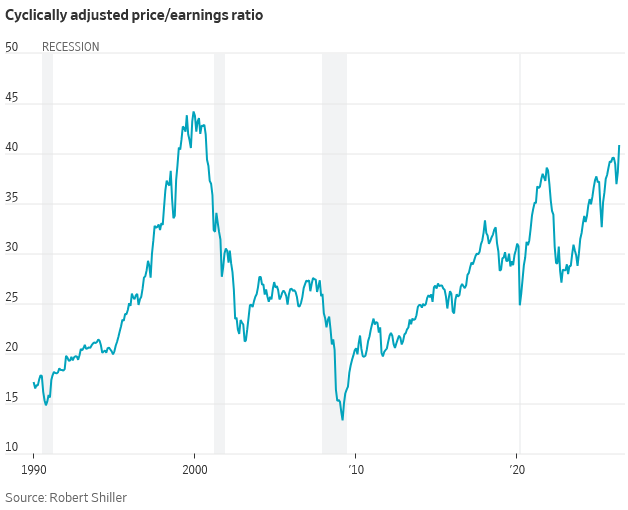
According to the 145-year history of Shiller’s research, the only other time the ratio was above 40 was in the years leading up to the dot-com crash in the early 2000s.
This is also a continuation of a theme I wrote about last week. Forecasters are cautiously optimistic. Carriers, customers, and frontline workers are saying something else. The disconnect is bigger than freight. It’s the whole economy right now. Joanne Hsu, director of consumer surveys at the University of Michigan, stated:
“Prices remain extremely high, labor markets have unambiguously weakened in the last four years, and now we’re in the middle of a war. I don’t think the fact that we’re lower than June 2022 should come as a surprise to anyone.”
If you can plan against both scenarios in parallel (an AI-led productivity boom for the companies riding that wave, and a K-shaped consumer pullback for everyone selling to households), you’re going to be in better shape than the operators picking one and ignoring the other.
2. AI Might Not Cause a Job Crisis. A Workforce Mismatch Could.
This was a useful data point. A Forbes piece this week (drawing on an Indeed Hiring Lab report) argues that the AI jobs scare is missing the more important story.
The big risk isn’t mass unemployment from AI replacing workers. The big risk is structural mismatch. Workers in the wrong roles, in the wrong locations, with the wrong skill mix. Jobs are unfilled in places people can’t get to. The dramatic apocalypse scenario gets the headlines. The quieter mismatch is what actually shows up on the P&L.
A few things worth noting from the research:
- Multiple recent studies, including from MIT Technology Review, find little evidence that AI has caused large-scale job losses yet.
- Worker anxiety about AI has jumped from 28% in 2024 to 40% in 2026, per Mercer’s Global Talent Trends report.
- PwC found that workers with AI skills earn up to 56% more than peers in the same roles without those skills.
- The World Economic Forum projects job disruption will affect 22% of all roles by 2030, with 170 million new positions created and 92 million displaced. The net is positive, but the transition is messy.
And I know, I know, I just can’t quit AI. Every week, there seems to be another story or angle that gets me thinking of how this affects the supply chain.
The real question this raises is one every leader (in virtually any industry) needs to ponder… Is your team set up for what’s coming, or for what you wish were coming? It’s easy to keep training people on yesterday’s job description. It’s much harder to figure out what the job will actually look like in 3-5 years.
In logistics and supply chain, that question has real-world implications. Professional drivers need to be comfortable with integrated technology in the tractor. Distribution center leadership needs to manage automation alongside frontline teams. Customer-facing roles need to understand and carefully balance AI-enabled analytics with the human side of relationships. The mismatch isn’t just a white-collar story. It’s showing up in every part of the operation.
3. In India, You Can Get Milk Delivered Faster Than You Can Make Coffee
This was the most genuinely surprising thing I read this week. The WSJ reported that in urban India, quick-commerce companies/apps like Zepto, Blinkit, and Swiggy are delivering groceries, household essentials, sanitary products, and even ambulances in under 10 minutes. Zepto can hit a Mumbai doorstep in 7 to 12 minutes from the time of order. Not from when the order goes to the warehouse. From the moment the customer taps “buy.”
How They Pull It Off
- Dark stores of 2,000 to 3,000 square feet, each positioned within 2 to 3 km (roughly 1.5 miles) of customers.
- Curated SKU mix of about 2,500 items, covering roughly 80% of urban Indian daily essentials, tailored to neighborhood demand.
- Layouts are designed purely for picking speed, not for shoppers. There are no shoppers. Fast-selling items are placed near the front for quick access.
- AI-driven inventory placement, real-time demand forecasting, and gig-based delivery routing.
- Roughly 6,000 dark stores are operating across India.

There’s a tension worth noting in the article. These companies are burning cash, and many are not profitable. But you know who’s never worried about making infrastructure investments – Amazon. Amazon just announced plans for 1,000+ new mini-warehouses across 100 Indian cities. Amazon is not in the habit of throwing capital at unprofitable models. If they’re moving in, they’ve concluded either that the unit economics work at scale or that they can afford to grind it out.
One detail that’s stuck with me is that Blinkit lets users order an ambulance in some Indian cities. Not groceries. An ambulance. Because public ambulance response times can’t be relied on. That’s what happens when a 10-minute private-sector logistics layer becomes good enough to substitute for public infrastructure. A genuinely complicated thing to think about.
Is this where U.S. urban delivery is heading? I’m not sure. Some of what makes the Indian model work is specific to that market. Dual-income households, long commutes, weak public infrastructure, high population density, and a young workforce willing to do gig delivery for prices that wouldn’t cover a U.S. minimum wage.
Even if we don’t go to 10-minute groceries, dark stores and micro-fulfillment are quietly reshaping what “speed” means for fulfillment in U.S. urban markets. Same-day urban delivery is becoming table stakes across several B2C categories (Amazon, Instacart). The supply chain build-out required to enable same-day delivery is meaningfully different from the traditional DC-to-store-to-customer flow. Operators planning around an outdated picture of customer expectations will find themselves outmaneuvered by competitors who saw it coming.
4. What the Pope Can Teach Us About Agentic AI
I did not expect to be writing this sentence today, but here we are. The supply chain research firm Zero100 published a piece this week leaning on something Pope Leo XIV (the first American pope, elected last year, Villanova grad) has said about artificial intelligence in his recent encyclical, Magnifica Humanitas:
“Technology is never neutral, because it takes on the characteristics of those who devise, finance, regulate and use it.”
That sentence lands harder coming from one of the oldest institutions on earth than it does from a consultant or a think tank.
Pope Leo’s (born Robert Francis Prevost) choice of name is itself a signal. He chose Leo specifically as a reference to Pope Leo XIII, who, in 1891, published Rerum Novarum, the Catholic Church’s formal response to the social impact of the first Industrial Revolution. The current Leo has been clear that he sees this moment as a parallel one. The Church’s job, according to him, is to ensure that the people building these technologies think about what they’re building, not just whether they can build it.
Why This Matters for Supply Chain Leaders
Zero100 applies the Pope’s framing directly to agentic AI in supply chains. The temptation with agentic systems (systems that take action, not just produce output) is to treat them as productivity tools. Faster planning. Faster sorting. Faster decisions.
The Pope’s reminder, applied to our world: every design choice in an AI system expresses a vision of humanity. Who gets automated? Who gets retrained? Who is respected in the workflow design? Those aren’t neutral choices. They’re moral ones, made by default, often by the people closest to the technology and furthest from those affected by it.
When you stand up your next agentic AI workflow, who’s at the table? Procurement? IT? Operations? An ethicist? Probably not the last one. Maybe they should be. Or at least someone willing to ask the questions an ethicist would ask.
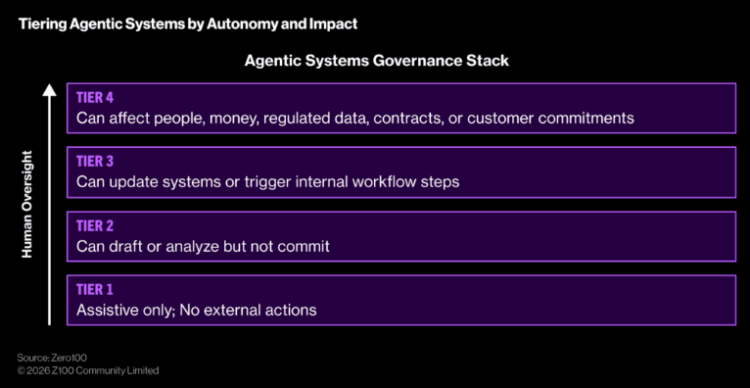
Heritage companies are sometimes tagged as slow to adopt new technology. I believe that’s an inaccurate stereotype. The companies that have been around for 162 years (Holman included) didn’t survive by chasing every shiny thing. They survived by asking, of every new tool, “Does this help us build the kind of company we want to build?” If the answer is no, the speed isn’t worth it. The question itself is the discipline. We talk a little about what that looks like for us here.
Bringing It Together
Four things and four narratives. Each of them is more complicated than the headline.
The market is up, but the people who buy things aren’t feeling it. AI isn’t taking jobs at the scale we feared, but the workforce mismatch is real. India is proving that 10-minute delivery is technologically possible, but nobody’s figured out how to make it profitable. And one of the world’s oldest institutions is asking some of the world’s newest companies to slow down and think about what they’re building.
Be curious about the gap between the number and the story. That’s usually where the interesting work lives.
Bonus #1: How Does Airplane WiFi Work?
I’ve thought about this for years. Reader’s Digest finally gave me a crisp, satisfying answer.
The short version is that planes use either air-to-ground WiFi, which works like your phone using cell towers and an antenna located underneath the plane. It connects to towers on a rolling basis as it travels. The second is satellite connections (which have to bounce signals tens of thousands of miles up and back). Either way, you’re sharing limited bandwidth with every other passenger on a steel tube moving at 500+ mph. The wonder is not that it’s slow. The wonder is that it works at all.
It’s a small reminder that we’ve gotten remarkably good at expecting things we used to consider impossible. And then complaining when they don’t work perfectly. Sounds like logistics and supply chain. But quoting one of my favorite movie lines: “This is the business we have chosen.” Cue the eye-roll from my 14-year-old.
Bonus #2: Keep It or Toss It?
Trash night this week reminded me of the perennial fridge question: Is this still good? Turns out there’s a website for that. Shocker. StillTasty.com will tell you how long pretty much any food stays fresh (and won’t have you up at night with stomach pain).
Some highlights from my refrigerator audit:
- Cooked rice: lasts about 4 to 6 days.
- Hard cheese: six months unopened, three to four weeks once opened.
- Eggs: up to five weeks past sell-by date if refrigerated continuously.
- Mayonnaise: two months once opened.
Some of these are surprisingly forgiving. Some are not. Either way, it’s a more reliable answer than my usual go-to… “well, it doesn’t smell bad.”
Two minutes well spent. You’re welcome.
Remember, it costs nothing to be kind.