By Alex Stark
The Adjustment Period: A Logistics Market Running Hot, Hacked Supermarket Freezers, IKEA’s Two-Year AI Retraining, and Brands Learning to Sell to Machines
I hope you were not too out of sorts this week with the recent time change. Circadian misalignment is a real phenomenon. According to research from Stanford University, even though we all technically “gained” an hour of sleep last weekend, our internal 24-hour clock (circadian rhythm) still takes days to weeks to fully adjust. This lingering effect leads to early-morning awakenings or fatigue. Stay alert if operating any heavy machinery.
Late yesterday, after 5 pm, as evening approached, it was the first time this fall it really hit me. With the sun set, it felt like we’ve slipped into the dormant months in my little corner of the supply chain.
Here are a few tips I read to help us all adjust. Try to get morning light by opening blinds shortly after waking up. It helps anchor your circadian rhythm. Better yet, go for a nice, brisk walk. Do your best to manage caffeine intake (especially late in the day) and screen time in the evening to protect your sleep quality. Overall, stay consistent by keeping wake and bedtimes steady.
The clock changed in an instant. Catching up takes a while. That gap showed up in everything I read this week. Inventory arrived faster than logistics capacity could follow. Freezer controls went online years before anyone secured them. IKEA gave its people time to catch up with AI, and consumer brands are still working out how to sell to an AI shopper. Four things this week, all about the adjustment period.
Let me know what you’re seeing.
1. Logistics Is Running Hot, and Capacity Can’t Keep Up
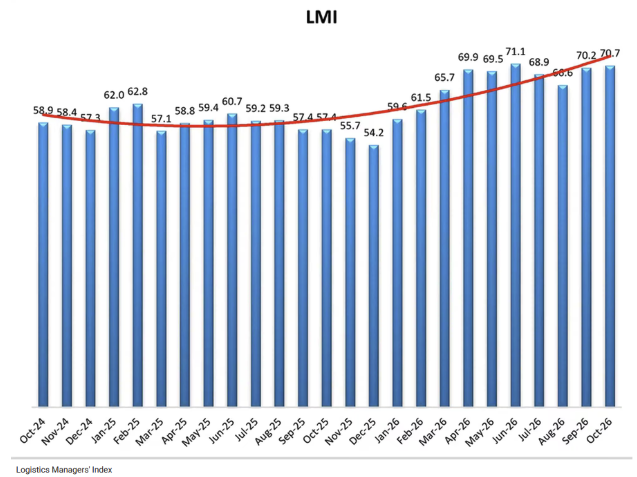
The October Logistics Managers’ Index came in at 70.7, up from 70.2 in September. That’s the second-highest reading in four years, behind June’s 71.1. Back on September 4th, I wrote about August’s 66.6. The market has only accelerated since.
How to Read the LMI
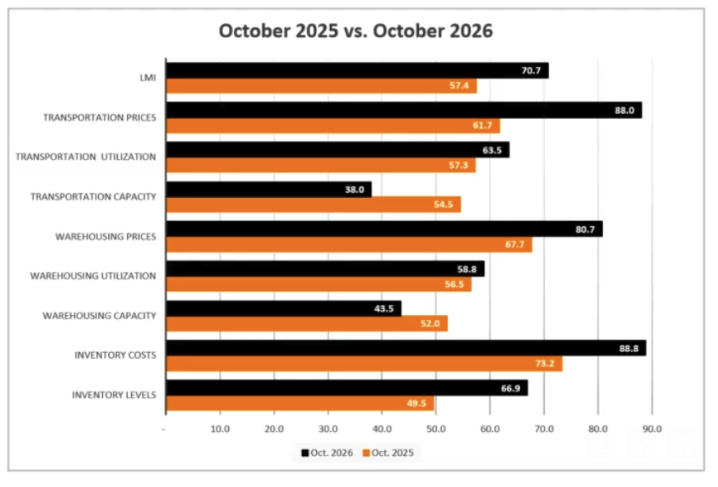
A quick knowledge point. The LMI surveys supply chain managers each month on eight measures: inventory levels and costs; warehousing capacity, utilization, and prices; and transportation capacity, utilization, and prices. Above 50 means a measure is growing. Below 50 means it’s contracting. The headline is a blend, so the story is usually in the pieces. Here they are for October:
- Inventory levels: 66.9, up 8 points. Per the report, firms “are now pulling inventories in as quickly as they can.”
- Inventory costs: 88.8, the highest since March 2022.
- Warehousing: capacity at 43.5, still shrinking, with prices at 80.7.
- Transportation: capacity at 38.0, the 11th straight month of contraction, with prices at 88.
- Aggregate logistics costs: 257.5 on a 300-point scale, also the highest since March 2022.
Put the capacity numbers next to the price numbers, and you have the whole story. Inventory is arriving faster than trucks, and buildings can adjust, and the gap is showing up in price. The researchers put it plainly:
Given the pressure on logistics costs, it is likely that we will continue to see supply-driven inflation.”
I’ve been tracking the supply-driven freight reset since June, when the recovery was coming from shrinking capacity. Now it’s showing up as inflation. Carriers have noticed. Knight-Swift is targeting “at least double-digit” increases in contract negotiations; recent contract renewals are averaging 13%, according to FreightWaves’ SONAR data, and diesel is up 70% from a year ago. With September CPI at 3.7%, which I covered on October 16th, logistics costs won’t be what cools it.
If you’re heading into bid season, budget for it. The capacity that left the market over the past year isn’t likely to come back by January. Maybe ever.
2. Hackers Turned Supermarket Freezers into Ovens
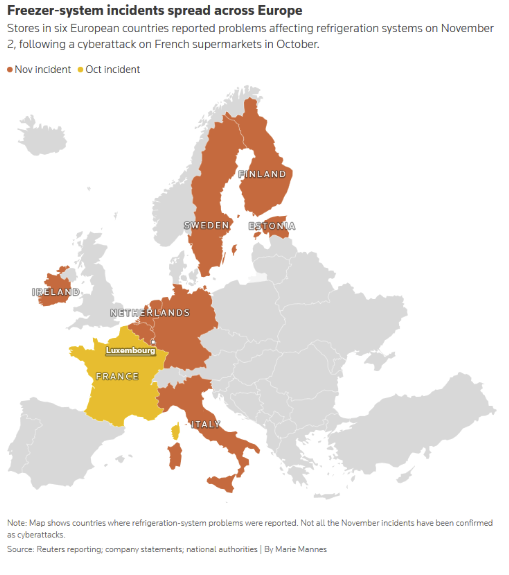
Overnight into Monday, November 2, attackers remotely changed the refrigeration settings at grocery stores across Europe. At an ICA store in Sjöbo, Sweden, staff found the fridges and freezers set to 50 degrees Celsius (about 122 Fahrenheit) and threw out the food. In Belgium, some units were switched into defrost mode, which heats them instead of cooling them.
The reported hits included ICA and Coop stores in Sweden, Delhaize stores and 15 Carrefour locations in Belgium, 13 SuperValu stores in Ireland, at least 17 businesses in the Netherlands, and stores in Estonia, Finland, Portugal, and Italy. A butcher in Hove, Belgium, estimated he lost about €15,000 (about $17,000 USD) in meat. Belgium’s federal prosecutor has opened a criminal investigation.
This was the second wave. Last month, French police said hackers seized control of cooling units at hundreds of French supermarkets, causing food losses and fires. Per Reuters, at least six U.S. military commissaries saw similar problems in August, and the Pentagon is investigating.
Three Weeks of Warning
Most affected systems were older Danfoss refrigeration controllers, some of which Danfoss no longer updates. They were reachable from the internet or through outside networks, and in the Netherlands, some still used default passwords. Danfoss told Dutch customers to disconnect from the internet on October 13. France’s national cybersecurity agency had an alert out by October 16. The second wave hit three weeks later.
That’s the adjustment period in its most expensive form. The equipment went online so contractors could monitor it remotely, but security didn’t keep pace. Stephan Moelans, CEO of the Belgian refrigeration contractor Sabcobel, said a software update alone won’t fix the problem because some installations require physical changes.
On September 25th, I wrote about Samsung smart refrigerators in South Korea that spoiled food after a test build was sent to customers, calling it a cold chain failure close to home. This is the same weak spot, exploited on purpose. It also connects to last week’s piece on software risk hiding in the handoffs and to the Staples story the week before. Connected equipment lives in exactly those cracks.
Sweden’s National Cybersecurity Centre gave the clearest advice: make a list of every internet-connected device, remove the connections you don’t need, and keep the rest updated. In a warehouse, that list includes temperature controls, dock doors, conveyors, chargers, and anything else a vendor monitors remotely.
3. IKEA Gave Its People Time to Adjust
Fortune examined how IKEA handled AI in its customer service operation. In 2021, it launched an AI chatbot named Billie to handle routine questions: store hours, order tracking, stock availability, and return policies. In its first two years, Billie could assist 47% of the customers who used it. Today that figure is 74%.
Here’s what stood out. IKEA retained the people Billie freed up. It retrained about 8,500 call center employees over roughly two years. Some handled more complex service requests. Many became remote interior design sales advisers, helping customers plan their rooms by phone and video.
The Results
- Remote sales generated €1.25 billion ($1.4 B USD) last fiscal year, up from €1.08 billion ($1.2 B USD) the year before.
- Customer happiness rose to 89%, from 60% before Billie.
- Remote sales have grown 15% to 20% a year over the past three years across the 31 countries where Ingka Group, the largest IKEA franchisee, runs stores.
CX Today summed it up well: “Human interaction can be a revenue driver, not a cost to be stripped away.”
This counters much of what I’ve covered this year. In July, AI CEOs were walking back their job-loss rhetoric even as layoffs kept climbing. In August, Etsy cut 12% of its workforce. Last month, Amazon passed a million robots. Kimberly-Clark’s July model for citizens, translators, and wizards most closely matches what IKEA did. Namely, plan the roles before the technology arrives.
The adjustment period is part of the cost of AI. Two years of retraining isn’t cheap. IKEA budgeted for it, and it got a growing revenue stream and happier customers in return.
4. Brands Are Learning to Sell to Machines
At a consumer goods summit in Chicago last month, Padma Hari, chief digital officer of Nestlé Purina North America, and Joe Sta-Romana, chief customer officer for Haleon U.S. (the maker of Sensodyne, Advil, and Centrum), reviewed five statements about AI-guided shopping while the audience voted on whether each was fact or fiction. Hari set the tone:
Personalization should be helping our consumers make better decisions, not provide the decision.”
Loyalty or Convenience?
On whether repeat purchases signal convenience more than loyalty, the room voted 60% fiction. Hari leaned the other way, saying, “repeat purchase might be a symptom of convenience, not necessarily brand loyalties.” Her test for real loyalty is when a shopper sticks with a known brand even when an AI shows them comparable products. She also said brands now have to define brand equity “for a machine to read.”
Sta-Romana drew the line by category. Shoppers are willing to let an AI choose “when the threshold of failure is relatively low or inconsequential.” In health products, trust matters more. He pointed to Sensodyne, where shoppers are less willing to accept a substitute an agent recommends, even if it fits their needs and price.
This aligns with a thread from the spring. In April, Tillster found that 45% of consumers had changed their favorite brand within a year. In July, I wrote that convenience is the most commoditized thing you can offer. Two weeks ago, Walmart priced its membership bundle to build a habit. If repeat purchases are mostly driven by convenience, an AI that makes a different product just as convenient can move a lot of volume with a single recommendation.
Availability Is the Loyalty Program
The strongest vote of the session… 71% agreed that availability builds loyalty more than personalization. Hari said sales, marketing, and supply teams must be connected to deliver a frictionless experience, because fragmented organizations end up with stocking problems. Sta-Romana described availability in two senses. There is physical (on the shelf) and mental (in the information AI models and brand sites can read).
An AI can’t recommend a product that isn’t there. Physical availability is a supply chain promise, kept one order at a time, and it’s the foundation of our service. Hari had another line worth calling out:
If a consumer has a bad experience, bringing them back is harder than acquiring them in the first place.”
That’s the same lesson as the Failure Museum two weeks ago. Keeping a customer beats trying to win a new one.
The Adjustment Period
Inventory moved faster than logistics capacity could keep up with, and costs are rising to close the gap. Refrigeration controls went online years before anyone locked them down, and Europe’s grocers paid for the lag. IKEA treated the adjustment period as part of the investment and emerged with a growing revenue stream. And consumer brands are learning to speak to an AI shopper while keeping their human customers.
The time-change tips work here, too. Get some light on the problem early. Keep your routines steady. Give people time to catch up. Most of this week’s damage came from changes that had already occurred before anyone adjusted.
Bonus #1: Cold Showers
I’ll admit it. I’m too much of a baby to take a full-on cold shower all the time. Now, in the summer, after a run, sweaty. No problem. It feels wonderful. On a cold winter morning, not so much. They certainly are refreshing. Plus, I do like the health benefits I read about in this piece from the University of Basel.
Psychologist Lena Glaser’s study followed 719 healthy adults, ages 18 to 65, who agreed to take showers as cold as their shower allowed for 12 weeks. They took 31% fewer sick days on average than a control group. The environmental side adds up, too. Shorter, colder showers cut CO2 emissions by about 15 kilograms (approximately 33 pounds) per person over the 12 weeks, roughly equivalent to driving 100 kilometers (~62 miles). My favorite detail fits this week’s theme. Many people quit in the first two weeks, and then the dropout rate fell. Glaser’s hypothesis: “That suggests people gradually get used to it.”
Bonus #2: The Oregon Trail
This article got my attention because it references one of the all-time OG video games, The Oregon Trail. It worked because it leaned on our imaginations. It worked our educational, historical, and problem-solving muscles. If you’re a frequent reader of this series, you know I’m a big fan of getting out in nature. This article does an excellent job of not only being mindful of an afternoon hike in your local state park, but also exploring those ‘what if’ scenarios.
A little history on the game. Three Carleton College student-teachers, Don Rawitsch, Bill Heinemann, and Paul Dillenberger, built the original in about two weeks for Rawitsch’s classes in Minneapolis. It debuted December 3, 1971, on a teletype terminal that printed on paper. The version most of us remember, the one with graphics, is MECC’s 1985 Apple II edition. The series has sold more than 65 million copies.
For more on the survival lessons, Dr. Elaine Reno, a wilderness medicine physician at the University of Colorado Anschutz, wrote an Oregon Trail-themed guide for The Conversation. A few habits worth working into your routine are leaving your itinerary and expected return time with someone you trust, packing extra food, water, and rain gear, and treating your phone and GPS as backups.
And I found this free, no-download online version. If you’re of a certain cohort, give it a whirl for old times’ sake. If you’re a novice (and only know GTA and the like), check it out. Visit Oregon launched it in 2024. You manage your party’s health, hygiene, stamina, and morale, and you still have to fit everything in the wagon.
You’re welcome.
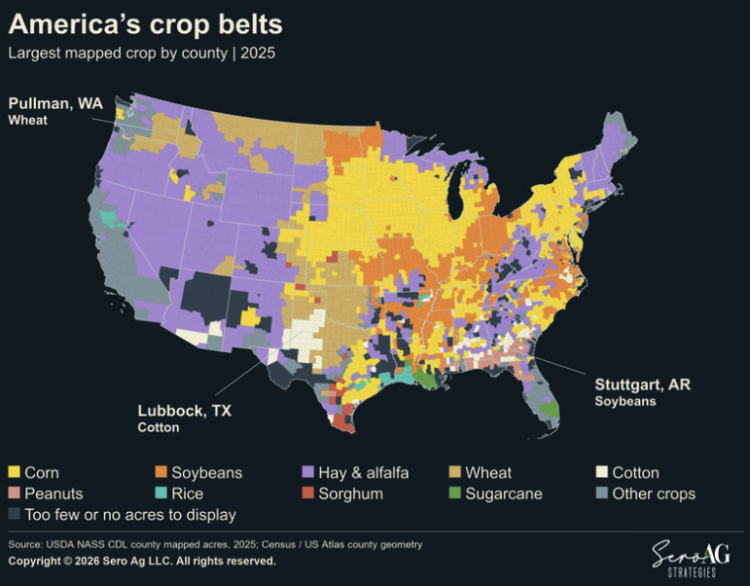
One More Thing… America’s Crops, County by County
With the onset of colder weather across the U.S., I start thinking about the end of the growing season. The end of the harvest season in the U.S. has no single fixed date. It varies by crop, region, and weather conditions, generally winding down from late October through November. So, when I recently discovered this map from Sero Ag, it was enlightening to see the different crops grown across America. When looking at this map, please keep in mind that it shows the largest crop by acreage in each county, not total production or value.
Back in August, I wrote that harvest is when farms burn enormous volumes of diesel, right as the country builds heating oil stocks for winter. With diesel up 70% from a year ago, the fuel bill for this harvest was steep. Thank a farmer when you sit down at the table this month, especially on Thanksgiving.
Remember, it costs nothing to be kind.