By Alex Stark
Go Looking: The OECD’s Depleted Buffers, Hormuz Repricing Your Contracts, a Trailer Surge Built on Deferral, and Operating Model Debt
Fall officially arrived this week, so feel free to consume as many pumpkin-flavored items as you like without judgment. If you’re not along the Northeast coast (thank you, nor’easter), maybe you can enjoy a hearty walk this weekend as autumn starts to take over. Looking at the Farmer’s Almanac map of the U.S. for this fall, fingers crossed, it should be mostly free of any extreme weather.
Here are four things I learned this week, and they share a similar through line. In each one, something has been accumulating in a place nobody routinely checks. Spent buffers. Repriced contracts. Deferred equipment. Workarounds that became permanent. None of these items show up on a dashboard until they show up all at once.
Let me know what you’re seeing.
1. The Global Economy Held Up. The OECD Says the Buffers Are Running Out.
The Organization for Economic Cooperation and Development’s September Interim Outlook released Wednesday nudged 2026 global growth up to 2.9%, a tenth higher than its June estimate, while trimming 2027 to 3.0%. U.S. growth is now projected at 2.2% this year and 2.1% next. Still a clear slowdown from last year’s 3.4%.
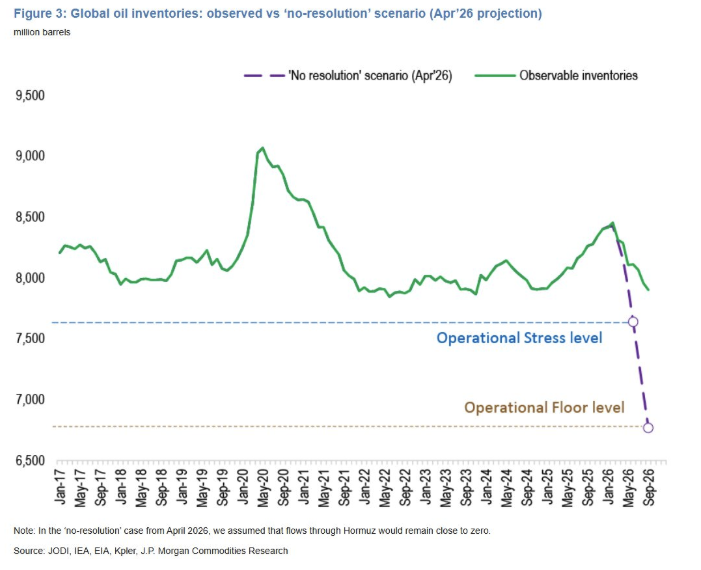
Sizeable oil inventories, coordinated strategic-reserve releases, extra supply from producers outside the Gulf, lower oil demand from China, and government support measures absorbed the energy shock. Heavy AI investment also propped up production and trade. Secretary-General Mathias Cormann offered the line that matters most:
The buffers that absorbed the energy shock are being depleted… And this shock is not behind us. It is still working its way through the economy.”
He added that growth is weaker than last year and inflation is rising again. G20 headline inflation is projected at 4.1% this year, up from 3.4% in 2025. Brent is expected to average around $105 a barrel in the fourth quarter before easing through 2027.
Four Risks, Four Familiar Names
The OECD named four downside risks: prolonged Middle East export disruption, weather shocks from a very strong El Niño, further increases in long-term bond yields, and AI investment returns that fall short of expectations. I’ve written about every one of those this year. Hormuz in June. The Super El Niño in July. Long-term yields in August and again this month. AI returns with the Gartner survey in August. The OECD also stated that AI investment increasingly relies on outside financing, which could amplify a correction if returns disappoint.
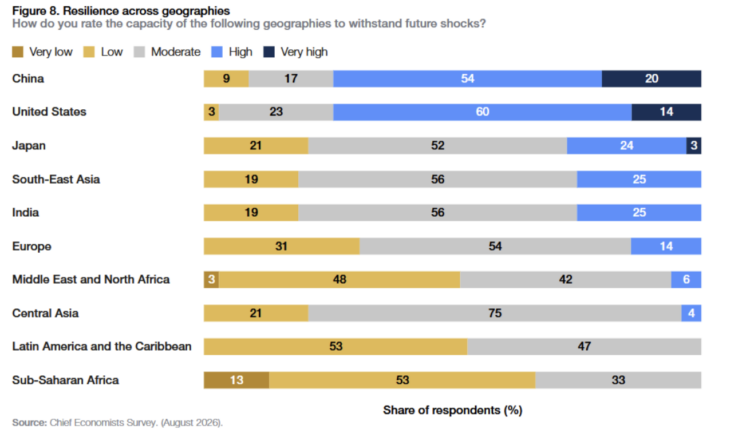
“Resilient” describes the outcome. “Depleted” describes how it was paid for. Strategic reserves and fiscal support don’t refill on their own, and the next shock lands on a thinner cushion. Resilience bought with reserves is not resilience you can count on twice.
2. Hormuz Is Repricing Freight, and Most Shippers Haven’t Looked
A solid piece from Nicholas Shipe, director of premium transportation at Circle Logistics, ran in SupplyChainBrain this week. On September 12, an unidentified vessel was struck by a projectile while transiting the strait, a fire broke out, and the crew evacuated. Six months in, analysts estimate total Gulf oil exports at roughly two-thirds of pre-war volumes, and that count includes dark crossings made with transponders switched off. The Internal Energy Agency has called this among the largest supply disruptions in the history of the global oil market.
The Number That Matters
Shipe’s central point is that the number shippers should watch was never oil price. It’s insurance and lead-time volatility, which move long before a barrel does.
- Before the conflict, war-risk insurance on a
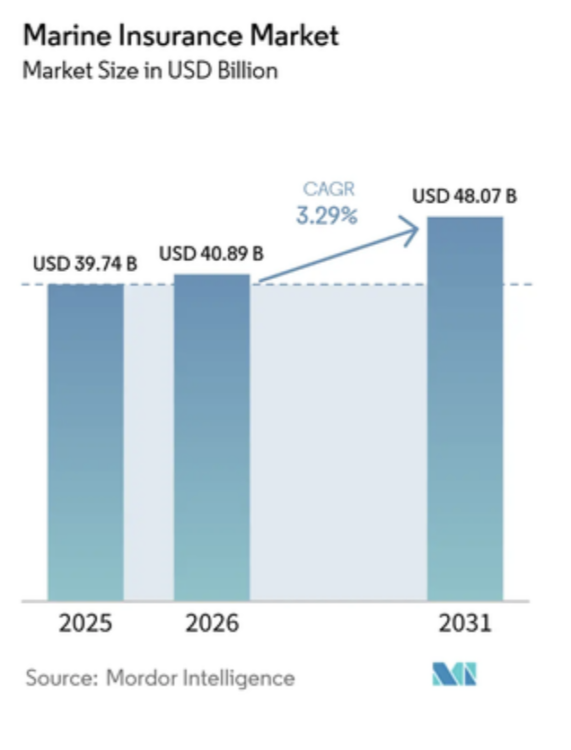 Hormuztransit ran about 0.15% to 0.25% of hull value. On a $150 million tanker, that’s $225,000 to $375,000 a trip.
 - Within weeks, it jumped to 3% to 10%, which on the same tanker can mean a bill of up to $15 million for a single transit.
- And it doesn’t reset when a ceasefire gets announced. Insurers and carriers have already built the risk into their models.
The strait doesn’t have to close for you to feel it. It only has to stay unpredictable long enough for insurers, carriers, and customers to price that into every contract permanently. Shipe’s point is that repricing has already happened, and most shippers simply haven’t looked for it in their own agreements yet.
Two Wrong Reactions
The most useful part of the piece is his description of how teams are responding. One group has decided this doesn’t touch them, since Washington says the Strait of Hormuz is open and oil never spiked the way people expected in March. The other group is tearing up contracts and rerouting freight that was never near the region “when they saw a bad headline.” His diagnosis of both:
Both groups are reacting to the news cycle instead of their own freight.”
That’s nearly the same lesson from a post I wrote in July, built around an S&P Global analyst’s line that you need to do something, but not too much. Targeted beats reflexive. Shipe’s prescription is the targeted version. He advocates (as a starting point) mapping exposure, including two tiers back. Renegotiate only the lanes carrying real risk premium, and leave the rest of the network alone. Build a second carrier relationship on any single-carrier lane now, while you still have leverage. Also, start the insurance and rate conversations before the next incident resets the market for everyone.
3. Trailer Orders Surged in August. Look at Why.
Both major forecasters saw the same thing. ACT Research put preliminary August net trailer orders at 24,200 units, up 55% from July. FTR (Freight Transportation Research) had 24,144, up 43%. ACT’s seasonally adjusted figure of 33,700 was the second-best in 43 months, and the 2026 order season finished up 13% over the prior season.
Both firms flagged the steep increases and point to the same reason. The year-over-year gains, 193% at ACT and 221% at FTR, look dramatic partly because August 2025 was so weak.
The Driver That Fits This Week
ACT’s Jennifer McNealy described the surge as a three-part event… ordering ahead of tariff-related price increases, healthier long-term business conditions, and pent-up replacement demand. Order boards opened early, and few build slots remain for the rest of this year.
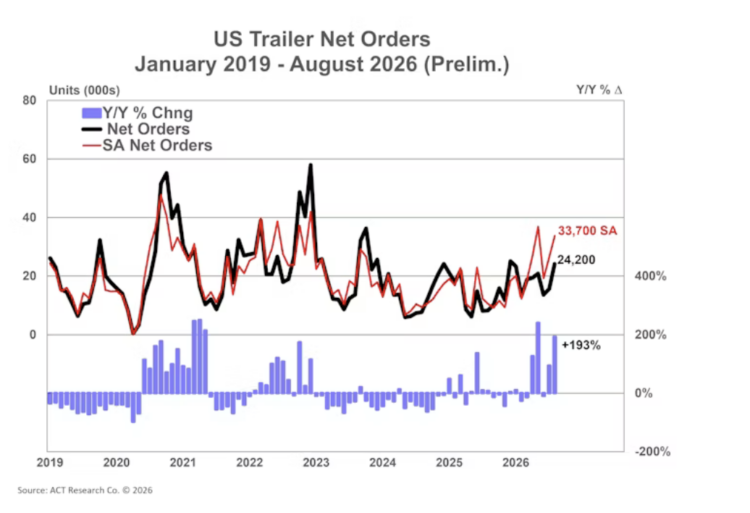
That third driver is the one worth noting. Carriers ran equipment longer through a brutal stretch, and McNealy pointed to higher maintenance costs and downtime as the counterweight now shaping purchase decisions. Deferred replacement never disappeared. It accumulated as repair bills and trucks out of service, and now it’s showing up as an order wave.
FTR’s Dan Moyer offered a measured take. He stated that the stronger order performance is encouraging, but the recovery remains uneven across segments, with elevated equipment costs and competing capital needs keeping spending selective. Flat freight volumes and weak sectors still cloud how long the recovery will last.
Last week, I wrote about executives calling this the tightest capacity in three years. Carriers replacing aging trailers fits into this same picture. Equipment and drivers are both catching up after years of holding equipment. If you’re a shipper heading into peak, it’s reasonable to ask your carriers about fleet condition and replacement plans. Deferred maintenance tends to show up as a breakdown in November.
4. Operating Model Debt, and Why Quick Fixes Aren’t Quick
A Supply Chain Management Review piece gives a name to the organizational version of everything above. Short-term supply chain fixes accumulate into operating model debt, draining resources, fragmenting technology and data, worsening talent shortages, and keeping organizations from achieving lasting transformation.
The description nails it because every quick fix seems reasonable in the short term. A spreadsheet to bridge two systems. A manual exception process. A one-off vendor to cover a gap. A workaround meant to last a quarter. None of those is a bad decision on its own. Together, they become how the operation runs, and it’s an easy call to say no supply chain teams/leaders agreed that this is the organization’s overall strategy.
A related SCMR piece from August describes what the accumulation feels like from the inside. It calls it decision debt, in which delayed choices create more choices and routine issues climb the org chart seeking approval. A 2026 Gartner survey found that 72% of supply chain leaders have had to revisit final approvals for network decisions at least once.
How the Mess Got There
Last week, SCMR gave us “automating the mess,” and I argued that you should standardize the work before automating it. Operating model debt is what created the mess in the first place. Automating the mess happens when you try to fix operating model debt by buying something instead of paying it down.
The true test is how many of your current processes were designed by someone, and how many were created just to get through a bad week in 2022. A partner that brings a standardized process, not another workaround, is the difference between paying that debt down and adding to it. That’s the part we focus on.
Go find the workarounds that became permanent. That list is your actual operating model.
Go Looking
The OECD says the buffers that carried the global economy through the energy shock are being drawn down. The Hormuz repricing is already embedded in contracts most shippers haven’t reread. The trailer surge is years of deferred replacement coming due at once. And operating-model debt piles up when every fix is temporary.
Back in August, I wrote about what to do when the bill comes due. The more useful exercise (and productive for the enterprise) is to find the bill before it arrives. None of these are exactly hidden. They’re just sitting in places nobody routinely checks. A reserve balance. A contract clause. A maintenance log. A spreadsheet someone built three years ago that the whole operation now depends on. That deliberate, dedicated effort is worthwhile.
Bonus #1: Halloween Spending Hits a Record
I’m getting to the outer edge of Halloween with my children. They’ve all aged out of costumes, candy, and decorations. My youngest will likely do something fun with her high school friends, but other than that, the days of trick-or-treating in the neighborhood are over. Of course, I will still be setting up the eight-foot talking scarecrow she asked me to get a few years ago to place on the front lawn. The mums are already out and looking seasonal. I’ll need to grab a few pumpkins, so I’ll be helping with this year’s spend.
This year’s spend is projected to be a record. The NRF projects $13.5 billion, up from last year’s record $13.1 billion. Average spending per person is $115.14, nearly flat against $114.45 last year, so the growth is coming from more people joining in rather than bigger budgets. Pet costumes alone are a $0.92 billion category, and the top choices are a pumpkin, a hot dog, and a ghost. I may (or may not) have a dog-sized Phillies uniform lying around.
Bonus #2: How Far We’ve Come
Since I’ve tipped my hand many times about my vintage, here’s a blast from the past. Yes, this is what our computers looked, and sounded, like back in the 90s. I love that the main screen even shows the correct time, just as it does on your current screen. That dedication to detail is pretty sweet.
Bonus #3: Is This Image Real?
Last weekend, I sent my daughter what I thought was a cute animal video. Turns out, AI duped me. I thought I had a better eye for that kind of thing. I will chalk it up to the end of a long week. I needed to eat a lot of “come on, Dad… do better” from my children.
To make sure we’re all staying on top of our game, I found a site that challenges you to tell whether photos are real or AI-generated.
Good luck. And you’re welcome.
And the dogs running into the leaf piles? My daughter assured me they’re real. Thank heavens. I love them too much. If you know, you know.
One Last Thing: Whatever Happened to Just Plugging It In?
People in South Korea had to throw away spoiled food because their smart refrigerators choked on a firmware update. You cannot make this stuff up.
On September 22, Samsung inadvertently pushed an internal test build to some customers during an update test for its bespoke AI refrigerators. Screens went black, the lights went out, and the compressors stopped. The incident occurred just before Chuseok, the Korean harvest holiday, when households stock their refrigerators for family gatherings. One owner reported throwing out 20 kilograms of spoiled food. Samsung halted the update and is covering repairs.
A tech outage meant to be an upgrade reached real customers yet failed. It is about as clear an example of a process gap as you’ll find.
Remember, it costs nothing to be kind.