By Alex Stark
Flatten, Not Fall: Sticky Inflation, Freight Rates That Peaked but Won’t Retreat, Amazon’s Robot Arms, and the Barcode’s Long Goodbye
No travel this week. I stayed in my little corner of Northeast PA and got in some morning walks with the dogs in the brisk October air. My daughter said there might be snow flurries this weekend. Ugh. Too soon. I’m not mentally prepared for that. Come on, second summer.
Back in September, I wrote that it could easily snow before Halloween. I didn’t mean it as a forecast.
Four things this week, and thanks to FTR Transportation Intelligence for providing the throughline. In each story, something people expected to come back down is instead flattening out.
Let me know what you’re seeing.
1. Inflation Was Supposed to Keep Cooling. It Flattened Instead.
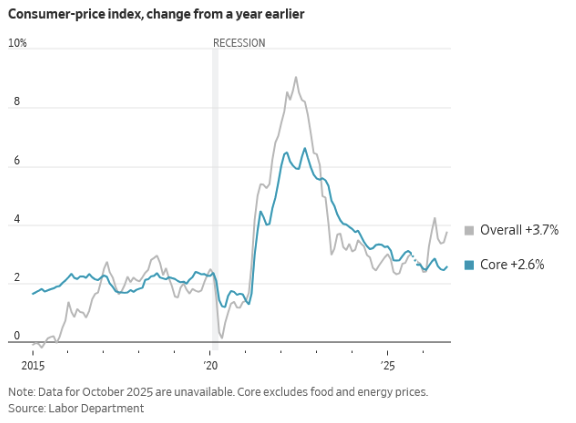
September CPI came in Wednesday at 0.6% month-over-month and 3.7% year-over-year, up from 3.4%, where it had held for two months. Core CPI, which strips out food and energy, rose 0.3% to 2.6% annually, up from 2.4% in August, a five-year low. Economists had expected 2.5%.
Gasoline jumped 9.1% in September alone, accounting for more than half of the monthly increase. But economists also noted that price pressures were spreading beyond energy, making this story different from June’s. Moody’s chief economist Mark Zandi summed it up:
The overall report shows inflation is uncomfortably strong.”
I Called This One a Trend in August
On August 14th, I wrote that July’s cooling was a real trend because core was easing broadly, not just on energy. It held for one more month, with core hitting that five-year low in August. Then September broke it. On October 2nd, I quoted Heather Long saying September would come in higher, and she was right.
Here’s the flatten-not-fall view. Core CPI was 2.6% in June, 2.5% in July, 2.4% in August, and 2.6% in September. Over those four months, it held in a narrow band, well above the Fed’s 2% target, rather than sliding toward it. Inflation has now been above 2% since March 2021.
The Fed next meets on October 28, and analysts are split on whether it will hike again then or wait until December. Either way, nobody is forecasting cuts. Stop planning for a return to 2%. Plan for inflation that flattens above 2% and stays there for a while.
2. FTR Says Freight Rates Will Flatten, Not Fall
At FTR’s State of Freight webinar, CEO Jonathan Starks said that even in peak season, consumers aren’t what’s driving the market. Industrial demand, fuel costs, and the regulatory squeeze on drivers are keeping capacity tight and rates high. Avery Vise, FTR’s vice president of trucking, said spot rates appear to have peaked, but he doesn’t expect capacity to loosen much.
The Numbers
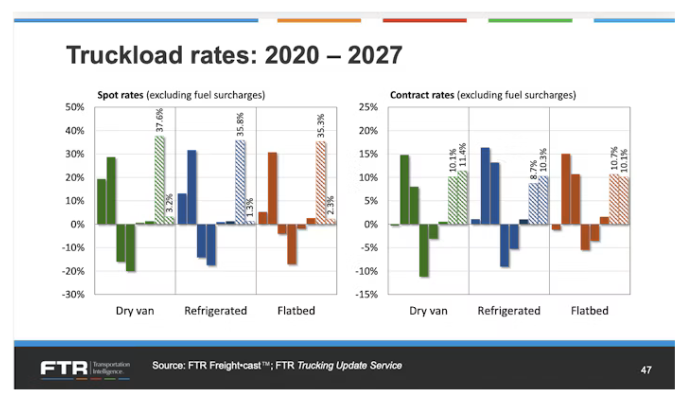
- 2026 spot rate growth is now forecast at 37.6% for dry van, 35.8% for refrigerated, and 35.3% for flatbed, all excluding fuel.
- Active truck utilization is about 99%, and FTR expects only a gradual decline to a level that stays historically high.
- FTR expects spot rates to stay strong through 2027 rather than falling back the way they usually do after a peak.
- ACT Research puts August contract rates 18% above a year ago and expects upward pressure for another 12 to 18 months.
A Forecast That Got Revised Tenfold
In January, FTR forecast a 3.6% increase in 2026 spot rates. Its new number is roughly ten times that. I don’t mention that to knock FTR. The war in Iran, the diesel spike, and stepped-up driver enforcement all arrived after January. It’s the best example I’ve seen of the theme from two weeks ago. Certainty arrives late, and even the professionals need to address and revise.
This is also the regulatory reset I wrote about in May. We’re experiencing the tightest capacity in years. In July, the American Trucking Associations said that supply, not demand, is reshaping the market. Regulation has shrunk the pool of drivers who can legally operate, and it doesn’t reverse when rates peak.
If your 2027 budget assumes freight rates drift back toward old levels, it needs a second version. Planning for a plateau is easier with committed capacity and a partner who owns the equipment. That’s how we approach it.
Peaked isn’t the same as falling.
3. Amazon Has a Million Robots. The Arms Are the Challenge.
Ars Technica went inside Amazon’s push into robotic arms. Amazon’s fleet now exceeds one million robots. But Scott Dresser, vice president of Amazon Robotics, told Ars that deployed robotic arms number in the single-digit thousands. CFO Brian Olsavsky said on the July earnings call that Amazon expects to more than double its arm fleet in 2026.
That gap is the story. Most of the million robots move shelves and totes around their network of buildings. Arms handle the harder job of picking individual items, something people handle easily but machines still find challenging. This is the next frontier for the e-commerce behemoth.
The Labor Question, Both Sides
Amazon’s case is that robots spare employees the toughest physical work, and the company says facilities with advanced robotics need about 30% more workers in reliability, maintenance, and engineering roles. A researcher Ars interviewed raised the concern that machines working alongside people can end up setting the pace of work, sometimes to the detriment of the human it’s working alongside.
Either way, human warehouse work isn’t falling off a cliff. It’s flattening and shifting toward maintenance, supervision, and handling the exceptions robots can’t handle. Last week, Walmart executives told the WSJ that turnover means no layoffs and that growth could keep headcount near today’s level.
This connects to a few threads from this fall. In mid-September, I covered Amazon’s million robots and the advice to standardize work before automating it. Last week, I focused on Walmart, whose supply chain chief described the supply chain as at peak complexity. And on October 2nd, Cornelia Walther argued that the real question with automation is who keeps the authority. A robot that sets the pace of the work is the warehouse version of that question.
When you evaluate automation, the unit count is the easy metric. Determine which tasks it performs and who controls the pace of everything around it.
4. Barcodes Aren’t Going Extinct. They’re Getting Company.
The Hustle reports that barcodes are about to go extinct. The real story behind that headline is GS1’s Sunrise 2027 initiative. By December 31, 2027, retail checkout systems are expected to read 2D codes, either QR codes built on the GS1 Digital Link standard or GS1 DataMatrix codes, alongside the familiar linear UPC.
Why “Extinct” Overstates It a Bit
Sunrise 2027 isn’t a law, nor is it a shutoff date. GS1 itself says products with 2D codes still need a linear barcode until 90% of checkout scanners can read 2D. Most brands are printing both to avoid being left behind (or off the shelves). 2D codes require imaging scanners because many checkouts still use laser scanners that can’t read them. The old barcode isn’t going away; however, the transition could be bumpy.
Why It Matters in a Warehouse
A linear barcode identifies the product. A 2D code can also carry batch and lot information, ingredients and allergens, and the expiration date. This enables lot-level recalls and first-expired, first-out rotation right at the scanner, without a separate label. Walmart has participated in GS1 U.S. testing, and Wegmans is exploring 2D codes for food traceability.
A little history, with a familiar rivalry attached. The first UPC scan occurred on June 26, 1974, at a Marsh Supermarket in Troy, Ohio, on a pack of Wrigley’s Juicy Fruit gum. I’ll concede that one to Ohio.
Back in August, I wrote about the Brannock Device, the shoe-store tool that got it right the first time and barely changed in a century. The barcode had a similar fifty-year run. Now it’s changing, slowly. If your operation runs on scanners, budget for imaging hardware before the end of 2027, and plan for years of both codes rather than a clean switch.
Flatten, Not Fall
Core inflation flattened above the 2% target instead of falling to it. Freight rates peaked and are settling at high levels. Warehouse work is shifting toward maintaining and supervising robots rather than disappearing. And the barcode is settling into a long coexistence with the codes meant to replace it.
Most planning (in the past) assumes things revert to the way they were. You ride out the peak, and things generally return to normal. All four stories this week describe a new plateau instead. The work is planning for where things are settling, not for where they used to be.
Bonus #1: Moss on Concrete
Cool story about a Dutch company that has created a bioreceptive concrete. Respyre, a startup based in Leiden, developed Mosscrete, built on research from TU Delft. Moss grows directly on the surface. The moss greens buildings, helping them absorb sound and improve thermal insulation. Because moss has no roots, it attaches without damaging the material underneath. Respyre has completed eight projects so far, including tests on the bases of wind turbines.

Last week I said that once the leaves are gone, it’s six months of brown. Moss stays green all winter. I’m taking notes.
Bonus #2: 16 Cozy Fall Activities
With the changing seasons, here’s a helpful list I found to add some cozy activities to your adventurous weekends.
Bonus #3: Slime Soccer
I was intrigued. Then, after five minutes, I think I lost a dozen times. The game randomly picked Iceland as my team. I got crushed. I switched to the U.S.A., thinking that would inspire me. I got a couple more goals, but the CPU still whooped me. After a summer of the real World Cup in Philadelphia, I’m being beaten at soccer by a slime.
Slime Soccer. Give it a go. Hopefully you will do better than me.
You’re welcome.
One Last Thing… Halloween Candy by State
With Halloween right around the corner, I read a piece that ranked each state’s candy spending. Everyone remembers the houses with the “good candy” and the full-sized bars. Those houses rocked.
Maryland, where I was last week, leads the country at $67.95 per resident. And a personal bonus: here in the land of Hershey, Pennsylvania ranks third at $59.35, while our neighbor to the west doesn’t crack the top ten. The national average is $49.19.
Ohio got the first barcode scan. Pennsylvania gets the candy.
Take care of those trick-or-treaters.
Remember, it costs nothing to be kind.