By Alex Stark
It Gets in the Cracks: A Split Fed Holds, 250 Watchmen at the Nation’s Busiest Ports, the Software Risk Nobody Tests For, and the Gravel Lots Riding the AI Boom
I cannot believe the string of days we’re experiencing in my little corner of the supply chain. The weather has been extraordinary. We’ve been inundated with sunny skies for what seems like the entire month of October.
This region only averages about 70 fully clear/sunny days per year (with another 106 partly sunny days, so approximately 176 total days with sun). For those of you keeping score, that’s 48.2% of the year. One of my go-to jokes is that we only get so many per year. I can now see that there is 100% truth to that. Any stretch breaking past the two-week mark is extraordinarily rare. The forecast says we’ll keep this rolling until next Thursday. That’s when there will be a possibility of rain. So, dry skies for the youngsters on Halloween.
Four things this week, and Fed Chair Kevin Warsh handed me the through line on Wednesday. “Interest rates get in the cracks,” he said. So does almost everything else I read this week. In each story, a small piece most people overlook is carrying far more weight than it looks like it should.
Let me know what you’re seeing.
1. A Split Fed Held, and the Chair Said Rates “Get in the Cracks”
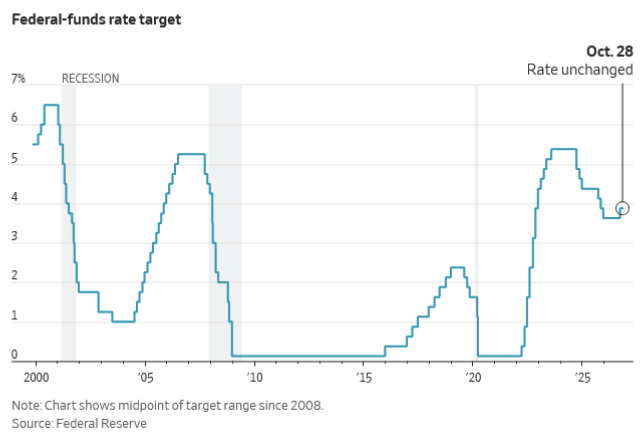
On Wednesday, the Fed held its benchmark rate at 3.75% to 4.00%, as expected, on a 10-2 vote. Governor Lisa Cook and Cleveland Fed President Beth Hammack dissented. Both wanted another quarter-point hike. In September, the unanimous vote to raise rates was 12-0.
The statement upgraded the economy from expanding at a “solid” pace to a “strong” one, and said inflation “remains elevated.” Warsh’s read on September’s hike was measured. He said what the Fed has done “in this monetary medicine is starting to work some, but there’s no firm conclusions.”
The Line of the Week
When asked what would prompt the Fed to raise rates, Warsh said he was optimistic about AI’s impact on the broader economy. He added that the Fed would have a better understanding of economic and financial market developments by the December meeting. Warsh rejected the notion that rate increases cannot affect the AI boom. He stated:
Interest rates get in the cracks. Interest rates affect directly or indirectly almost everything.”
That’s the whole ball game in two sentences. A rate decision doesn’t stay at the Fed. It works its way into equipment loans, facility leases, inventory carrying costs, and what a customer is willing to commit to for next year. It takes time, and it shows up in places nobody was watching.
I’ve been following the votes all year. In July, three regional presidents, including Hammack, dissented in favor of a hike. In September, the whole committee joined them. Now two officials want to go further. Last week, I wrote that economists expect the 10-year Treasury yield to end the year at 5.1%. On Wednesday it touched 5.04%.
Fewer Meetings Ahead
Here’s another change worth knowing. Warsh said the Fed will hold fewer rate-setting meetings in future years, starting in 2027, and add strategy sessions with no rate decision. The Fed has held eight rate meetings a year since 1981. The law requires at least four.
Markets now put roughly 85% odds on a hike at the December 8 and 9 meeting, which also brings new economic projections. If a quarter point matters to a financing decision you’re making before year-end, plan as though it’s coming.
2. 250 Watchmen Could Stop Most of Long Beach
About 250 watchmen, members of ILWU Local 26, have authorized a strike at the ports of Los Angeles and Long Beach that could begin as soon as 5 p.m. Pacific on Sunday, November 1. As of Thursday, no deal had been announced.
Watchmen provide security at individual terminals. Local 26 is about 2% of the ILWU’s membership, and its members work under a separate agreement from the coastwide longshore contract, which runs through 2028. They’ve been working under a contract extension. Their agreement expired in July 2025. The Pacific Maritime Association (PMA), which represents the terminal operators, says it has put wage increases and pension improvements on the table and that “significant differences remain.”
Why 250 People Matter
The terminals where these watchmen work handle about 85% of Long Beach’s cargo and about a third of Los Angeles’ cargo, according to the PMA. Walkouts and picket lines are a visual reminder that any work stoppage can derail the final end-of-year product’s efficient movement through the supply chain. Thousands of longshore workers, marine clerks, and foremen could honor the picket lines. Together, the two ports handle more than 31% of the nation’s containerized cargo. The PMA’s message to the union:
We urge Local 26 to work with us to reach an agreement that avoids a disruption at the nation’s two busiest ports.”
A Complex Already Stretched
The timing is not optimal for business. Both ports set monthly records in September, about 1.04 million TEUs at Los Angeles and 997,177 at Long Beach. Rail is already the pinch point. As of October 26, about 35,700 import containers were waiting for on-dock trains, and more than 10,000 of them had been waiting nine days or longer. Rail dwell across the complex rose to 7.19 days in September from 6.75 in August. Long Beach CEO Noel Hacegaba says “some of our terminals are reaching 50% on-dock rail utilization.”
Back on July 17th, I credited the ports with absorbing a record import surge without gridlock. They’re still moving record volume. This time, the strain is showing up in two places most people never think about: the railcar supply and a group of 250 people responsible for port security.
If you have freight on the water headed for San Pedro Bay, now is the time to ask your logistics partners where it goes if the gates close Sunday night, and what it costs to hold or reroute it. Those what-ifs are a lot cheaper to work out before the weekend. It’s the kind of planning we do with customers ahead of disruptions like this.
3. The Software Risk Nobody Tests For
A SupplyChainBrain Think Tank piece by Carl Andrews opens with a line worth considering: “Software quality is no longer simply an IT metric. It’s a strategic business capability.” Andrews is CEO of Original Software, which sells software testing tools, so he has a stake in the argument. That doesn’t make him wrong.
His point, which he has made in other pieces as well, is that software can pass every technical test and still break a business process. An update can work exactly as designed and still disrupt how an invoice is paid, how an order is released, or how a label is printed. As he has put it elsewhere, “technical success does not always translate into business success.”
One Update, 8.5 Million Machines
The most expensive example proves the point. On July 19, 2024, a faulty CrowdStrike update crashed about 8.5 million Windows devices worldwide. Airlines grounded flights, and Delta put its cost at about $500 million over five days. One routine update from a single vendor rippled through airlines, banks, and hospitals worldwide.
Of course, we’re all still fresh off last week’s PHP scare. This crisis had massive infrastructure reach. PHP powers roughly 70% of the web’s infrastructure, including major content management systems and platforms like WordPress, Drupal, and Joomla. Bottom line: expect more, not less, of these challenges in the future.
Where It Hides in Supply Chains
Most supply chains now run a technology stack: a warehouse management system (WMS), a transportation management system (TMS), an ERP, carrier and customer integrations, EDI, and a growing layer of AI tools. Each one updates on its vendor’s schedule. Each one can pass its own tests. The risk lives in the handoffs between them, where nobody owns the whole picture.
I’ve approached this from a few angles this year. In April, it was cyber risk coming through vendors. In September, it was the warning not to automate a mess. Last week, it was Staples’ internal tool that trusted every logged-in session. Same family of problem: the system worked, but the business still got hurt.
Two practical steps. Test updates against real processes, with the people who run them in the room, including those from operations, finance, and customer service. Before peak, ask your software vendors what they plan to push in November and December. The answer you want is “nothing big.”
4. The Gravel Lot Next Door Is Having a Moment
The Wall Street Journal took a look at a corner of commercial real estate most people drive past without noticing… industrial outdoor storage. These are the gravel and asphalt yards that hold trucks, trailers, shipping containers, construction equipment, and materials. They’ve never been glamorous, and they’re now among the tightest assets in industrial real estate.
The Numbers
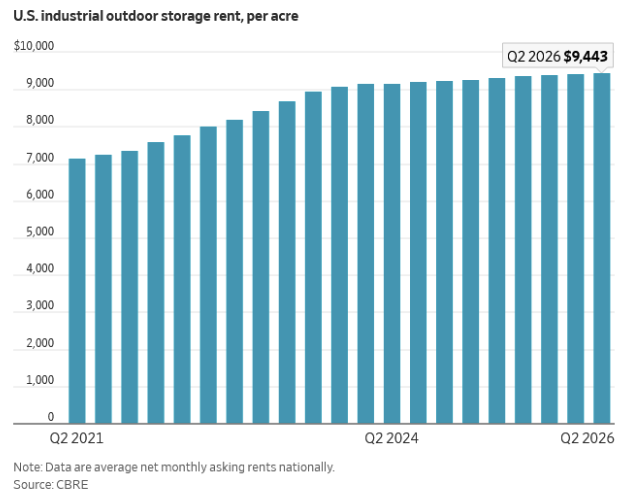
- National rents are up 32% since 2021, per CBRE. In the eight hottest port-linked markets, including Houston, Savannah, and Norfolk. Alterra IOS puts rent growth at more than 110% since 2020.
- Vacancy runs around 4%, compared with roughly 7% for traditional industrial space.
- Newmark estimates about 1.4 million acres nationally, though only a fraction of it is investable.
- Wall Street is moving in. Brookfield agreed to buy Peakstone Realty Trust for $1.2 billion, J.P. Morgan Asset Management partnered with Zenith IOS on about 100 properties in 33 markets, and Blackstone has lent more than $1 billion across storage deals.
100,000 Truckloads per Gigawatt
The AI connection is construction. DAT’s Dean Croke estimates that every gigawatt of data center capacity requires roughly 100,000 truckloads of concrete, steel, transformers, switchgear, and generators. All of that must be staged near the site. At the same time, data centers are consuming existing yards. In Manassas, Virginia, new data centers are slated to replace more than 200 acres of outdoor storage, over a fifth of local supply. And towns make it nearly impossible to permit new yards because they see them as noisy, unattractive, and low on tax revenue.
A few threads meet here. On October 16th, FTR said industrial demand is driving the freight market more than consumers are. The data center backlash I’ve written about since April now has a second-order effect on the yards around them. And as a longtime 99% Invisible fan, I have a soft spot for infrastructure hiding in plain sight. A gravel lot full of trailers might be the most 99% Invisible asset class there is.
If your operation leases yard space for trailers, equipment, or overflow, check your renewal dates now. Every trucking company and equipment operator needs a place to park, and that place is becoming scarcer and more expensive.
It Gets in the Cracks
A quarter point at the Fed works its way into almost everything. A group of 250 people can effectively cease operations of a port. A routine software update can break a process nobody connected to it. And a gravel lot nobody noticed is now a billion-dollar asset class, because the AI boom needs somewhere to park its components.
Small pieces, easy to overlook, carry a lot of the weight. That goes for sunny days in Northeast PA, too. We only get so many, so enjoy this stretch while it lasts. As the famous book/TV show says: “Winter is coming.”
Bonus #1: Birdwatching and the Brain
This article caught my attention because one of our favorite purchases two holiday seasons ago was Bird Buddy. This isn’t an advertisement for the product, though it is pretty great. Essentially, it’s a bird feeder with a camera and an internet connection. I can honestly say it’s deeply rewarding to watch the birds that frequent the feeder and to keep it stocked with food. I’m also proud of my design that keeps pesky squirrels away.
Canadian scientists published research in the Journal of Neuroscience earlier this year. They compared 29 expert birders with 29 beginners. The experts showed denser, more complex brain structures in regions tied to attention, perception, and working memory, with less of the usual age-related decline. You could argue that people with sharper attention may simply be more likely to take up birding. Either way, birding is the practice of noticing small things, which makes it a good fit for this week.

From the author’s aforementioned bird feeder. Please note: gray skies.
Bonus #2: Halloween Candy by State
If you’re a reader of this blog, and patient enough to stay with me until the end, you know that I love a map. This one’s a no-brainer. Each state’s standout Halloween candy. I can’t even give O-H-I-O grief on this one. Reese’s (thank you, Hershey, PA) is a winner (if I were to indulge). I like Swedish Fish, but now that I’m older, I care more about my teeth.
A little Reese’s history: H.B. Reese was a dairy farmer and shipping foreman for Milton Hershey before he started his own candy company in Hershey. He created the peanut butter cup in 1928, and his company merged with Hershey in 1963. A movie based on the life of Milton Hershey is coming out this Thanksgiving.
Bonus #3: Tube Dude
I thought I had what it takes. Clearly I do not. At least, not as Tube Dude.
Picture this… you’re the inflatable air tube out in front of whatever business hired you. Hold to blow air and stand him up, drag to lean, and flail his head into each customer’s ring before they walk past. Every level is a new client: a mattress sale, a taco truck, a dentist, a pizza shop. Levels are generated, so they never run out, and they get trickier as you go. It plays in any browser on a phone or a computer, with no download or sign-up.
You’re welcome.
One More Thing… Last-Minute Costumes
We need to talk about that costume. You’re not showing up to the Halloween party dressed as the overused “party guest” or “responsible adult.” Don’t worry, though, I discovered some last-minute easy(ish) ideas:
- Scrubs and furry coyote ears to be Noah Wyle Coyote
- Attach miniature cereal boxes to a shirt, and add a prop fake knife and some fake blood. Voila. Cereal Killer. To make it even simpler, carry around a bowl of cereal and a knife.
- Wear a fancy dress and a banner reading “I’m sorry” for a Formal Apology
- Wear all black with a giant “8” taped to you to be a Magic 8 Ball. You’ll have total power to tell people to quit their jobs all night
- Don operating room scrubs and a Google logo and go as a Google Doc
- Cover yourself in tinfoil to be Leftovers
Don’t forget to turn back your clocks Saturday night before you go to bed after the Halloween party. Maybe this will be the last of it. I read about a good compromise: we should spring forward 30 minutes next March, then never move the time again.
Clocks fall back at 2 a.m. Sunday, November 1. And the compromise has a real bill behind it. Rep. Greg Steube of Florida introduced the Daylight Act of 2026 in February. It would end the switching and set clocks permanently 30 minutes ahead of standard time, putting the East Coast 4.5 hours behind UTC. It has been sitting in committee since. The half-hour idea isn’t as strange as it sounds. Newfoundland and India already run on half-hour offsets.
Happy Halloween, everyone. Wherever you happen to be this weekend, I hope you enjoy dry skies.
Remember, it costs nothing to be kind.