Fed Holds Rates Steady
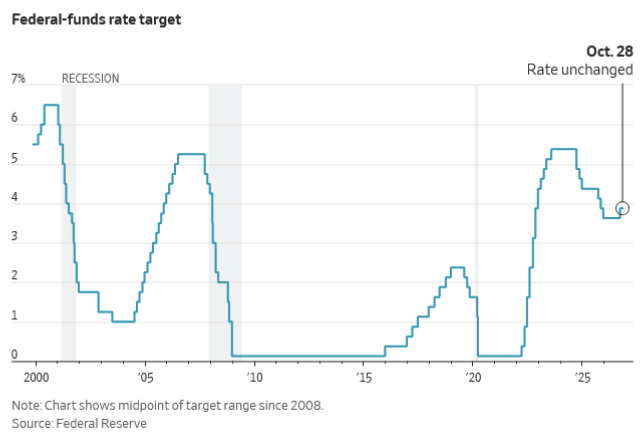
The Federal Reserve voted 10–2 to keep its benchmark interest rate steady in the 3.75% to 4.0% range, pausing after a September rate hike while it waits for more inflation data. Two officials voted against the pause, favoring a quarter-percentage-point rate increase: Fed Governor Lisa Cook and Cleveland Fed President Beth Hammack. This marked the first time a Fed governor and a regional bank president dissented together on the same side since October 1992.
Fed Chairman Kevin Warsh said the economy is expanding at a strong pace, but inflation remains elevated because of factors like energy costs and tariffs. The committee opted to wait for the “accumulation of more information.” Chairman Warsh announced plans to reduce the number of rate-setting meetings from eight to seven in 2027 (with one dedicated solely to broad monetary policy strategy) and six in 2028.
The odds of a rate hike in December sit at ~85%, and FedWatch says two more quarter-point bumps are likely in the first half of 2027.
The Latest Models Show Resilience
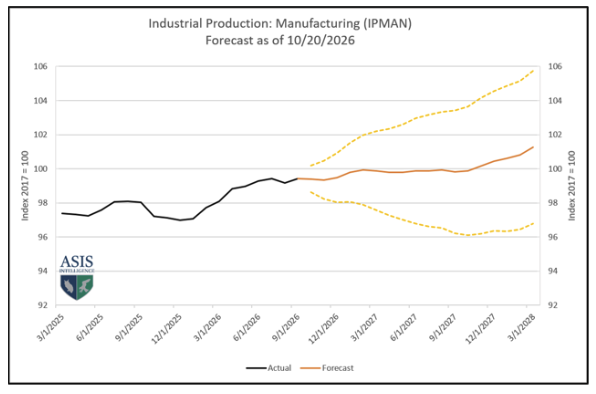
For the industrial production in manufacturing chart on the right (a critical input into the outlook for many models, including transportation, construction, and retail), the good news is that the outlook is strong. The forecast shows a modest flattening through year-end, followed by an early-2027 uptick and flat conditions through the end of 2027. After that, a solid growth trajectory emerges in early 2028.
Notice the two dotted lines in the graph at the top. The bottom line shows the risk of recession (based on 1,000 simulations). This model shows downside risk, including a moderately recessionary outcome. That’s important as you plan and consider the various scenarios for 2027. The model indicates a possibility of recession, but the consensus prediction right now is for 2.57% this year and 0.98% next year.
Many models have flattened this month. That’s a tough reality to work through. Retail and transportation models show solid upticks, suggesting the consumer side will remain stable if wages and job security continue.
Read more about how this, along with financial developments and other global issues, could affect your supply chain.