By Alex Stark
All Build. No Bull: Manufacturing’s Best Month in Four Years, the AI Spending Blind Spot, Etsy’s Unusual Layoff, and a Talking Toolbox
I flew back to my little corner of the supply chain this morning after a few days at our corporate headquarters in Seattle. It seems the smoke the East dealt with a few weeks ago has now settled over the Pacific Northwest. When I landed at SEATAC a couple of days ago, the setting sun was the same neon orange we experienced in June. The air was so thick with smog that I couldn’t even see Mt. Rainier. Easy breathing, everyone.
Four things caught my attention this week, and they all circled around the same idea. There is a real difference between noise and substance, and the companies worth watching right now are the ones actively choosing substance. Stanley put it better than I could, so I borrowed their line for the title.
Let me know what you’re seeing.
1. Manufacturing Just Posted Its Best Month in Four Years
The ISM Manufacturing PMI came in at 55.6 in July, up 2.3 points from June and the highest since May 2022. That’s the seventh straight month of expansion, beating the consensus estimate of 54.0. ISM says a reading at that level corresponds to roughly 2.8% annualized real GDP growth.
The number I keep coming back to, though, is employment. The index hit 52.8, the first expansion reading in 32 months. Nearly three years of contraction ended. Sixty percent of panelists reported their companies are hiring. After everything I’ve written this year about automation, humanoid robots in operations, and overall workforce anxiety, it was a welcome sign to read that result.
The Rest of the Picture
- Production jumped 6.3 points to 58.5, the highest since November 2021.
- New Orders hit 56.7, growing for a seventh straight month, with a 3.5-to-1 ratio of positive to negative demand comments.
- Fifteen of sixteen industries expanded. Chemical products was the lone contraction.
- The caveat: the Prices Index sits at 71.1. It eased for a third straight month, but raw materials costs have now risen for 22 consecutive months, and respondents still cite tariffs, the war in Iran, and longer lead times.
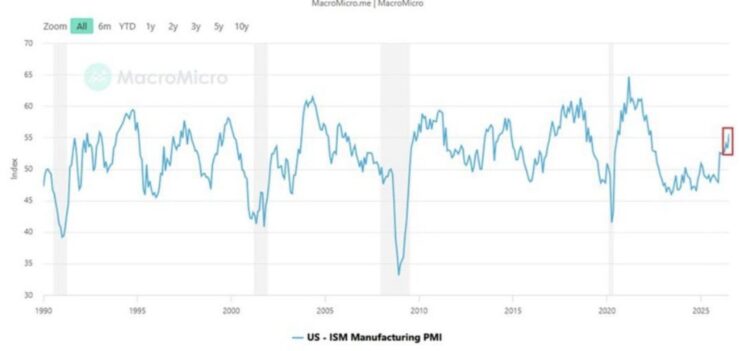
Three weeks ago, I wrote that June’s cooling CPI print was a single soft month, driven almost entirely by energy, and cautioned against re-planning around it. Fair to ask the same question here. Why is this one different?
Breadth. Four of five subindexes improved, and fifteen of sixteen industries grew. ISM’s survey chair, Susan Spence, told Bloomberg that her read is that this isn’t a one- or two-month trend. Companies are seeing six or more months of solid demand factors moving in the right direction. One category moving is a head-fake. Everything moving at once is a trend.
It may be worth noting that analysts read the report as growth-positive yet hawkish on Fed expectations, which aligns with last week’s story about three officials already voting to hike rates. Strong manufacturing plus stubborn prices is not a combination that argues for cuts.
The takeaway for operators is if you serve manufacturing, have your capacity conversations now rather than in Q4. Production at a five-year high, hiring turning positive, and freight capacity still tight make for a genuinely difficult peak season.
2. Two-Thirds of Supply Chain Tech Budgets Go to AI. More Than Half of Chiefs Can’t Tell If It Works.
Put these two Gartner numbers side by side, and you have the whole story. 67% of supply chain digital investment is now allocated to AI. 55% of chief supply chain officers are unclear on the return of those investments.
This isn’t a small sample of enthusiasts, either. Gartner surveyed 394 supply chain professionals at organizations with at least $250 million in revenue from November 2025 through February 2026, and 135 senior leaders from January through April of this year.
The Problem Isn’t the Technology
Gartner’s diagnosis is change management. AI use cases are multiplying faster than organizations can develop the approaches needed to support them. Senior principal analyst Lorraine Gavin described it as companies having become reasonably good at executing change on individual initiatives, while the harder question is deciding where to direct limited change resources so they serve the outcomes that matter.
Earlier Gartner work fills in the picture. Only 23% of supply chain organizations have a formal AI strategy. Most take a project-by-project approach, chasing short-term wins. That pattern tends to produce what one of their analysts memorably called “franken-systems,” layered architectures that stretch payback periods and resist scaling.
This SupplyChain247 article makes me think of the Kimberly-Clark citizens, translators, and wizards piece from a few weeks ago. It’s also the AI-relocates-bottlenecks story from May. Node-specific wins that never translate into network-level results. It’s the same lesson every time. Technology is the easy part. The people-and-process model determines whether any of it yields results.
Before your next AI budget cycle, ask three direct questions about each initiative. What outcome does this serve? Who has to change how they work for it to matter? Have we funded that change? If the answer to the last question is no, you’ve bought a tool and called it a transformation. Two-thirds of the budget is a lot of money to spend on something you can’t measure.
3. Etsy Cut 12% of Its Workforce and Refused the Easy Explanations
Etsy announced Wednesday that it is cutting about 220 employees, roughly 12% of its workforce, with the cuts concentrated in product and engineering. Headcount will be about 1,600 afterward, with about $35 million in restructuring charges, substantially complete by the end of Q3.
What makes it unusual is the overall context. CEO Kruti Patel Goyal, who took the job at the start of this year, said explicitly that the cuts were not a cost-cutting move and were not driven by AI. Her line to employees:
Cost savings are a consequence of these changes, but they are not the objective.”
The stated goal is to become an organization with fewer silos, fewer handoffs, and flatter teams built to tackle broader problems. The company described this as leaning in during a period of momentum rather than retrenching.
Does the Context Support It?
Mostly, yes. Q2 revenue was $668.3 million, up from $629.1 million a year ago, with core marketplace sales up 9.3%. Operating income climbed to $125.2 million from $94.1 million. The headline net loss of $46.6 million is almost entirely attributable to a $160.9 million loss from discontinued operations related to the sale of Depop to eBay. They raised full-year guidance. This is not a company cutting to survive.
That said, 220 people lost their jobs, and no amount of talking changes that. It’s also worth noting that Etsy runs an app within ChatGPT that lets shoppers search for and compare items using natural language. So “not driven by AI” is a statement about intent rather than a claim that AI is irrelevant to how they think about org design. To their credit, the severance is genuinely decent to those who lost their jobs. They are providing at least 16 weeks’ pay, plus tenure-based additions, and up to 12 months of healthcare support.
In July, I wrote about AI CEOs walking back their job-apocalypse rhetoric, and my advice was to watch the organizational makeup rather than the interviews. This is the interesting inverse. Whether you buy the explanation or not, refusing to blame AI when it was right there on the shelf is a choice.
The operator’s takeaway is smaller than the headline suggests. Silos and handoffs are real operational costs, and they almost never appear as line items. If you can’t identify where the handoffs occur in your organization, that’s worth an afternoon or two. Whatever you decide, be clear about what you’re doing and why. People can tell.
4. Stanley Built a Talking Toolbox to Call Out Marketing Hype
Stanley launched a global brand platform on Monday called ALL BUILD. NO BULL., aimed at small business residential construction pros and paired with an overhauled product portfolio. The campaign centers on “Stan,” a sharp-witted talking toolbox who spends ten ad spots mocking overengineered gizmos, overcomplicated features, and industry marketing that doesn’t serve the people doing the work. It runs across North America, Latin America, Europe, Australia, and New Zealand.
Stan’s launch line is the entire campaign in eight words:
If it sounds like bull, it usually is.”

Stanley’s brand president framed it as the ability of their customers to distinguish noise from substance. Their global brand marketing lead made a sharper point: residential pros, especially the younger ones, are savvy enough to be skeptical and to tune out anything that feels like posturing. That’s a real read on the market. Plus, it’s entering a construction slowdown, which makes it a shrewd play amid business uncertainty.
The Part That Got Me
Back in May, I wrote about Stanley Black & Decker closing its 183-year-old tape measure factory in New Britain, Connecticut. The lesson then was that tariffs grabbed all the headlines, while the real killer was a quiet shift in what customers wanted, specifically a two-sided tape measure the plant couldn’t retool to produce. My line at the time was that customer preference shifts are quieter than tariff news and far more dangerous to long-tenured products.
Three months later, the same company built an entire global platform focused on listening to what pros want and cutting everything else. I have no idea whether the campaign will work. But a company that was caught not listening is now spending real money to say it’s listening. That’s not nothing.
Skepticism is the customer’s default posture now, in construction and logistics. Anyone who has sat through a capabilities presentation loaded with words like “seamless” and “end-to-end” knows exactly what Stan is making fun of. The honest version in our world is showing up on time, telling customers early when something has gone sideways, and letting the service record do the arguing. The 3PL survey I wrote about two weeks ago found that partnerships fail on service, not on rate. Same lesson, different industry.
All Build. No Bull.
Manufacturing posted a number with real breadth behind it. Gartner found that two-thirds of supply chain tech budgets are flowing toward AI, while more than half of the executives spending that money can’t say what it’s returning. Etsy restructured and declined to blame the two most convenient villains. And a tool company founded in 1843 decided its edge is refusing to oversell.
I’ve spent most of this year writing about the gap between the story a company tells and how it truly operates. What’s different this week is that several of these companies are closing that gap on purpose and treating it as a competitive advantage rather than a compliance exercise. Customers and employees have both become very good at distinguishing noise from substance.
The animated toolbox is right. If it sounds like bull, it usually is.
Where’s the bull in your business right now?
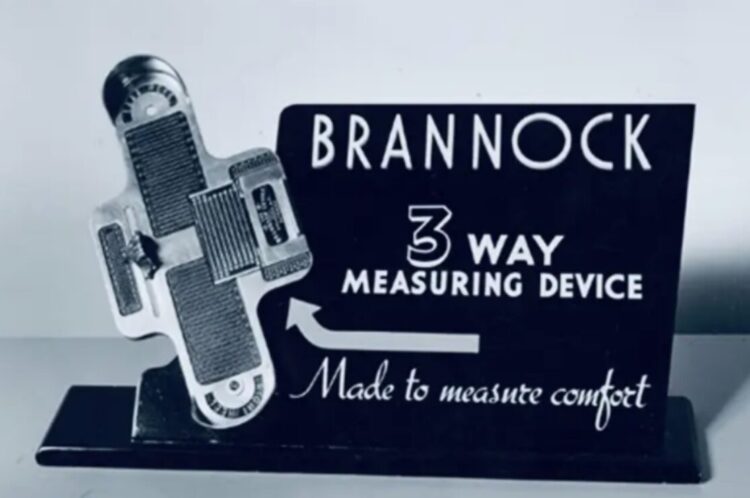
Bonus #1: The Brannock Device
While I drove home from the airport, I listened to one of my favorite podcasts. I’m a long-time 99% Invisible wonk. The show focuses on the hidden world of everyday design, and having lived in logistics and supply chain for the bulk of my professional career, I feel a certain kinship to anything that exists almost invisibly in society.
This particular episode covers the Brannock Device, that metal sliding contraption in every shoe store you’ve ever walked into. Charles Brannock invented it in Syracuse in the 1920s, and the design barely changed over the next century because it never needed to. A tool that got it right the first time and has resisted a hundred years of improvement is about as all-build, no-bull as it gets.
Bonus #2: Carsized
I’m not currently in the market for a car, but I found this site fun and informative. That’s one of my favorite combos. Any two vehicles you can think of, compared side by side. Specs, silhouettes overlaid on each other, plus and minus on every measurement. The site is genuinely useful for determining whether a given vehicle will fit in your garage, which is a more common miscalculation than most of us admit.
You’re welcome.
One Last Thing: Left-Handers Were a Problem to Be Fixed
I talked about my red-headed son last week, and how that 1 to 2% of the world’s population can seem endangered. Thankfully, it is not. That, of course, led me down another rabbit hole to an article on left-handers, which includes me.
For much of history, left-handers were treated as a problem to be corrected. Schoolchildren had their left hands tied behind their backs well into the twentieth century. The word “sinister” derives from the Latin word for left. Yet roughly 10% of people are still left-handed, a share that has remained remarkably steady across cultures and centuries despite considerable efforts to stamp it out.
Some traits persist precisely because they were never a defect in the first place.
Remember, it costs nothing to be kind.