By Alex Stark
Certainty Arrives Late: A Stronger Economy Than We Knew, a Holiday Season on Edge, El Niño as a Trust Opportunity, and Who Gets to Steer AI
We’ve made it to Q4. This is it. The busy season is here across (all) corners of our supply chain. This is the final sprint of the year, culminating in the holiday break, then a reset for 2027.
As the calendar rolls into October, do you know what’s on my mind? No. Not pumpkin spice, or even pumpkin pie for that matter. What got to me earlier this week was a long conversation with a friend and colleague about Thanksgiving. True, we’re not there yet, but in Canada, Thanksgiving is being celebrated this year (the second Monday in October) on Monday, October 12th. It really boils down to gratitude.
Four things this week, and they share an idea. In each one, people have to act before they know how it turns out. Certainty tends to arrive late, sometimes months late.
Let me know what you’re seeing.
1. The Economy Was Stronger Than We Thought. We Just Found Out.
On Wednesday, the Bureau of Economic Analysis released its annual update, and the revisions moved in a notable direction. Second-quarter GDP was revised up to 2.2% from 1.5%, beating economists’ expectations. First-quarter growth was revised up to 2.5% from 2.1%. Investment, consumer spending, and government spending all came in higher than first reported.
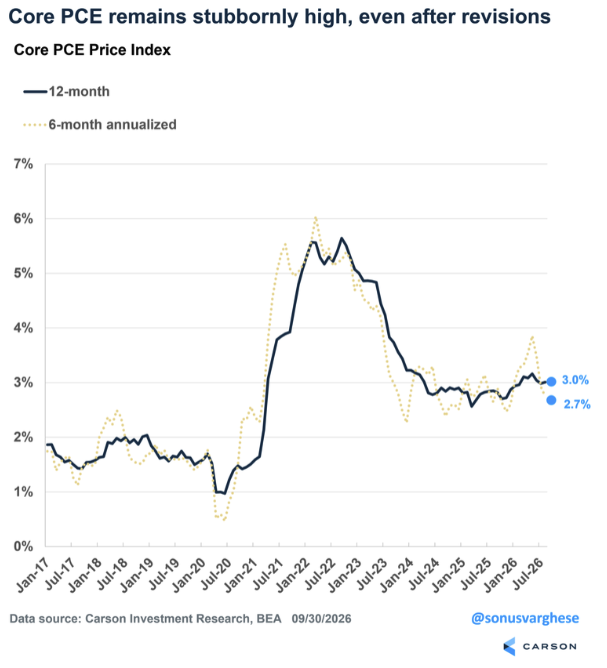
Inflation went the other way. Second-quarter Personal Consumption Expenditures (PCE) inflation was revised down to 5.0% from 5.3%, and core to 3.3% from 3.6%. First-quarter PCE came down to 4.2% from 4.6%.
When I Wrote About This in May
On May 1st I ran a section called “The 2% Economy.” First-quarter growth had just come in at 2.0%. It turns out it was 2.5%. Same quarter, same economy, and a meaningfully different number five months later. Nobody planning in May could have known that.
Better growth and lower inflation than first reported is good news, and there’s no reason not to say so. But the revisions don’t change the direction. August PCE came in at 3.4% headline and 3.0% core year over year, the same as July. Heather Long at Navy Federal Credit Union said the data showed no progress on inflation in August, and she expects September to come in higher.
Sonu Varghese at Carson Group put it bluntly:
There’s no two ways about it. Slice the data any way you want, and it still shows an inflation problem. The question is how far the Fed is willing to go to pull it back as we move into Q4 and 2027.”
Markets are now watching October or December for another rate hike, following September’s meeting. However, reports say Fed officials are weighing whether a second rate hike might be needed if inflation (somewhat) cools.
Although U.S. economic data seems buoyed by the data above, news of missing job expectations, a slight unemployment tick up (4.2%), increasing mortgage rates, and general uneasiness show consumer sentiment is glum.
Overall, this is a straightforward example of the week’s theme. The numbers you plan around are provisional. Build plans that hold up if the data shifts half a point in either direction, because it probably will.
2. Retailers and Shoppers Are Both on Edge Heading into the Holidays
Retail Dive’s Daphne Howland laid it out pretty plainly. Retailers and consumers are both on edge. Shoppers will find lean inventories this season as they hunt for the right items at the right price, and the hunt has already started. The most illuminating data point I found in the article is that, since January 2018, Numerator (the consumer insights company) reports prices are up more than a third for consumers.
What the Forecasts Say
- Adobe projects U.S. online holiday sales at $275.1 billion, up 6.7%, for November and December.
- Cyber Week is projected at $47.5 billion, with Cyber Monday alone above $15 billion.
- October is projected at $95.8 billion online, with Prime Big Deal Days on October 6 and 7 near $9.9 billion.
- AI-driven traffic to retail sites is projected to go up 130% year over year, and 141% on Thanksgiving. Back in July, I wrote about Prime Day AI traffic up 89%. The curve keeps rising.
- Many shoppers are using the season to stock up on essentials, not just gifts.
The Lean Shelves Are Deliberate
A month ago I wrote about retailers cutting SKUs on purpose. Under Armour was down more than 25%, and BJ’s was targeting 20%, along with BJ’s own candid warning that an earlier round of cuts had cut sales along with SKUs. This is that strategy reaching the shelf. Shoppers will hunt for them because retailers chose to carry less.
And back to the opener… U.S. Thanksgiving falls on November 26th this year, leaving 29 days to Christmas.
Last week, I said to plan for units, not dollars. I’d add one thing. Plan for demand that pulls forward into October and depletes thin inventory. Retailers and shoppers are both acting before they know how this season ends.
3. El Niño Is a Chance to Build Trust, If You Speak Up First
Zero100 argues that El Niño is an opportunity as much as a threat. You know a disruption is coming, which means you can tell customers before it lands. The firm’s own consumer research, a survey of 14,000 people across seven countries, explains why that matters:
- 82% of consumers have noticed prices rise.
- Only one in three consider those increases unfair when they’re framed as the result of supply chain challenges.
- 47% are what Zero100 calls supply chain-aware. They’re open to hearing the reasons behind higher prices and to offers built on supply chain tactics, like discounts for slower shipping or alerts when an item is back in stock.
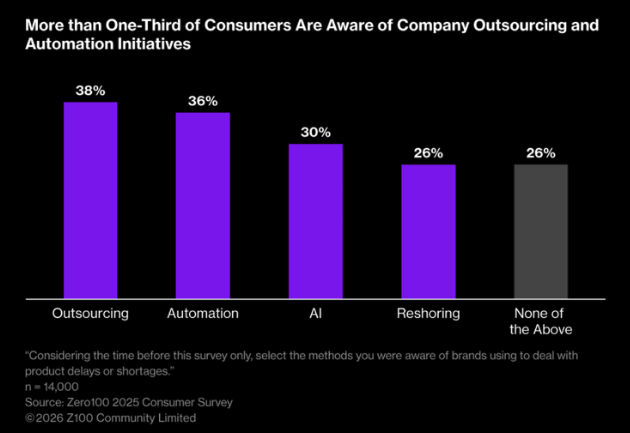
The El Niño thread has been building all year. In July, I wrote about the forecast for a very strong event. In August, the Panama Canal cut transits because of drought. Last week, the OECD named a very strong El Niño as one of its four downside risks to global growth. It’s getting closer to certain, and the window for early communication is getting shorter.
Damage Control or Relationship Building
Most companies treat disruption communication as damage control. Zero100’s data says it works better as relationship building. Customers mostly accept a supply chain explanation, but not repeated failure.
The 3PL survey I discussed in July found that partnerships fail more often because of poor service than because of rate. Telling a customer what’s coming before it arrives is the service. It’s how we approach our business relationship and is core to our principles.
If your customers will feel El Niño somewhere in their supply chain, tell them now, while it still reads as foresight rather than an excuse.
4. No One Gets Certainty First on AI. That’s the Point.
I greatly enjoyed this Wharton opinion piece from Dr. Cornelia Walther, a visiting scholar who spent more than 20 years as a humanitarian practitioner at the United Nations. Her argument is that we can’t count on a handful of technology companies to keep advanced AI safe, because no single company, government, or individual can do it alone.
She’s careful about the uncertainty in both directions. Catastrophe isn’t established. Neither is safety. Then she makes the business case directly: a board doesn’t ignore a potentially ruinous liability just because nobody can calculate its probability to three decimal places.
The Part That Matters for Operators
Her section on companies focuses on practical operational design rather than philosophy. Every company adopting AI decides whether a system drafts a document or sends it, proposes a transaction or executes it, or recommends a decision or quietly becomes the one making it. She says boards should know:
- Which systems can act on their own.
- What resources those systems can reach.
- Who can interrupt them.
- Which decisions require human sign-off.
- What happens when a model behaves outside expectations.
A few weeks ago, I covered last-mile operators who had pushed AI adoption to 66% but trusted it only to predict, not to decide. Real-time dynamic routing ranked dead last among their use cases. Walther’s distinction between AI that recommends and AI that becomes the decision-maker is exactly the line those operators had already drawn for themselves.
She offers a short framework, AGENCY. Ask where authority is shifting. Guard human decision rights. Examine incentives and evidence. Name accountability before deployment. Coordinate beyond your organization. Yield only what can be reclaimed. The “N” is what Target did in August by naming an owner for AI before shipping features. The “Y,” making reversibility a design principle, is the one most companies skip.
Her conclusion is that the more immediate danger may be assuming somebody else is responsible.
Human agency begins before certainty.”
For every AI system in your operation, you should be able to say who can stop it and how you’d undo what it did. If you can’t, that’s the gap.
Certainty Arrives Late
The GDP numbers from last spring changed this week. The holiday season starts before anyone knows how it ends. El Niño’s exact impact won’t be clear until it arrives, and by then the chance to tell customers early is gone. And on AI, nobody gets certainty first, not the labs and not the regulators.
You act on the best information you have, you tell people what you know, and you adjust when the numbers get revised. Which they undoubtedly will.
Gratitude doesn’t wait for certainty either. You don’t need to know how the year will end to be thankful for the people who have brought you this far.
Bonus #1: Socktober
I wasn’t aware of this annual collection drive. It keeps gathering steam and awareness. It’s a community-based response to help the more than half a million people in the U.S. without a home on any given night. This year’s goal is 3 million participants.
It started in 2011 in Arkansas with a few middle school students and Brad Montague, the creator of Kid President, and has grown since. Shelters say socks are among their most requested items and among the least likely to be donated. People living outside walk constantly and rarely get the chance to wash or change them.
Awesome spreads. Well said, Kid President.
Bonus #2: Singapore Is Paying People to Read
On the subject of nudging people toward beneficial activities, Singapore is experimenting with building a reading culture to combat brain rot. Reading versus doomscrolling. Would seem like a sound investment, and I’m here for it all day.
The National Library Board launched a five-year campaign called ReadSG. Fifteen minutes of reading a day earns 20 virtual coins, and 1,000 coins equal one Singapore dollar. So, 50 days of reading gets you about 80 U.S. cents. Nobody’s getting rich here. The campaign pitches 15 minutes as roughly the time between three subway stops. People will say that they are reading words on a screen. This is deep reading: spending deliberate time and committing to a longer format. Still, I like the idea and especially their sentiment – “Let’s keep reading… and keep expanding how we think of ourselves.”
Bonus #3: Check Box Race
In my weekly quest to find a game that is (a) not too complicated and easy to jump right into, coupled with (b) something that genuinely raises my competitive spirit, I discovered Check Box Race. Simple. Frustrating. Addictive. Good, quick distraction.
Yes, I see the irony of recommending a browser game between two pieces about putting down your phone. I’m trying to keep you sharp, people.
You’re welcome.
One Last Thing… Actually, 118 Things
As I was reading about pushing back against doomscrolling, NYT Wirecutter gladly obliged with an article on 118 things to do instead of staring at your phone. Pick one this weekend.
Remember, it costs nothing to be kind.