By Alex Stark
Less, On Purpose: A Divided Fed Holds, Importers Show Restraint, UPS Sheds Amazon Volume, and 3PLs Post a Banner Year
It was a wonderful break to take a few days off last week and enjoy some summer with my family. It all goes by too quickly, so enjoy it while it’s here. At this time of year, I swear I can already feel autumn creeping in. My wife and I take the dogs out nearly every night, and as we near the end of July, I keep reaching for a sweatshirt to fend off the cooling temps.
Back at the desk in my corner of the supply chain, four stories caught me this week, all circling the same idea. Each one is about knowing how much to do and then stopping there. The Fed held. Importers pulled cargo forward, but with a lighter hand than last year. UPS walked away from half of its biggest customer’s volume and made more money. And 3PLs posted their best year in a while by getting more disciplined rather than more aggressive.
1. The Fed Held Again, and Three Officials Said That Was a Mistake
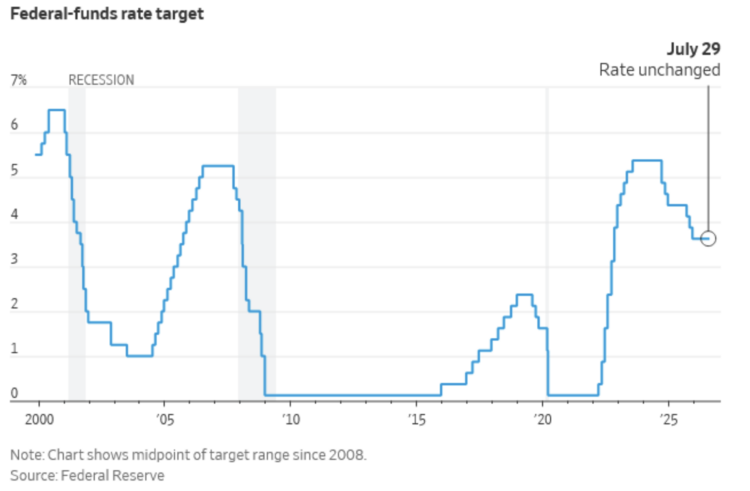
The Fed left its benchmark rate unchanged in the 3.50%-3.75% range on Wednesday, marking the fifth straight meeting without a move. The interesting part was the vote: 9 to 3, with three regional bank presidents dissenting and voting for a quarter-point increase. Beth Hammack of Cleveland, Neel Kashkari of Minneapolis, and Lorie Logan of Dallas all wanted to hike now.
This was Kevin Warsh’s second meeting as chair, and inflation has now run above the 2% target for more than five years. The committee’s own June projections already penciled in one quarter-point increase by the end of 2026, so the direction isn’t really in dispute. The timing is.
What to Watch from Here
- Warsh has stepped back from the forward guidance his predecessors offered routinely, which left investors with very little to read after the statement. He has also described inflation as “a choice.”
- Logan said in a mid-July speech that inflation has been too high for too long and doesn’t appear on track to return to target, and that modestly higher rates would serve better right now.
- Governor Christopher Waller voiced similar concerns publicly in recent weeks, then voted with the majority to hold. That gap between what officials say and how they vote is worth watching.
- Markets had priced roughly a one-in-three chance of a surprise hike. Attention now shifts to September.
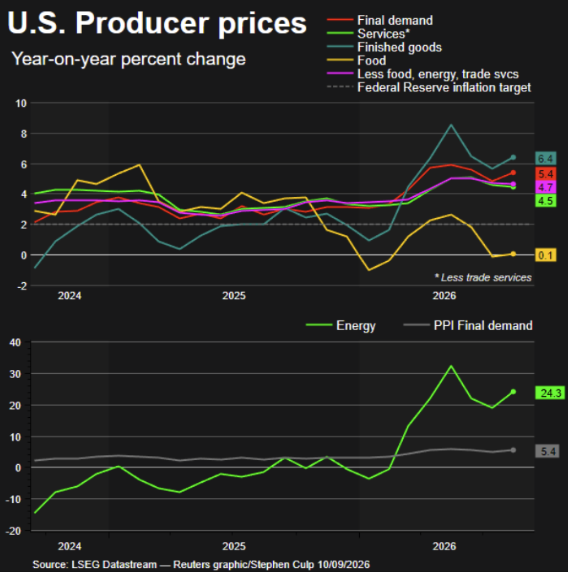
Two weeks ago, I wrote that June’s cooling CPI headline was almost entirely energy-driven, that core was stuck at 2.6%, and that the Fed hadn’t blinked. This is the confirmation. A softer headline didn’t move policy because those setting policy are reading the same underlying composition problem. The restraint here isn’t passivity. It’s a deliberate choice to wait for more data rather than overcorrect.
The takeaway for operators is to plan for borrowing costs assuming rates hold or rise, not fall. Nobody on that committee is arguing for a cut. If your 2027 capital plan assumes cheaper money, stress-test it now against a hold-or-hike path while you still have time to adjust.
2. June Imports Rose, but Shippers Have Learned Not to Overreact
June container imports totaled around 2.4 million TEUs, up roughly 9% from a year earlier but down 1.2% from May. The more revealing number is the first half of 2026 as a whole: essentially flat, down 0.3% compared with the same stretch in 2025. All that tariff drama, and the six-month total barely moved.
Chris Rogers, Head of Supply Chain Research at S&P Global Market Intelligence, told Logistics Management that after two years of tariff turbulence, shippers have built themselves a playbook for uncertainty. His description of the situation is one of the best things I read all week:
You need to do something, but you shouldn’t do too much.”
He notes there’s still pull-forward activity, but not to the same extent as last year. That’s genuinely new. Two weeks ago, I wrote about the record 2.47 million TEU in July, driven by the Section 122 deadline, and the surge is real. What Rogers is describing is the discipline behind it. Companies are still hedging. They’ve just learned that over-hedging costs more than the risk it was meant to prevent.
The Rest of the June Picture
- China-origin imports hit 814,474 TEUs in June, up 27.4% year over year.
- The top 10 ports handled 84.3% of total imports, a concentration worth paying attention to.
- Port performance split. East and Gulf Coast delays improved, while Los Angeles delays nearly doubled as volumes there rose 16.1%.
- Watch list for the second half of 2026: Middle East maritime risk, tariff uncertainty, ongoing Red Sea disruption, and new Panama Canal restrictions. That last one connects straight to the Super El Niño piece from three weeks ago. The canal is already tightening.
In a volatile year, the instinct is to hedge everything. Rogers is right that every hedge carries a cost, including working capital, warehouse space, and obsolescence risk. The discipline is to separate the risks you genuinely need to control from those you’d merely like to control, and to be honest that they are two different lists.
3. UPS Walked Away from Half Its Amazon Volume, and Q2 Proved the Point
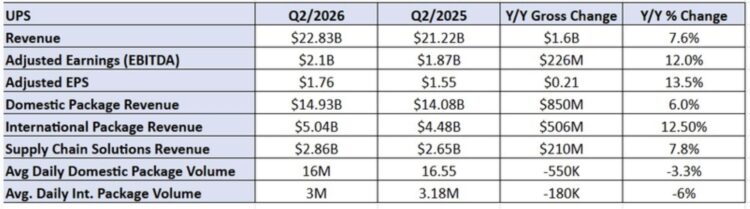
UPS reported second-quarter results on Tuesday. Parcel volumes declined as the company completed phasing out its low-margin Amazon business. Revenue totaled $22.8 billion, up 7.6% year over year, and adjusted operating profit rose 12% to $2.1 billion, or $1.76 per share, beating expectations. Management raised full-year revenue guidance to $91.2 billion.
Here’s what they did. Over 18 months, UPS worked with Amazon to eliminate unprofitable shipments that accounted for roughly half of the volume Amazon tendered. They shed outbound delivery from Amazon fulfillment centers within about 50 miles of a residential address, the short-haul runs that don’t require an integrated end-to-end network. They kept the Amazon business that pays.
It wasn’t painless, and it’s worth saying so plainly. The restructuring has involved roughly 30,000 jobs, about 25 million operating hours, and dozens of facility closures, on top of 34,000 positions and 93 facilities in 2025. The Teamsters opposed the driver buyout program as insufficient. Such deliberate restraint at that scale affects real people.
Same Gravity, Opposite Decisions
Three weeks ago, I wrote about FedEx Freight spinning off and shifting from chasing volume to chasing the right volume. This is the same lesson from the other side of the parcel business, and the results are now on paper. Volume down, revenue per piece up, profit up, and guidance raised. Doing less of the wrong work proved more valuable than doing more of it.
And there’s a nice symmetry with something else I wrote a month ago. Duluth Trading handed its fulfillment to Amazon because the customer was already there. This week, UPS walked away from Amazon volume because the economics didn’t make sense. Same gravitational field, opposite decisions, and both are defensible. The question was never whether Amazon is good or bad for your business. It’s whether the specific work you’re doing for them, or through them, actually pays.
The takeaway is to run the margin math by segment, not in aggregate. Most operations have some version of the sub-50-mile Amazon route. Volume that looks like a customer relationship but behaves like a subsidy. Finding it is uncomfortable. Acting on it is harder. UPS just showed what happens when you do.
4. 3PLs Had a Very Good Year, and the Reason Isn’t What You’d Guess
Inbound Logistics released its 21st annual 3PL Perspectives report, and the numbers are strong across the board. Not a soft year hiding behind good headlines. Actual growth.
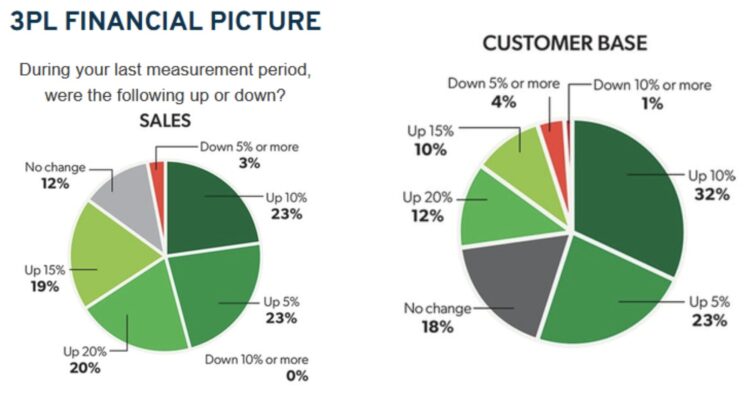
- 84% of 3PLs reported sales growth, including 62% growing 10% or more. A year ago, those figures were 70% and 47%.
- Nearly 80% reported profit growth, with 54% topping 10%. A year ago, 69% and 38%.
- 77% grew their customer base, with 54% adding at least 10% more customers.
What Moved on the ‘Top Challenges’ List
The challenge rankings are where this gets interesting. Capacity jumped into the top five at 52%, up from 31% a year ago. That’s the single biggest mover in the survey, and it’s the supply-driven freight reset I’ve been tracking since May, reflected in providers’ own words. Compliance and regulatory burden also climbed to 46%, up from 43% and 40% the two prior years.
Labor went the other way. The share of respondents citing finding, training, and retaining people fell to 40%, down 6 points from last year and nearly 20 points since 2023. After several years as the industry’s dominant worry, it’s now well down the list. Rising operational costs remain the top challenge at 66%, down from 72%.
The Two Numbers That Matter Most
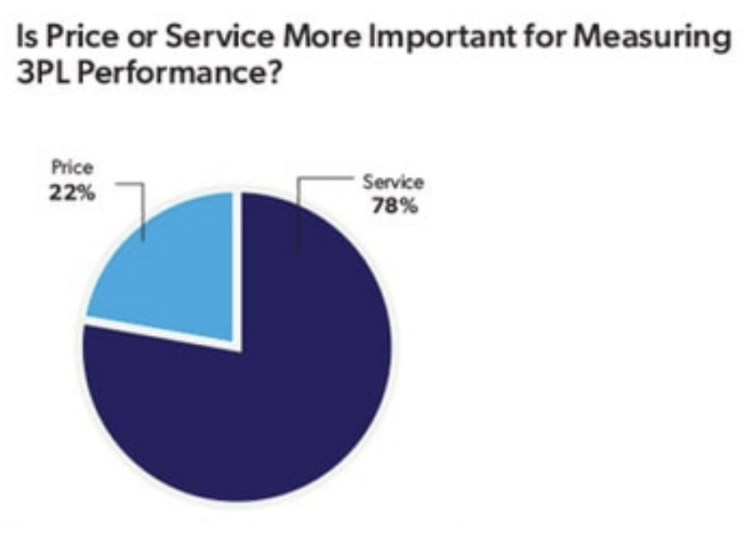
- 78% of shippers say service matters more than price when they measure 3PL performance.
- The top reason cited for a failed partnership is poor customer service at 33%, with failed expectations second at 29%. Not rate. Not capacity. Service.
There’s also an AI split worth flagging. Among shippers, implementing AI was cited as the single most important challenge by 73%. Among 3PLs, AI was named the top disruptive innovation by 93%, but only 50% viewed it as a challenge. Providers are noticeably more optimistic about AI than the customers they serve, an interesting dichotomy. Meanwhile, autonomous vehicles fell 10 points to 36%, and blockchain dropped to 8%, down 20 points over two years.
The through-line with the rest of this article is restraint. 3PLs aren’t winning by chasing every load or customer. They’re prioritizing efficiency amid cost pressure, and shippers are rewarding service over price. That’s the same lesson as the friction piece from two weeks ago, now backed by survey data rather than theory. The thing customers pay for is the part that’s hardest to automate away.
Partnerships fail on service, not on rates. That’s been the argument for asset-based, relationship-first logistics all along, and it’s satisfying to see it reflected in the numbers rather than just in the pitch. It’s the business we’re in.
Less, On Purpose
The Fed held, and three officials thought that was too little. Importers hedged, but with a lighter hand than last year. UPS handled less volume and made more money. And 3PLs grew by getting more efficient rather than more aggressive.
In a volatile year, the instinct is always to do more. More hedging, more volume, more coverage, more activity. Every one of these stories makes the case for the harder discipline of figuring out how much is enough and then stopping there. Rogers said it better than I can. You need to do something, but you shouldn’t do too much.
Let me know what you’re seeing.
Bonus #1: Scrolling… but Make It Restful
As we start thinking about opening the windows to let in some fresh air overnight, hopefully everyone can put down their phones and get some solid rest. And if you simply cannot manage that, I found a site that makes scrolling before bed far more soothing. It’s beautiful in its simplicity and genuinely captivating.
Bonus #2: Bison… at a Safe Distance
If you must engage, here’s a fun game I found on the interwebs. It reminds me of that grandfather in Yellowstone earlier this month who, luckily, survived a bison encounter. I’ve had the pleasure of hiking and camping in Yellowstone, and those animals are majestic. They’re also about the size of a small car, so it’s best to keep your distance.
For the safety-minded, a bull bison can weigh more than 2,000 pounds and run about 35 miles per hour, roughly three times faster than most of us can sprint. The Park Service advises staying 25 yards back. Or just play the silly game instead.
You’re welcome.
One Last Thing: Are Redheads Going Extinct?
As the parent of a redheaded child, I marvel at his distinctive locks. I do wonder whether it’s a trait that will ever disappear. The short answer is no.
Red hair results from recessive variants of the MC1R gene, and recessive traits don’t simply vanish. They quietly persist in carriers who never show the trait, then surface again generations later. Roughly 1-2% of people worldwide have red hair, with the highest concentrations in Ireland and Scotland. Rare, yes. Endangered, no.
Good news for the small percentage of us raising them.
Remember, it costs nothing to be kind.