By Alex Stark
Before the Season Starts: Souring Expectations, a Record Diesel Low, the Panama Canal Cutting Transits, and Two Retailers Betting on Boring
School activity is ramping up here in my little corner of the supply chain in the Northeast U.S. Fall sports are in full swing, moving past tryouts and practices to matches and games. Incoming first-year high school students are already getting a dose of school spirit before the opening bell of class on the day after Labor Day. That means children and buses will be back on the roads. The roads near me are already backed up at nearly every school by 8 am. Be mindful out there, especially for the 11% of kids who still walk or bike to school—more on that stat below.
Four things I learned this week, and they all share a certain theme. The Conference Board put it best, without meaning to. Their Present Situation Index rose in August, while their Expectations Index fell. People feel roughly okay about right now and considerably worse about what’s coming.
That struck me for every story I gathered this week. Diesel inventories hit a record low before the demand season that drains them. The Panama Canal is cutting transits before the dry season. And two of the country’s biggest retailers are investing in reliability before the holiday quarter. The warnings are arriving early this year, which is the good news, as long as somebody acts on them.
Let me know what you’re seeing.
1. Consumers Feel Fine (Maybe) About Now and Worried About What’s Next
The Conference Board’s Consumer Confidence Index slipped 0.8 points to 89.4 in August, a second consecutive monthly decline and the weakest reading since January. For scale, the August readings in the two prior years were 97.8 and 105.6.
The Split Is the Whole Story
- Present Situation Index rose 6.8 points to 121.2, its first improvement in four months.
- Expectations Index fell 5.8 points to 68.2. That index has sat below 80, the level historically associated with a recession. This seven-month low appears to be driven by the country’s growing pessimism about the future of the business climate and the labor market.
- All three Expectations components deteriorated. Business conditions, labor market, and household income, though income stayed positive at +3.8%.
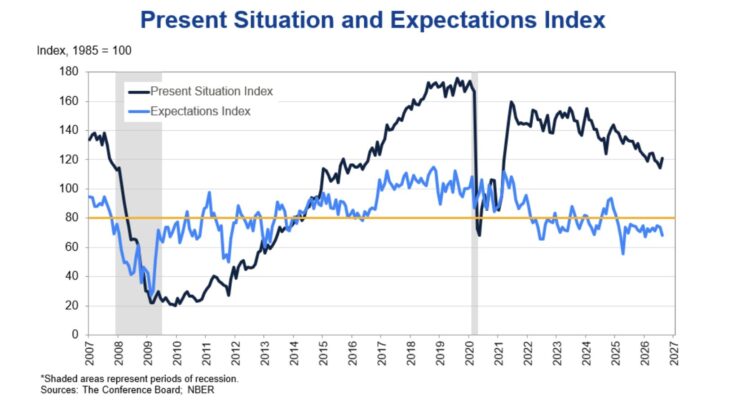
The labor detail is the strange one. Consumers describing jobs as plentiful rose to 27.0% from 24.4%, and those saying jobs are hard to get fell to 19.5% from 21.7%. That differential is at its highest point of the year. So, people are describing a labor market that feels better even as they expect it to get worse. And that’s not even getting into the rabbit hole I fell into on all the chatter surrounding the collective exasperation of “ghost jobs.”
The open-ended responses got darker. Mentions of prices and energy costs remained high, and respondents cited armed conflict, geopolitical tensions, food costs, and trade issues more often than the month before. The share saying a recession in the next twelve months is very likely ticked up. The University of Michigan index tells the same story, falling about 8% in August and ending two months of improvement, with expected business conditions down 11% for the short run and 17% for the long run.
Back in June, I wrote about the gap between a stock market at its highs and sentiment at its lows. This is the same divergence, except now it lives within a single survey. The present seems to be holding. The forward view is not.
Here’s what that could mean operationally. When customers’ expectations deteriorate even as their current situation improves, they don’t stop spending. They start deferring. Big-ticket items, discretionary purchases, anything that can wait a quarter (or two). If you sell something that can be deferred, model a demand curve that flattens with postponement in addition to one that collapses (just in case).
2. Diesel Just Hit the Lowest Seasonal Level Ever Recorded
I wrote about diesel last Friday. It got worse in seven days. Distillate inventories fell to 103.4 million barrels for the week ending August 21. That is the lowest seasonal level in EIA records going back to the early 1980s. Not the lowest since 1996, which is what I reported a week ago. The lowest ever for this point in the year.
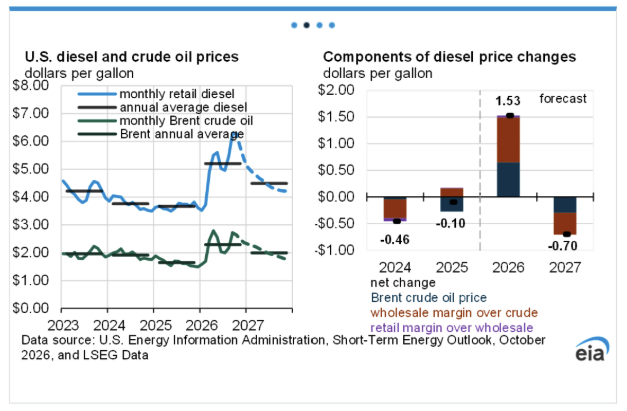
Retail diesel is trading above $5.60 per gallon in many markets, amid record refining margins. And the export picture explains a lot of it.
- Weekly distillate exports have topped 1.5 million barrels a day in all but three of the past eighteen weeks. The four-week average sits around 1.7 million, roughly 24% above the 2025 pace.
- Domestic demand is firm too, with product supplied running about 1.8% above a year ago.
Here’s the counterintuitive part. Domestic shippers are now competing with export demand for the same barrels. Thin European refining capacity, Russia’s export ban, and Latin American demand are pulling U.S. Gulf Coast product into the global market at record levels. American diesel has become a hot global export precisely because global supply is tight and each cargo drains domestic tanks.
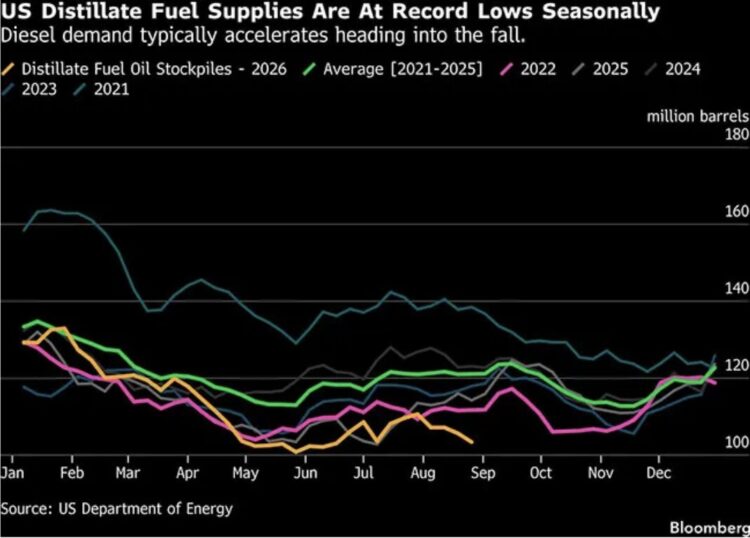 Now, the timing. Global diesel demand typically climbs around October as the heating season and agricultural activity ramp up. The record low is arriving before the season that draws it down.
Same advice as last week, but with more urgency. Look closely at your fuel surcharge exposure now.
If you can lock in terms or hedge for Q4, this might be the window. October will be too late.
3. The Panama Canal Is Cutting Transits, and the 2027 Warning Is the Real Story
The Panama Canal Authority (ACP) issued an advisory reducing daily vessel transits beginning in September and postponing planned draft increases for Neopanamax vessels. Starting September 3, Neopanamax capacity drops to nine daily slots and Panamax to 25, with Panamax falling further to 23 slots on September 15.
The numbers behind all this are deeply concerning. Rainfall across the Canal watershed from May through August was 34% below the historical average, and watershed inflows were 44% below normal. The rainy season began, but the watershed did not respond as expected. Gatun Lake sat just above 84 feet in early August, nearly a foot below its July level.
What Scarcity Costs When There’s No Slack
Last-minute auction slots ran roughly $135,000 to $140,000 before the Middle East conflict. They hit around $385,000 in March and April. On August 14, a gas carrier reportedly paid a record $4.6 million for a single Neopanamax auction slot. That is what a chokepoint with no slack looks like on an invoice.
On July 10th, I wrote about the Super El Niño forecast and made exactly this point. The canal depends on freshwater lake levels; the 2023-24 drought had already forced restrictions, and forecasters put the odds of a Super El Niño by winter at 63% to 80%. Six weeks later, it is here.
What It Means Downstream
- Each one-foot draft reduction forces a Neopanamax containership to shed several hundred containers per voyage, which raises the per-unit cost.
- Trans-Pacific rates from Asia to the East Coast are up 42% since the Iran war began, now at $10,527 versus $7,193 for the West Coast.
- That spread plus canal uncertainty could push importers toward West Coast gateways. LA and Long Beach already ran near-record July throughput of about 1.9 million TEUs.
- East and Gulf Coast terminals may see fewer canal-routed vessels but more volatile arrival bunching, and western railroads could face added transcontinental intermodal demand after network slowdowns earlier this summer.
The ACP’s stated concern is the dry season from January through April 2027. They are telling everyone now, in August, what the problem will look like next spring. If your network assumes East Coast arrival via the canal, consider running analysis of a West Coast landing plus intermodal routing.
4. Target and Walmart Are Competing on Something Boring to Deliver Sales
Both retailers reported earnings, and the CX story from both calls was not new. It was all about reliability. Target’s EVP and COO Lisa Roath named consistency the theme of the year, built on in-stock rates, store updates, and faster checkout, all while more than 100 stores are being remodeled. Walmart leaned on delivery speed and omnichannel operations.
That consistency needs to show up in the experience we create for our guests.”
The Results
- Target Q2: comparable store sales up 3.8% year over year, comparable traffic up 3.6%, net sales up 5.3%. Reliability metrics at multi-year highs, meaning more customers finish a trip with everything they came for. Roath was candid about the fact that they still aren’t where they want to be.
- Walmart: Walmart+ membership grew by double digits, marking the best first-half membership growth in the program’s history, and members spend roughly four times what non-members do.
One analyst in the piece put his finger on it. What ruins an experience is going to the store or ordering online, expecting something to be in stock, only to find it isn’t. That is not a marketing failure. That’s a supply chain dropping the ball.
The backdrop matters here. Brand loyalty is falling, and spending is softening, which is the same story as the Tillster data I wrote about in April showing 45% of consumers changed their favorite brand inside a year. When loyalty is cheap or nonexistent, the differentiator isn’t the campaign. It’s whether the thing is there at the point of purchase.
Two weeks ago, I wrote about Target hiring its first chief AI officer and pairing that hire with a UX promotion, arguing that the pairing was the point. This is the same company that says the measure of success is whether a customer walks out with what they came to buy.
For both retailers, delivering a good customer experience requires finely tuned supply chains. Otherwise, shoppers will go somewhere else. In-stock rate is a distribution problem. Delivery speed is a network design problem. Consistency is a process discipline problem. Every CX metric these two retailers described in this piece traces back to the supply chain executing quietly and repeatedly, which is the work we do, at scale.
Plus, notice the timing. Both companies are investing in reliability before the holiday quarter, not during it.
Before the Season Starts
The Conference Board’s present index went up, and its expectations index went down. Diesel hit a record low before the season that drains it. The Panama Canal is cutting transits in September and issuing warnings for next spring. And two retailers are investing in reliability ahead of the quarter that will test it.
None of this is a surprise, which is the useful part. The warnings arrived with lead time. Fuel, water, capacity, and consumer patience are all saying the same thing at the same time, and each is cheaper to address now than during the holiday rush.
The companies that come out of Q4 in decent shape will mostly be those that treated a late-August warning as a deadline rather than a headline.
Bonus #1: Walking to School
This one is for anyone who’s ever heard an older person say they walked to school, uphill both ways (in a snowstorm). School is starting here in the Northeast, the annual Labor Day end-of-summer ritual, and the buses are back out there. I remember one day in high school missing the bus and my mother telling me to bike to school. I didn’t miss the bus again after that. That was a long time ago in much different times.
Here’s an insightful piece on improving infrastructure, following a man who tries to walk to school and immediately finds out why parents don’t let kids do it. The video is worth watching, and it correctly notes that this is not a New Jersey or Pennsylvania problem. It’s a U.S. problem we should want to fix.
Bonus #2: Hamster Launch
I’m always down for a fun diversion. I kept this one in the files until today’s piece, courtesy of Reddit. It’s a physics-based browser game where you propel a hamster across various biomes.
Simple and innocent fun, people.
You’re welcome.
Bonus #3: The 2026 Fall Foliage Forecast
I’ll admit, I’m already thinking about fall. Nothing crazy, like setting up Halloween decorations or stocking up on pumpkin spice. Just an ease with the cooler nights, knowing the days are getting shorter. As an East Coaster who revels in the colors, I came across this helpful 2026 fall foliage forecast and have it bookmarked. Make your plans to get out in nature in the coming weeks and enjoy its majesty.
One Last Thing… Dolly
Dolly Parton left us this week, peacefully surrounded by family at age 80. I’m certainly on board to join the chorus of people showing love to Dolly Parton. I first became aware of her in the 1980 classic 9 to 5. It was on steady rotation on HBO back in the day, when TVs didn’t even have remote controls (that duty fell to my youngest sister).
Who didn’t like Dolly Parton? That may be her greatest legacy. Being a good and decent human. Her family’s statement called it a rhinestone life that shone bright enough for the world to see, which is spot on.
The Imagination Library, which she started in 1995, is a pretty close second. It has put hundreds of millions of free books into the hands of children. Instead of flowers, her family has asked that donations go there.
Dolly, the world was made a better place because you were in it.
A sterling example of it costs nothing to be kind.