U.S. Economy: July Spending Tells a Tale
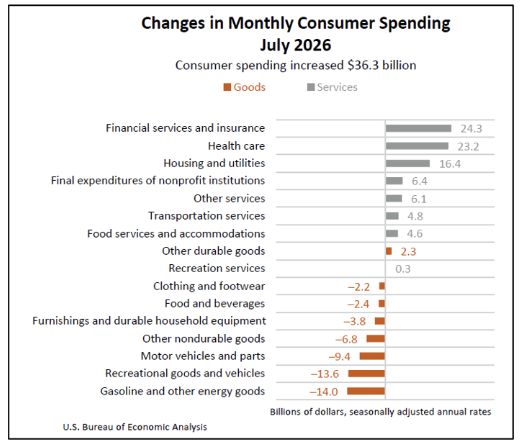
According to the latest U.S. Bureau of Economic Analysis (BEA) report, the narrative is of a consumer who is pinched, spending largely on necessities and unable to focus more on discretionary categories.
The BEA breaks it out, with gray representing services spending and orange representing goods spending. In this month’s data, inflation (or the pullback in prices) was a major factor. Take gasoline, for instance. This was not a 14% drop in consumption; it was driven largely by a decline in gasoline prices (which have since risen since this survey was conducted).
In some categories where prices are more stable (such as automotive), we can honestly say there was a pullback in spending, and we can corroborate it with other measures. Bottom line, the broader economy is strained enough that households are focused on essentials and necessary spending, and less on other, more discretionary spending.
Recent Consumer Sentiment Survey
The Conference Board released its Consumer Sentiment report for August, showing that confidence slipped slightly this month, down 0.8 points to 89.4.
From the report: “On a six-month moving average basis, auto purchasing expectations remained strong. Homebuying expectations declined slightly for the month but maintained an upward trend after slumping to decade-lows in early 2024. Among consumers’ planned purchases of durable goods within six months, furniture and smartphones remained the most desired items, but expectations for smartphones continued to moderate in August. Spending plans for televisions fell the most on a six-month moving average basis, while plans for most other durable goods moderated slightly.”
There’s some great intel in that depending on the industry you are in.
Read more about how this, along with financial developments and other global issues, could affect your supply chain.