U.S. Economic News: Big Week for Releases
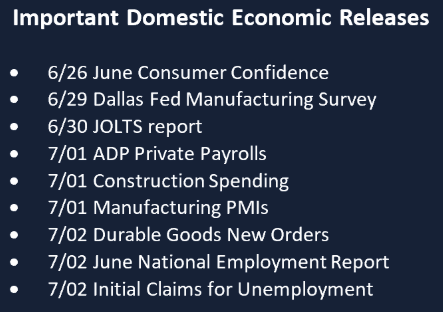
Many eyes will be on the labor report on July 2nd. However, there will still be some Iran war-induced noise in the data. But the various labor data releases will be critical in understanding the position the Fed may have to take.
If there is any hint of weakness in the data, the stock market will likely see it as a positive development – and as a sign that interest rate cuts could be back on the table. But on the other front, if we see job creation improve (outside of World Cup-impacted growth) and wages remain stable, unemployment holds fast, etc., we might see a threat of a Fed rate hike seep in, and markets will react negatively to that (at least initially).
Construction spending during May 2026 was estimated at a seasonally adjusted annual rate of $2,210.2 billion, 0.1 percent (±0.7 percent)* above the revised April estimate of $2,207.1 billion. For the first five months of this year, construction spending amounted to $858.4 billion, 2.7 percent (±1.0 percent) below the $882.2 billion for the same period in 2025.
What Now?
The U.S. is in an odd place (and the world as well, for that matter). In a matter of a few weeks, the World Cup will be over (and the anticipatory focus on this point in time that it created over the past 4 years for the U.S.). The war is now at a low simmer (for now), and the second half of the year is about to officially start.
What does that leave next?
Emotionally, it creates an odd place for executives. There’s only one major deadline ahead that really matters – the last ruling on 301 tariffs. Once that news is released, everything else, from a policy perspective, will be somewhat behind us.
From a business perspective, it throws us into an interesting period where businesses will have to make their own news and make things happen, rather than sit back, dodge risks, adapt to policy changes, and adjust their supply chains to shocks.
Read more on how news, developments, and other global items are affecting the supply chain.