By Alex Stark
Demand Is Redrawing the Map: Duluth Hands Amazon the Keys, Europe Discovers Ranch, the Whey Crunch Deepens, and America Keeps Moving Out
The World Cup rolls on, my evenings are still happily booked (Go U-S-A), and the strangest economic story of the week is that Europe has discovered ranch dressing. More on that one below, because it is better than it sounds.
This week’s reading kept circling the same idea. You can build the most efficient, best-laid supply chain in the world, and then demand shows up and rearranges the furniture, repaints the walls, and forgets to feed the dogs. Sometimes it moves faster than the supply side can possibly react. Four stories, four versions of the same lesson.
Let me know what you’re seeing.
1. Duluth Trading Just Handed Its Fulfillment to Amazon. That Tells You Something.
Duluth Trading, the workwear retailer, is now using Amazon’s fulfillment network for its Amazon marketplace orders. CFO Heena Agrawal described it plainly at a June 8 investor event. It’s a traditional wholesale model. Amazon picks up products from Duluth’s fulfillment centers, then owns the inventory, Prime shipping, returns, and reorders as it sells through.
The reasoning is the part worth marinating and why it caught my attention. Duluth saw search interest for its products on Amazon and decided to meet customers where they already were. As Agrawal put it, customers were going to Amazon for access, Prime shipping, free returns, and all the conveniences Amazon spent decades building. Duluth’s own website offers standard shipping in five to seven business days. Amazon offers same-day delivery in a growing list of markets. That gap is the whole story.
What This Actually Is
This is a real strategic trade, fairly dressed up as customer-centricity. Duluth gains access to Prime’s conveniences and frees up time to focus on its own stores and website. It also hands the customer relationship, the data, and a chunk of the fulfillment margin to the company I described two weeks ago as parking 80,000 trailers in the LTL market’s driveway.
That’s what Amazon’s supply chain gravity looks like in practice. First, the network opens up (the LTL and Supply Chain Services moves I wrote about earlier this month). Then brands plug into it, because the customer is already there. The pull is real, and it compounds. Duluth posted a $10 million net loss for the quarter and an 8.7% drop in direct-to-consumer sales, so the pressure behind this decision was not theoretical.
Every brand will face some version of this choice. Plug into the dominant platform for reach and convenience, or hold the customer relationship and absorb the disadvantage in speed and cost. There’s no clean answer. The only real mistake is drifting into it because a quarterly number nudged you there, rather than deciding to do so on purpose. For shippers who want the fulfillment muscle without handing over the customer relationship, that’s precisely the alternative a 3PL partner provides. It’s the model we’ve built since 1864.
2. Europe Discovered Ranch, and Kraft Redrew Its Packaging in a Week
Now the fun one. World Cup visitors from Europe have fallen, hard, for ranch dressing. A Swedish traveler’s post (“Why did no one tell me ranch sauce is like crack? EUROPE WE NEED RANCH ASAP”) sailed past 10 million views. The TSA put out a public reminder not to pack full bottles in carry-on bags, which itself topped 5 million views. And within days, Kraft launched a limited-edition “TSA Compliant Ranch” travel kit: a clear quart-size bag, enough packets to equal a full bottle, and a ranch-bottle-shaped luggage tag.
This article belongs in a supply chain blog for one reason. It’s a perfect, low-stakes case study in demand-driven agility. A viral moment created a brand-new use case (portable, security-friendly ranch) that did not exist a week earlier, and the company that could respond fastest won the moment. Kraft did not have a TSA-compliant travel SKU sitting in a warehouse. They read the demand signal, repackaged an existing product into a format that solved the actual customer problem (getting it past airport security), and shipped it while the trend was still hot.
The lesson certainly isn’t about ranch dressing. It’s about packaging and format flexibility as a competitive weapon. The product didn’t change at all. The package did, and the package was the only thing standing between the customer and the purchase. So, here’s the honest question for your operation… How fast can you reconfigure format, pack size, or presentation when a demand signal shows up? For most companies, the answer is likely (honestly) “slowly,” and that slowness is a vulnerability.
3. The Protein Boom Is Now Eating Its Own Supply Chain
Back in April, I wrote about the protein boom breaking dairy’s production math, when whey flipped from a cheap cheesemaking byproduct into one of the most in-demand ingredients in food. This week WSJ went deeper, and the picture has gotten more serious. Whey protein is genuinely running out.
The Numbers
- Whey protein concentrate (80% protein) spot prices have topped $13 per pound. Isolate (a more processed version) has seen a 50% price increase.
- U.S. whey inventories have fallen by half since 2023. Some suppliers are sold out for the rest of the year.
- The demand driver makes it structural, not faddish: roughly 12% of the U.S. population currently reports taking GLP-1 medications, and those users are told to load up on protein to preserve muscle. Add the “proteinmaxxing” wellness trend and revised federal dietary guidelines, and the demand isn’t going anywhere.
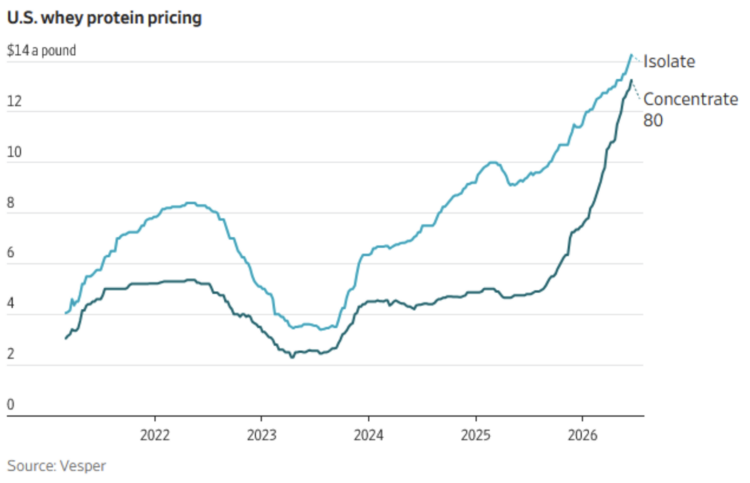
Here’s the supply chain punchline, and it’s the heart of the story. You cannot simply make more whey. Nobody runs a dairy operation to produce whey. They make cheese, and whey is the byproduct. So, whey supply is capped by cheese demand, not by protein demand. The supply chain physically cannot answer this demand signal the normal way, because the thing everyone suddenly wants is a leftover from making something else entirely.
The reformulation pain is real, and (sometimes) a little funny. One company swapped in a substitute protein and watched its pancake mix turn into, in the founder’s words, “complete sawdust.”
This is a perfect example of a demand signal slamming into a supply chain that’s structurally incapable of flexing to meet it. Here’s the lesson for the rest of us. Know which of your inputs are byproducts. A byproduct input cannot scale on your timeline because its production is entirely governed by another product’s demand. That’s the same family of risk as the “every operation has a helium” point from April and the Hormuz lessons from last week. A specific, mappable vulnerability, and far better understood before the shortage than during it.
4. Why So Many Americans Moved to the Middle of Nowhere
A fun Hustle piece this week on the exurban boom. Since 2020, Americans have been moving not just to the suburbs but to the exurbs, the subdivisions rising out of cornfields 40 and 50 miles from city centers. Fulshear, Texas, about 40 minutes west of Houston, grew nearly 300% from 2020 to 2025, from 16,300 people to 64,600. Celina, north of Dallas, was the fastest-growing city in the country last year.
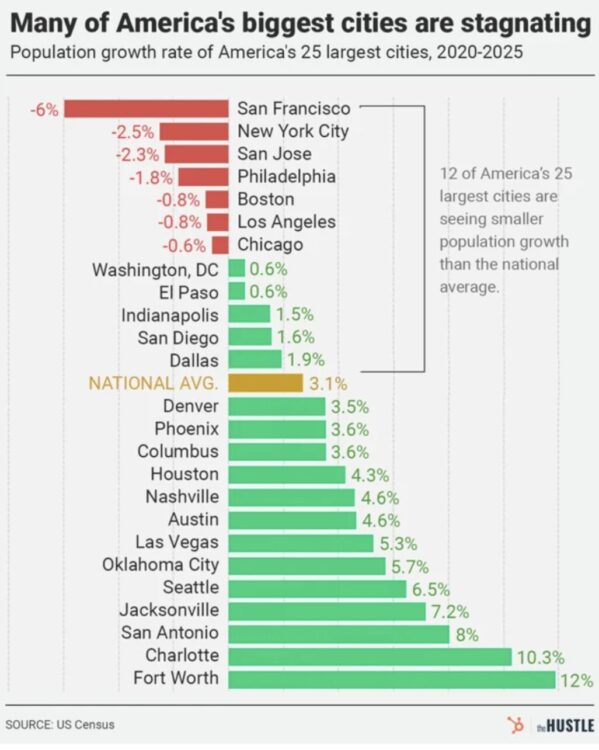
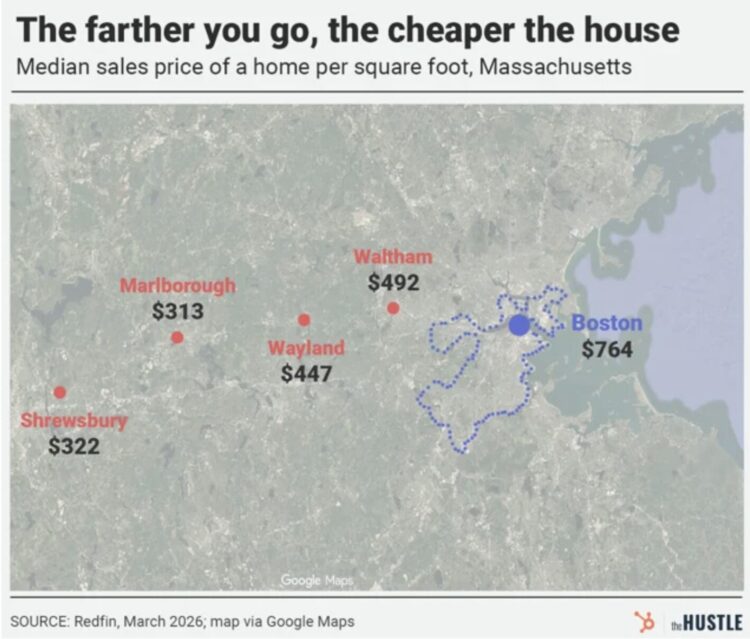
Two things are driving it. Affordability is the first. Boston’s median home price hit $849,600 this spring, pricing out even the upper middle class, so people drive until they qualify. Lifestyle is the second. Master-planned exurban communities come with pools, trails, and fitness centers, as well as bigger homes for the money. The pandemic and remote work lit the fuse, and it has not gone out. Developers just announced a $7 billion bet on an area 75 miles north of Dallas.
What It Does to the Last Mile
Every one of these population shifts redraws the last-mile delivery map. When tens of thousands of people move 50 miles past the existing distribution footprint, the e-commerce and grocery networks built around old metro density suddenly have to serve a population spread thinner and farther out. And here’s the catch. Those exurban buyers want the exact same Prime-speed, same-day convenience that pulled Duluth into Amazon’s orbit back in the first story. They’re just harder and more expensive to reach.
That tension is why micro-fulfillment, regional DC placement, and last-mile network design are some of the most active questions in logistics right now. Demographics are a slow-motion demand signal, and they’re one of the few you can see coming. The freight and fulfillment networks that win the next decade are being designed now, around where people are moving, not where they used to be. If your distribution footprint is still optimized for a 2019 population map, it’s already behind.
Four Stories. One Pattern.
Demand is redrawing the map, and in all four stories, the supply chain is playing catch-up. Amazon’s pull is reshaping who controls fulfillment (and maybe even logistics). A viral craze rewrote a packaging line in a week. Protein demand is draining an ingredient that physically cannot scale on command. And millions of people quietly relocating to the exurbs are redrawing the last mile one subdivision at a time.
You can’t always predict the demand signal. Nobody had “Europe discovers ranch” on the 2026 bingo card. But you can build an operation that’s quick to read one and quick to respond. When demand moves first, speed of response is the whole game.
What demand signal is redrawing the map in your corner of the business world?
Bonus #1: A Philosopher’s 5 Tips on How to Get Along
In our fast-paced, slightly chaotic world, we need prosocial, amiable, cooperative people. So, who better to turn to than an 18th-century Scottish philosopher? This Big Think piece lays out David Hume’s five tips for fitting in and getting along with others.
Hume pondered philosophically on cheerfulness, good manners, wit, and modesty. He thought agreeableness was a genuine virtue, not just social lubrication, and that being pleasant to be around was a moral good worth practicing. Which, three centuries later, still tracks. Thanks, Mr. Hume.
Bonus #2: Pushball!?
World Cup, this isn’t. Pushball was developed in the 1890s by a Massachusetts inventor who was dissatisfied with American football. The Public Domain Review collection has the black-and-white footage, and it is a must-see. There’s a six-foot, fifty-pound leather ball shoved around a field by scrums of players, including versions played on horseback. Gloriously absurd. Worth two minutes for the videos alone.
One Last Thing
My daughter, who just celebrated her birthday, asked for a record player as a present. I have hope yet for the younger generation. As a Generation Xer, I’m firmly in the camp of heaven bless physical media. And as the song goes, “Joni Mitchell never lies.”
There’s a small thread connecting that to the rest of this post, if you want one. Sometimes demand moves backward, toward the tangible, the analog, the thing you can hold. That’s worth noticing too.
You’re welcome.
Remember, it costs nothing to be kind.