By Alex Stark
Why Prime Day looked great and soft at once, what the early holiday import rush really signals, how Kimberly-Clark is rebuilding supply chain talent for AI, and why the freight market’s safety cushion is nearly gone.
Short week, as I feel we might be losing people’s attention heading into the nation’s big one this year. The country turns 250 years old on Saturday, and it is going to be (it’s already) roasting on the East Coast. Stay hydrated and keep reapplying, my friends. I’m especially looking forward to a public reading of the Declaration of Independence in my little corner of the supply chain. I’ve read the document plenty of times over the years. However, I’ve never stood among neighbors and heard it read aloud. That feels like the right way to mark this momentous birthday.
Before the long weekend, four things from this (short) week’s reading. The thread running through all of them… the headline number and the operating reality kept telling two different stories. Basically, like my grandmother used to say… There are two sides to the story, and then there’s the truth.
As always, would love to know what you’re seeing.
1. How Did Amazon Do on Prime Day? Depends.
Prime Day 2026 ran four days, from June 23 to 26. Two analytics firms looked at the same event and came away with nearly opposite stories, which is the whole point.
Adobe Saw a Record
- U.S. retailers drove $26.4 billion in online spend across the four days, up 9.3% year over year and above forecast.
- For scale, that tops the $14.2 billion U.S. consumers spent on Cyber Monday during the 2025 holiday season. Adobe’s framing: summer is starting to rival the winter holidays as a shopping season.
- Mobile hit an all-time high at 54.2% of online sales.
Numerator Saw a Retreat
- Average order size fell about 11%, from $53.34 to $47.66.
- Average household spend dropped 8%, from $156.37 to $143.45.
Both can be true, and that’s the lesson. More households placed more orders, which lifts the aggregate even as each individual basket shrinks. The top line looks like a record. The per-household line looks like a consumer quietly trimming. It’s the same nominal-versus-real split I mentioned in the retail sales piece from a couple of weeks back. The aggregate is healthy. The individual is stretched.
One forward-looking detail worth flagging: AI-driven traffic to retail sites jumped 89% year over year and converted at 40% higher rate than other channels. That’s a huge gain from 2025, when AI traffic converted at 23%. The absolute volume is still modest, but the direction is the story. AI is quietly becoming a real shopping channel.
When you plan demand, be sure to get all sides of the story. Provide warehouse labor and transportation for the aggregate, and you may overshoot what individual demand supports. Plan against baskets, not just totals.
2. Christmas in July: Retailers Are Rushing Holiday Imports Early
The WSJ reports that retailers are pulling holiday imports forward, front-loading goods into U.S. ports now to get ahead of looming tariff costs. On its face, that looks like confidence. It is closer to the opposite.
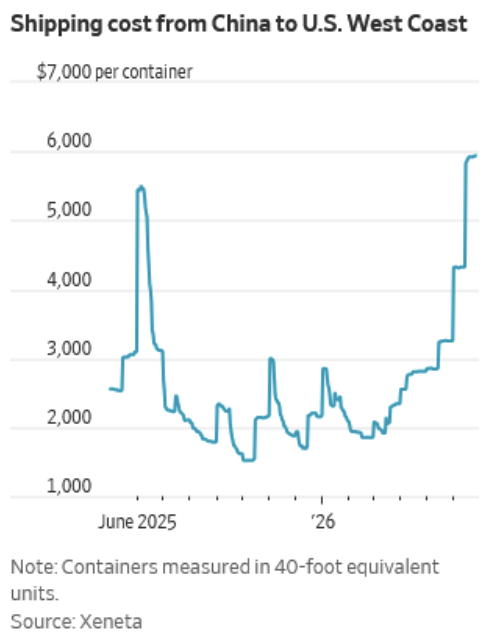
The mechanics are a replay of last year. Most of the tariff rounds have now taken effect, and importers are racing to land holiday inventory before further cost increases. We saw this in 2025, when Walmart and others moved Christmas shipments into June and July, and ocean rates spiked as everyone rushed through the door at once. The National Retail Federation (NRF) expects container imports to decline through the rest of the year, a predictable hangover after an early surge.
Of non-partisan note, the tariff picture itself has been volatile. Earlier this year, the U.S. Supreme Court ruled 6-3 that the International Emergency Economic Powers Act (IEEPA) does not authorize the President to unilaterally impose tariffs. The only real constant for importers has been uncertainty. With that, uncertainty is becoming a planning cost.
Front-loading is a rational hedge, but it is not free. It ties up working capital in inventory, raises carrying and warehousing costs, and concentrates port and trucking demand into a narrow window, which pushes freight rates up for everyone (more on that in the fourth story). The honest read is that this early surge is a fear-driven pull-forward, not a demand-driven one. The bill arrives later as a soft second half, and now with higher logistics costs. It’s the “stop waiting for normal” world in miniature. Companies are managing volatility, not chasing growth.
This is exactly the environment where flexible warehousing and dedicated capacity earn their keep. The shippers who can flex storage and lock in transportation ahead of the crush ride the surge rather than get run over by it. That’s the kind of work we do.
3. Citizens, Translators, and Wizards: Kimberly-Clark Rewrites the Talent Playbook
A Consumer Goods piece details how Kimberly-Clark (Huggies, Kleenex, Scott, Kotex) is rebuilding its supply chain talent model around three new archetypes for an AI-first operation. It’s one of the most concrete answers I’ve read to the question… What does the workforce look like when AI is woven into the operation?
The Three Roles
- Citizens. Frontline supply chain people, not formally trained in code or data science, are equipped with low-code and AI tools to solve their own problems without waiting on a central tech team.
- Translators. The bridge between the data scientists and the operators. The people who can sit with a plant manager understand the real problem and turn it into something the technical team can build. This role has been around for years under the name “analytics translator,” and it’s consistently the hardest to hire for, because it requires fluency in two languages at once.
- Wizards. The deep technical experts. The data scientists and AI engineers are building the agentic systems and models under the hood.
For months, I’ve written that durable gains in AI come from disciplined application, not from sprinkling AI on everything like we’re making muffins. This is what disciplined application looks like in an organizational chart. Kimberly-Clark isn’t just buying AI tools. It’s rebuilding human capability to use them well. K-C leadership is defining the role of education within its enterprise. The persona-prompting study, the piece on AI relocating bottlenecks rather than fixing them, and Pope Leo’s “technology is never neutral” framing all point right here.
The technology is the easy part. The people model is the hard part, and it’s the part that decides whether the investment pays off.”
There’s an honest tension worth calling out, and it connects to the workforce-mismatch piece I wrote back in May. Not every current employee fits neatly into the citizen, translator, or wizard role. Building this model means retraining some people, hiring others, and being upfront that some roles will change significantly. The companies that handle that thoughtfully will pull ahead. The ones who buy software and hope might only be making baked goods.
Perhaps a question worth asking about your own operation: Do we have our translators? Most companies have citizens (eager frontline people) and can hire wizards (technical talent is on the market). The translators, the ones fluent in both the work and the tech, are the scarce resource. And they’re usually grown in-house, not bought.
4. The Freight Market’s Quiet Squeeze: Costs Up, Volumes Down, Cushion Gone
The latest U.S. Bank Freight Payment Index (Rates Edition, produced with DAT) is the clearest data yet on the supply-driven freight reset I’ve been tracking since May. Rates are climbing fast while volumes fall, and that combination only happens when a market is reshaping around supply, not demand.
The Numbers
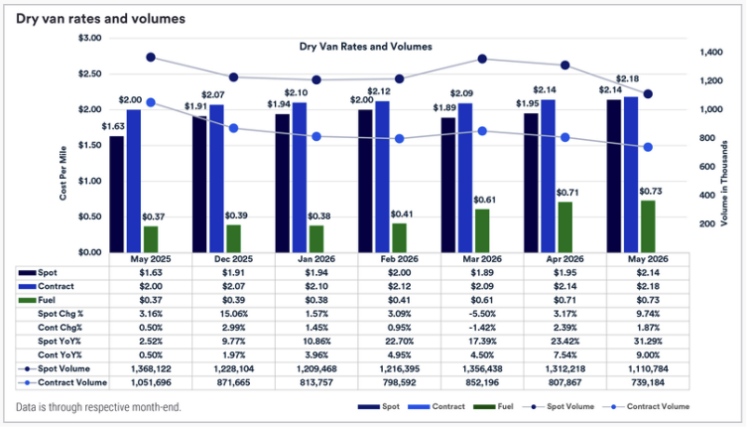
- Dry van spot rates hit $2.14 per mile in May 2026, up 31.3% year over year and 9.7% month over month.
- Contract rates reached $2.18 per mile, up 9% year over year.
- Volumes went the other way. Spot shipments fell from 1.31 million in April to 1.11 million in May.
ATA chief economist Bob Costello summed up the whole dynamic on the Q1 version of this index:
This is a market being reshaped by supply, not demand.”
Fewer trucks competing for freight, not more freight. Here’s the detail that matters most, and it’s a genuine operator lesson. The spread between contract and spot rates has compressed from about $0.39 per mile a year ago to roughly $0.11 per mile now. That cushion, the gap between what you pay on contract and what you’d pay on the spot market, is the shock absorber shippers have always used to manage cost exposure. It is nearly gone. When contract and spot converge, you have almost no room to flex when something unplanned happens.
It isn’t uniform across modes, which is worth noting. LTL carriers like Old Dominion and XPO are holding yield even as shipment counts soften, opting for pricing discipline over chasing volume. Old Dominion’s shipments per day fell 7.9% year over year, while revenue per hundredweight, excluding fuel, rose 4.4%. The structural mechanics of LTL pricing insulate those rates from spot swings. So, the squeeze isn’t identical everywhere, but the direction is the same. You’re paying more to move the same freight, or less of it.
The report’s advice is sound and worth passing along to others. Monitor spot-to-contract relationships closely, align routing guides with carriers’ behavior, and stress-test budgets against continued upward pressure on contract pricing. The era of using the spot market as a cheap release valve is ending. This is the same lesson as the “nobody’s waiting for normal” piece, now appearing directly on the freight invoice. Lock in strategic capacity because the cushion that used to absorb exceptions is mostly gone.
Two Stories and Somewhere in Between is the Truth
Each story this week had two readings. Prime Day was a record or a retreat, depending on whether you measured total sales or basket size. Holiday imports are surging, but out of fear rather than confidence. Kimberly-Clark’s AI story is really a people story. Freight costs are rising as volumes fall, and the shipper’s safety cushion is quietly disappearing.
The useful work, in business and maybe in citizenship too, is reading all the sides of the stories to get a fuller picture. Pay attention to the basket, not just the total. The reason for the surge, not just the surge. The people, not just the tools. The cushion, not just the rate.
Bonus #1: You’re Weirder Than You Think
A Seth Godin post led me to a cool site featuring a seven-question quiz that gauges how your particular combination of traits stacks up against that of randomly chosen Americans.
Interesting results, for me at least. My combo came back at 1 in 390, or 0.258% of U.S. adults. All I can say is that explains a lot. Try it and find out how many people share your POV. A fun, quick diversion, and a fitting one for a week spent reading underneath the averages.
Bonus #2: Literary Journeys, Mapped
It’s beach-reading season, and I stumbled on ReadingMaps, a fun site that plots journeys made in fiction onto a real global map, with a bunch of movies thrown in too. With Christopher Nolan’s new Odyssey film being released soon, it was informative to revisit Odysseus’ ten-year voyage. I cannot remember that far back to high school. Being a fan of Nolan, I need to do as much pre-work as possible.
One Last Thing: What Americans Ate in 1776
I’m a sucker for anything with history, so I could not pass up this little ditty on what Americans ate in 1776. Lots of cornmeal and corn-based products, salted meat, and cider, as you might expect, along with a few dishes that have thankfully not survived to the present day.
Maybe after hearing the Declaration being read, people celebrated with a syllabub (a frothy dessert of cream and alcohol). It ties the whole weekend together rather nicely.
You’re welcome.

Remember, it costs nothing to be kind.