Is the Bond Market Telling Us Something?
Many people take a purely analytical approach to the bond market. But there is also an emotional, predictive component worth considering. Bond traders have a tremendous amount of market intelligence and resources to track geopolitical developments. Bond traders almost behave like a global geopolitical temperature gauge.
Do bond traders think a breakthrough in the Middle East is close at hand?
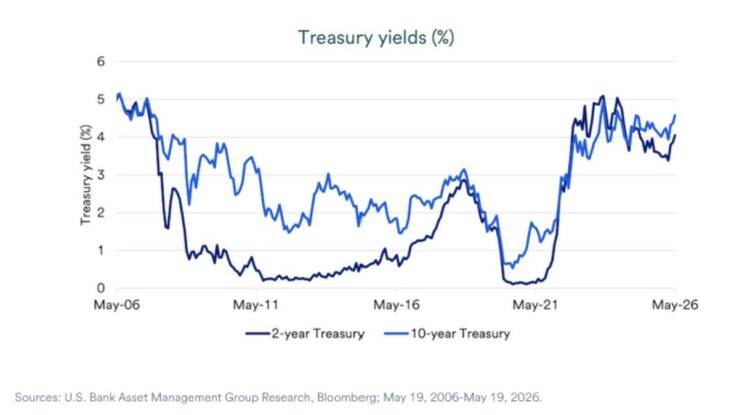
The U.S. 10-year Treasury note serves as a leading indicator for other market signals (such as the S&P 500 and VIX) because it tends to be more conservative and less prone to daily or hourly swings in sentiment. Bond traders are making long-term investments and need to be certain that they are reading the tea leaves correctly.
The movement down in yield rates (from 4.66% on 5/18 to 4.47% currently) may suggest that traders believe the situation is improving. Worth noting… before the war in Iran began, bond rates had pierced the 4% threshold, and refi activity and new mortgage originations surged.
Increasing Energy Costs Will Impact Everyone
The cost of energy has soared to levels not seen in years, and by most accounts, this is just the start.
This situation has been warned about for many years. It is the inevitable collision between limited power availability and rising demand. Fossil fuels face increased opposition; nuclear power remains suspect, and the much-touted alternatives are nowhere near ready to shoulder the burden. At the same time, demand is through the roof, driven by data center expansion, increased robotics, and the move toward EVs.
It has been estimated that the US alone will need an additional 44 Terawatts (TW) of power by the end of the decade. One terawatt of continuous power can supply roughly 750 million homes. For context, total global power consumption is between 18-20 TW.
Then there is the usage expected in regions that are just starting down that road. Air conditioning in emerging markets alone will require 20 times the power currently used globally. The bottom line is that energy costs will skyrocket for years and be the primary driver of higher inflation. Looking at the increase in inflation over just the last month, energy is behind the jump from 2.5% to 3.5% at the consumer level.
Read more on how energy, policies, and other global items are affecting the supply chain.