Better Shift to Active Supply Chain Monitoring
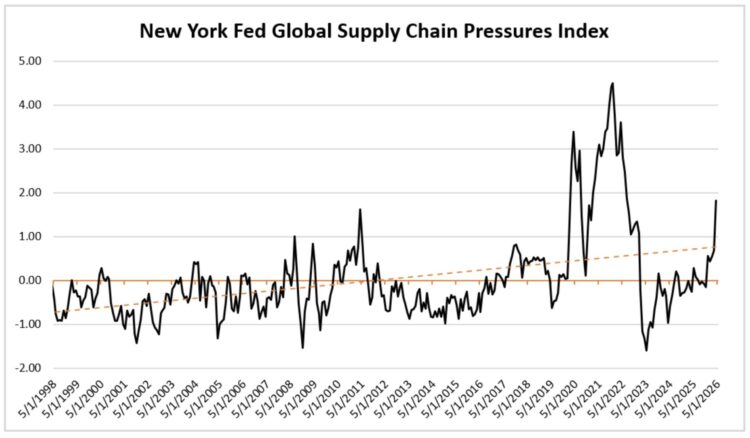
If your leadership teams are not having weekly meetings and updates on the global supply chain (including suppliers and shipping firms), you might want to reconsider. The New York Fed’s Global Supply Chain Pressures index has surged at its fastest rate since April of 2022 (Russia’s invasion of Ukraine).
The chart below shows the current index. It is now at one of its highest levels in history, except for the 2020 lockdown and the 2021/2022 global supply chain crisis. Remember that, at the time, the world’s busiest port was shut down for nearly a month in 2021, creating shortages of everything from toilet paper to certain food items
 .
.
Upstream visibility is key to supply chain continuity, and that’s where conditions are breaking down.
As a prime example, Mexican manufacturers were already warning in April that some of their output reductions were due to shortages of inbound inputs. They couldn’t keep their supply chain running and replenish it with materials to keep their assembly lines operating, and some were starting to shut down. It’s situations like this that are the flashing red warning lights.
Trucking Capacity Tightening Quickly
Last week, the U.S. Supreme Court ruled that freight brokers could be held liable for carrier accidents (ones they broker). This is leading 3PLs and other brokers to conduct additional screening within their contract carrier pools and to eliminate carriers that may pose a safety risk.
This is a good thing in the long run, but it will drive prices even higher in the near term at a time when diesel prices are just 18 cents from all-time highs.
A combination of events has dramatically tightened trucking capacity around the nation. As demand increases, these tight conditions will quickly show up.
Be ready for 5-15% price increases on base transportation prices over the summer (excluding fuel). Fuel prices could be much, much higher given current conditions. And of course, this cost increase will translate into broader inflationary readings (both producer and consumer prices) and ultimately continue to put the Fed in a tough spot in its interest rate approach.
Read more on how transportation and other global items will affect the supply chain.