By Alex Stark
I don’t want to sound too excited, but I’m starting to think spring is just over the next hill. It’s still quite cold here in the Northeast, seasonally speaking. Looking out my office window, it’s the usual mix of overcast skies and temperatures around 34-40 degrees. So, not ideal. However, like our western PA rodent prognosticator, those warmer temperatures are out there. We all deserve it after coming out of the coldest start of the year since 2014.
AI and discussions about AI in your operations dominated the conversation at Manifest 2026. I have to admit, reading some of the takes on AI’s potential disruption this past weekend felt pretty jarring. It left me in a strange place. Thankfully, I also came across many AI articles that gave me hope for the industry’s future.
I especially appreciated an article in Supply Chain Management Review on the “AI efficiency trap.” I believe the authors accurately described a balanced approach to unlocking AI’s value. Companies should not see AI solely as a way to cut costs or automate tasks that reduce labor. Alone, that doesn’t give a competitive edge. It’s simply a race to the bottom. Instead, companies should also integrate AI into their decision-making processes. These two strategies are actually complementary, not opposing.
“The primary reason differentiation is undervalued is structural: Cost benefits are immediate and easy to measure (e.g., minutes saved), whereas differentiation benefits are gradual and qualitative (e.g., decision quality). Leaders gravitate toward what is easy to quantify, which tilts investment heavily toward the cost side and leaves the differentiation side underdeveloped…Efficiency frees time; differentiation determines how well that time is used.”
As long as there are people, people will need things. That speaks directly to logistics and the supply chain. We’re in the business of moving stuff.
Speaking of moving goods, is that a transportation rebound I hear approaching? After a monthly freight webinar hosted by FreightWaves, they seemed genuinely convinced by the numbers that the market might finally be emerging from the darkness.
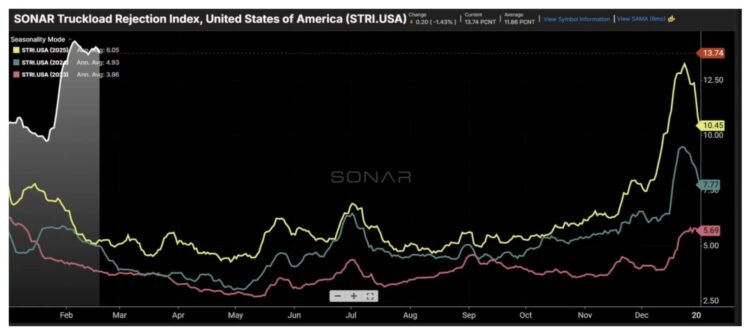
They summarized the current optimism by pointing out truckload rejection rates. A high rejection rate, which is the percentage of tendered loads that carriers decline to haul under existing contract rates, indicates several things about the U.S. freight market.
Tight capacity signals that the truck supply is struggling to meet freight demand. Carriers are rejecting contract freight because they can find higher-paying loads on the spot market.
When rejection rates rise, shippers who can’t secure their contracted carriers to accept loads are pushed into the spot market, which drives up prices. Spot rates generally move in tandem with rejection rates.
Carrier leverage then shifts, marking a transition from a “shipper’s market” (where capacity is plentiful and rates are low) to a “carrier’s market.” Carriers gain negotiating power, and contract rates tend to increase in the next bidding cycle.
Sustained high rejection rates often indicate strong underlying economic activity. However, they can also be caused by supply-side disruptions, such as weather, regulations, or driver shortages, rather than demand alone. There has been weather these past few weeks, but it hasn’t been significantly different from previous years.
Readings above roughly 10–12% generally indicate a tightening market, while spikes above 20%+ signal significant strain.
Beyond these readings, the data that provided the most bullish comments came from this chart.
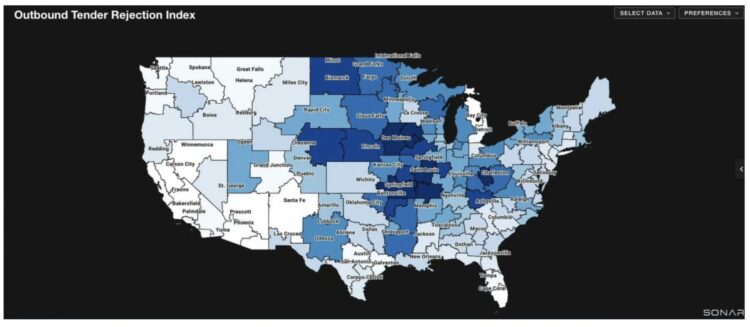
It shows where in the country the highest rejection rates have occurred. The darker colors indicate higher rates. These are mainly in the central part of the nation, where industries like automotive and energy originate. It’s not the ports on either coast. Reports indicate that the rejection rate in Iowa is close to 40%.
The output shown on this map reflects the latest ISM (Institute for Supply Management) report. In January, the reading indicated expansion (above 50%) for the first time in a year. The next report is set for March 2nd. Maybe the trend will keep going. This is generally a healthy sign for the U.S. economy.
I want to stay hopeful, but watching the markets every day doesn’t boost confidence. They swing wildly each day. Still, the S&P 500 is only 2% below its high.
In an article published by the WSJ, they stated that a helpful way to measure volatility is to examine different sectors.
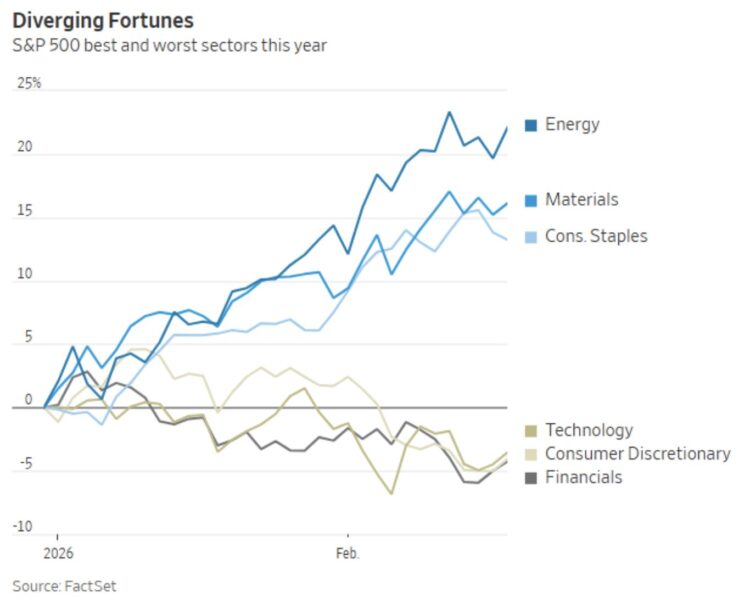
“The gap between the three best-performing sectors over six weeks and the three worst has rarely been bigger, and usually during some sort of panic…The last time the sectors diverged so much was just before Silicon Valley Bank’s collapse prompted a global banking panic and federal rescues. Before that was the rebound from the first lockdown low. And before that was during the global financial crisis of 2008-09.”
The general consensus appears to be one of three approaches to handling this market: ignore it, trade it, or panic.
So yeah. No warm and fuzzy feelings.
One final take on AI. And it’s not about how it’s being used in business. I thought this was extremely important and might be overlooked. MIT Professor and all-around supply chain guru Yossi Sheffi published a piece about the power (down)side of this data exchange.
One of the many reasons the U.S., and even the global supply chain industry, can perform at such an incredible level is access to reliable energy sources. Data centers could be a potential threat to that access.
“Data centers require gigawatts of electricity to power computing, servers, network- and data-storage equipment, and cooling systems. The U.S. Dept. of Energy forecasts that by 2030, data centers’ energy consumption could account for up to 12% of all U.S. electricity use. It’s not a stretch to say that data centers could soon be in competition with industrial facilities for energy resources.”
All of us (shippers, vendors, providers) should add this to our list, which covers everything from geopolitical impacts to trade/tariffs to labor.
As you may have noticed from my weather refrains, I’m starting to turn my attention to longer days (I see you, Daylight Saving Time) and warmer temps. One skill that comes in handy when living in the northeast U.S. is having patience. Another is utilizing the reset button for a mood boost.
Sometimes, it all becomes a bit much. It’s normal to fall into a routine.
Here’s a helpful list of ways to boost your outlook in just 15 minutes each. My favorite is putting away all screens. As a father of three, it’s healthy to show my kids how to disconnect. We all know there’s more to life than that blue screen.
Go analog.
Have a conversation.
Read a book. Make a cup of tea and stare out the window.
And remember, it costs nothing to be kind… to others and to yourself.