By Alex Stark
It’s been an interesting January thus far. With storms, ice, and freezing temperatures (hello, -3 this morning), coupled with market uncertainty, it’s challenging to feel bullish for the balance of 2026.
The news this week has been dominated by a significant wave of layoffs. In January, reports indicated that nearly 600,000 jobs were lost in the U.S., including 30,000 at UPS, 16,000 at Amazon, and 4,500 at Dow, among others, adding fresh anxiety to the economy. The layoffs are driven by corporate restructuring, AI’s impact, and a response to missed revenue targets.
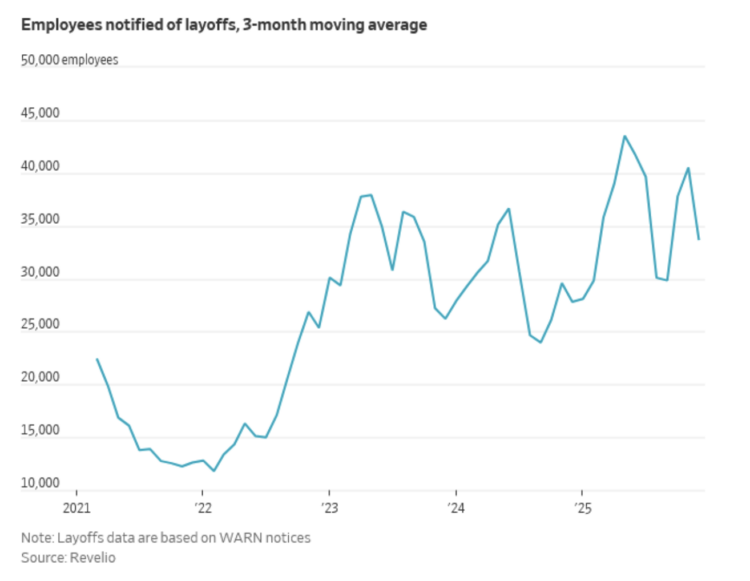
According to the WSJ article, “The layoff story is centered on bloat. The sectors that recorded some of the top hiring surges in 2020 and 2021—tech and logistics—are now seeing the most layoffs…The tech sector led all private-sector industries with 154,445 job cuts, followed by warehousing with 95,317.”
How this will affect spending, productivity, and unemployment numbers in 2026 will be something worth watching closely.
Uncertainty translates into choppy waters in the logistics and supply chain space. In a Supply Chain Dive piece, the writer documented trends that logistics leaders should monitor to navigate the seas toward positive outcomes.
- Cost pressure associated with transportation, especially the last mile, will continue to increase. Increases of 5-6% in rates and surcharges from companies like UPS and FedEx will force shippers to make strategic choices.
- Overcapacity in ocean shipping should carry over into 2026. This provides rate relief, which is good news. However, companies need to stay attuned to their metrics to mitigate any delays or costs. Any disruption to the current port and trucking environment will derail best-laid plans.
- If air transportation is a mode of product flow, industry reports state that this segment is now relatively stable. Flexibility, transparency, and delivery costs can be effectively managed using AI-powered systems and analytics, which, in turn, should remove risk while increasing the bottom line.
- In the rail industry, all eyes are on the potential Union Pacific-Norfolk Southern merger and how this mammoth deal will impact customers, transit time, service, and labor. This is a situation where long-term planning is essential in planning network optimization.
- Key market trends and regulatory shifts in trucking will impact shippers, carriers, 3PLs, and logistics partners. Items include innovation, the growing role of AI, cargo theft, M&A activity, and the impact of new federal rules limiting non-domiciled CDLs. The industry is desperately seeking a rebound that hasn’t arrived since the boom that followed the end of the global pandemic.
The orchestration of all those inputs is powerful. In a 2025 survey, the Indago supply chain research posed the following question to its audience of logistics leaders from manufacturing, retail, and distribution:
How effectively does your supply chain organization turn data and information into timely, informed decisions and actions?
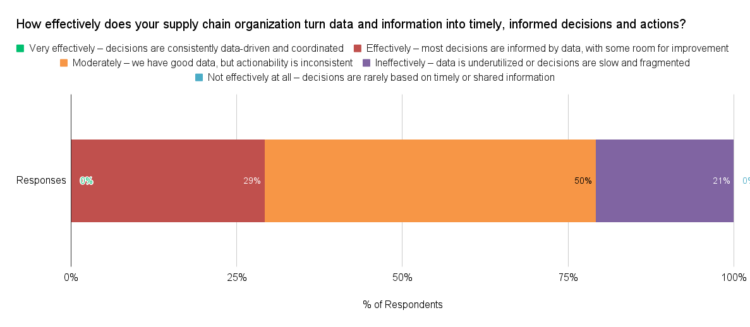
Those are telling results. Getting data is not the issue. The challenge arises from data that is not trusted or not easily used to generate actionable insights.
One issue that should not be debated is the health care gaps that affect babies. This was a heartening article after reading several dour ones this week. Huggies, the diaper brand owned by Kimberly-Clark Corporation, is working with the National Diaper Bank Network (NDBN) to improve diaper access for families in the U.S. and Puerto Rico. In the article, it states this alarming figure:
According to the NDBN, diaper insecurity affects nearly one in two US families with young children.
Kimberly-Clark stated that it would donate 15 million diapers now and another 65 million over the next three years.
Addressing diaper insecurity through diaper banks saves $2 in healthcare costs for every $1 spent on diapers. Improving access to essential hygiene products reduces healthcare expenses, potential income loss, and emotional strain on parents.
Bonus: I know I certainly skew old (and my children roll their eyes) when I wax longingly for the ‘old days’ when we were forced to think of things rather than look them up instantly on our phones. Having visited London, I was only superficially aware of the tremendous skill cab drivers need to operate in the city’s complicated road network. This article hammers it home. ‘The Knowledge’ is a requirement and takes usually takes three to four years to master. This is the reason their taxi service is considered the finest in the world.
Plus, if you’re seeking a quick diversion that will stimulate your mental synapses, check out this game. Crack the safe by aligning the dials. The goal is to spell five 5-letter words by rotating the concentric rings. When all 5 columns spell valid words, the safe opens and you win.
Cold, snow, and ice remain across most of the U.S. Stay warm and stay safe.
And remember, it costs nothing to be kind.