Thoughts on the Fed Outlook
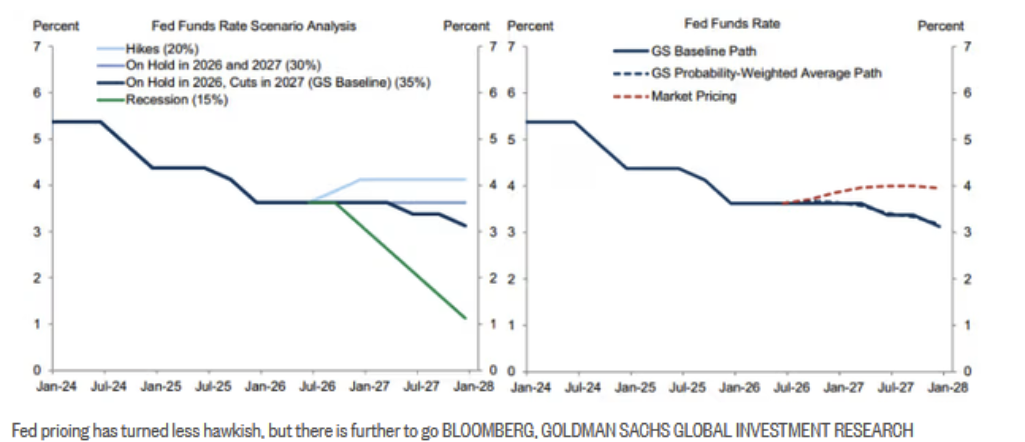
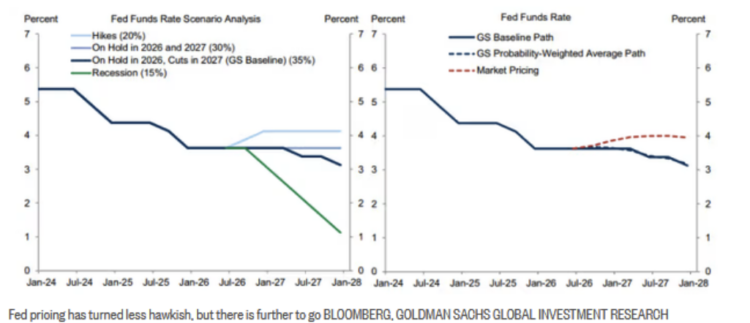
Goldman Sachs is projecting (in their base case) three Fed rate hikes between now and March of next year, followed by a gradual series of estimated cuts starting in December 2027 through Q3 of 2028.
This assumes that the Fed can control conditions and engineer a “second soft landing”, which is very rare.
The green line, incidentally, reflects (partly) the overtightening risk that comes with rate hikes in an environment like this. Goldman Sachs believes this is partly due to the Fed trying to “build headroom” to trim rates if needed on an emergency basis. For bonds, this is problematic because it makes managing the Federal deficit that much more expensive. Simply put, inflation risk is outweighing sovereign debt risk.
Managing the Unspoken
If we accept the “K”-shaped recovery, or the economic data showing that 78 million households typically live check-to-check, many have maxed out their credit cards and have little room to recover in the event of inflation or an emergency. We all know that; it is the narrative that’s been around for years. But the duration matters here. They can absorb high inflation for a period of time, but if it is durable, we start to lose them over time.
In the data, we saw inflation-adjusted household income fall by 1% Y/Y, driven almost entirely by upper-middle- and upper-income households. Lower-middle- and lower-income households are likely underwater under the weight of inflation, if we accept the Sticky Core CPI earlier of 3.5% or more and general wage growth of 2.5-3.0%. That’s the problem.
If we lose those 78 million households and they start defaulting on credit cards, auto loans, and even some mortgage payments, that could trigger a credit crisis that is difficult to unwind.
Read more about how this, along with financial developments and other global issues, could affect your supply chain.