By Alex Stark
Trust Has a Price: Higher-for-Longer Yields, Walmart’s $120 Shot at Prime, the Staples Gift Card Heist, and the Six Forces of Failure.
Recently, we hosted a school field trip at one of our distribution centers. About 20 students from the St. Joseph’s Catholic Homeschool Co-operative, along with some of the parents who teach them, toured the site. The co-op follows an educational model where parents share their skills and expertise while teaching a range of subjects. That day, the subject was supply chain management, under the occupational education banner.
The team created a supply chain scavenger hunt and passport-stamp book that led students through the operation to find the specific items that keep product moving smoothly and safely.
I would have loved to visit a warehouse as a kid. I still get a thrill whenever I visit an operation or manufacturing site I haven’t seen. AI can do some incredible things; however, I’m a staunch believer that genuine human curiosity and acumen will never get outsourced. Until someone can 3D-print or conjure a box of cereal, a bag of pet food, or a brand-new microwave oven at home, supply chains will still be needed.
Those parents trusted our team with their kids for a morning. That’s no small thing to hand a warehouse crew. Trust kept coming up in this week’s reading, and in every story, somebody is putting a price on it.
Four things this week. The common thread is what lenders charge for trust, what Walmart will spend to win it, what Staples paid for assuming it, and how companies end up in a museum after losing it.
Let me know what you’re seeing.
1. Economists Stopped Calling Higher Yields a Blip
The Wall Street Journal surveyed 71 economists from October 2 to 7, and the headline is the bond market. On average, they now expect the 10-year Treasury yield to end 2026 at 5.1%. In July, that forecast was 4.4%. They see it at 4.96% by mid-2027 and 4.78% by the end of next year, up from July projections of 4.3% and 4.26%.
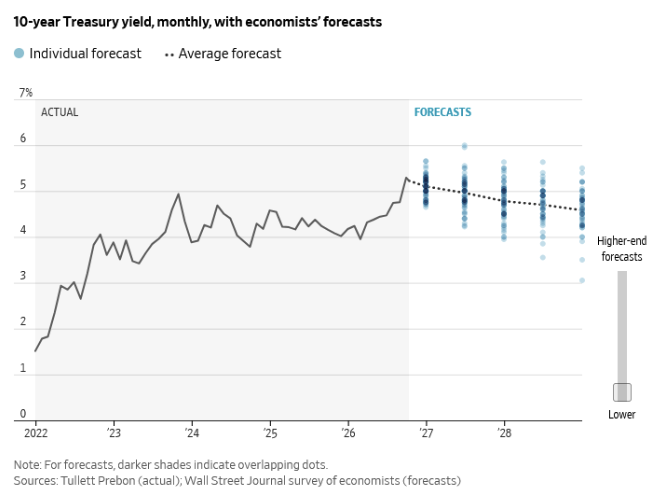
The rest of the survey is better news than you might expect. The average 2026 growth forecast rose to 2.4% from 2.1% in July. Recession odds for the next 12 months sit at 24%. Economists see CPI at 3.5% in December, easing to about 2.3% by late 2027, with unemployment near 4.2%.
The Price of Trusting the Long Run
The WSJ points to three forces pushing forecasts for sustained higher yields. They are a combination of improving growth, inflationary pressures, and concerns about the U.S. fiscal trajectory. One reason for higher bond yields is oil.
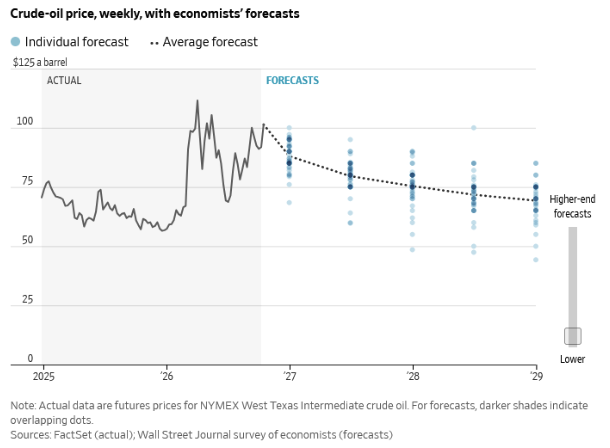
On fiscal concerns, lending for ten years means taking on risks you don’t carry when you lend for three months. Inflation could run hotter or stagnate. Deficits could keep growing. The government might need to borrow far more than planned. Lenders ask for extra yield to carry that uncertainty, and economists call it the term premium. Think of it as the price of trusting the long run. When confidence in the long-term path slips, that price rises, regardless of what the Fed does with short-term rates.
Not everyone sees the same path. Allen Sinai of Decision Economics believes the Fed is behind on inflation and expects the 10-year to approach 6% in 2027. Carl Tannenbaum of Northern Trust projects about 5.2% through 2028. Rajeev Dhawan of Georgia State sees a softer labor market than the headlines suggest, with job gains averaging 66,000 a month over the past six months. He expects the Fed to resume cuts once that weakness is clearer.
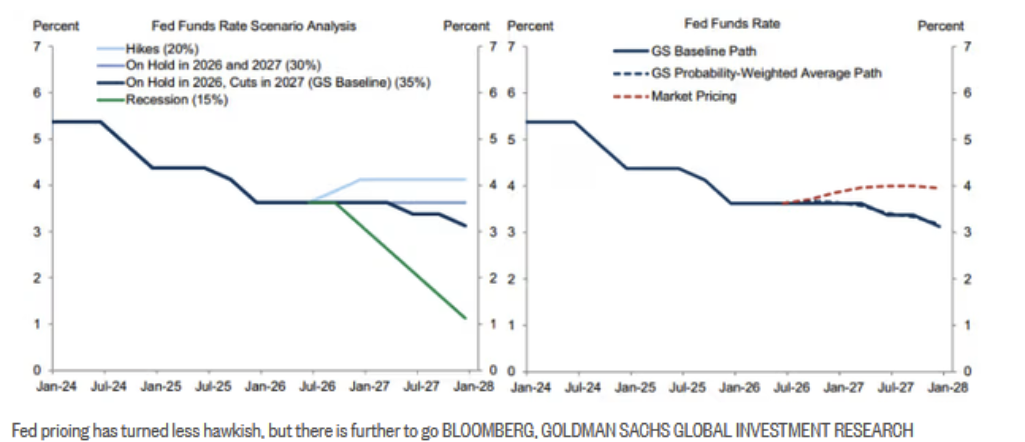
I’ve been on this thread since August. On August 21st, I wrote that the national debt passed $40 trillion and that the long end of the curve responds to supply. On September 4th, the 10-year was near 4.7% after a bond selloff. On September 18th, the Fed raised rates for the first time since 2023. Forecasters no longer treat the climb as a blip. The Fed meets again on October 27 and 28.
If your 2027 plan includes refinancing a facility, financing equipment, or waiting for borrowing costs to ease before a big project, run the numbers with a 10-year rate around 5%. The survey’s own average doesn’t dip below 4.8% until the end of next year.
2. Walmart Put a $120 Price Tag on Loyalty
On Tuesday, Walmart launched a combined Walmart+ and Sam’s Club Plus membership for $120 a year, and Retail Dive calls it the company’s latest challenge to Amazon Prime. Bought separately, Walmart+ costs $98, and Sam’s Club Plus costs $120, so the bundle saves $98. Walmart rounds that to about $100. Here’s what the $120 covers:
- Free delivery from both retailers, with order minimums of $35 at Walmart and $50 at Sam’s Club
- Members-only pricing at Sam’s Club, plus 2% back in Sam’s Cash
- A subscription to Peacock or Paramount+ streaming service
- 10 cents a gallon off gas at more than 17,000 stations
Brett Rose, CEO of wholesale distributor United National Consumer Suppliers, called it “a direct shot at Prime.” His math: “$120 vs. [Amazon Prime’s] $139, and you get a warehouse club, delivery, streaming, and gas thrown in.” Walmart CEO John Furner says the company is “raising expectations for what a membership can deliver.”
The Gas Math
The fuel perk alone is worth running the numbers. Gas still sits well above $4 a gallon in most of the country. AAA’s national average is $4.27 (as of 10/22/2026). If your household buys 15 gallons a week, 10 cents off saves roughly $78 a year. That alone covers most of Walmart+’s cost.
Price Gets the Trial. Habit Keeps the Member.
Rose also made the other side of the argument. He points out that Amazon “literally patented one-click buying,” and that shoppers use the two retailers for different things. His conclusion:
A cheaper bundle doesn’t break that overnight and doesn’t create an imminent threat for Q4 holiday shopping.”
Prime launched in 2005. That’s more than twenty years of one-click habits. Walmart is using price to earn a trial, and gas, streaming, and delivery to give members a reason to come back every week. Rose’s read on the timing: “Consumers are stretched heading into the holidays.” With September CPI at 3.7%, that tracks.
On the supply chain side, I’d keep an eye on delivery. Every member who signs up expects free delivery, and Walmart serves them from 4,615 stores and more than 600 Sam’s Clubs as it heads into peak. Two weeks ago, Walmart’s head of U.S. supply chain operations described the network as being in “peak complexity.” A membership push in late October adds volume to that complexity right when the buildings are busiest.
The lesson carries over to all aspects of business, large or small. A lower price can get you a trial. What keeps the customer is the experience after the sale, every week, without surprises.
3. The Staples Hack Didn’t Need a Password
404 Media reported this week that a Chinese organized crime group hacked Staples and used the access to issue more than 15,000 gift cards worth over $5 million. The details come from a recently unsealed search warrant application. The document doesn’t name Staples. 404 Media identified the company through its Massachusetts headquarters, its gift card fulfillment partner, and the system’s name. Staples hasn’t responded to requests for comment.
How It Worked
Staples ran an internal customer support tool called Nexus, which it believed could be accessed only from its own computers. The attackers accessed it from outside. They then requested heap dumps, which are snapshots of everything an application holds in memory at a given moment. That memory can include the session details of people who are already logged in.
That was enough. The attackers took over sessions belonging to customer service reps who were already signed in and, from within those sessions, issued gift cards to email addresses they controlled. Nobody’s password was stolen because none was needed. Aviv Nahum, CEO and co-founder of Above Security, put it this way to Inc.:
Once the login has occurred, trust is implied.”
Where the Money Went
The headline says millions, and that’s the value of the cards issued. The spending documented in court records, so far, is smaller, about 4,630 cards worth roughly $425,000:
- Target. About 3,850 cards worth about $141,000, in roughly 300 transactions across 85 stores in 18 states over two days. At one New Hampshire store, 35 cards went through in an hour on Apple, Bose, and Powerbeats products.
- Lowe’s. About 450 cards totaling $226,000, online and at more than 22 locations.
- Sephora. About 330 cards worth $58,600, in about 1,500 online transactions.
The retail theft ring stored much of the merchandise in warehouses before shipping it to China. The wider network allegedly acquired more than $100 million in gift cards through multiple schemes. In April, the Justice Department announced prison sentences for three Chinese nationals connected to the operation. Homeland Security investigations learned about the Staples breach in October 2023. It took three years for the breach to become public.
Freight Has Its Own Version
Back on April 17th, I wrote that a partner’s cybersecurity belongs on the scorecard right next to on-time delivery and pricing. This story reminds you to look inside your own walls, too. Freight has a familiar version: the fictitious pickup, where a thief shows up with paperwork that looks right and a truck that looks legitimate, and the load leaves because everything appears in order. Same pattern. The check happened once, at the door, and everything after it was trusted.
Nahum’s broader point is certainly useful. Any business where frontline staff can issue refunds, credits, or gift cards via an internal tool “has similar exposure.” In logistics, add releasing orders, changing a delivery address, and approving a carrier. Make a list of every internal tool that can create value or move product, and ask what each assumes about the person on the other end.
4. The Museum of Things That Didn’t Work
Sean Jacobsohn is a partner at Norwest Venture Partners. He’s also the founder and “chief historian” of the Failure Museum, a collection of more than 500 artifacts from companies, products, and ideas that didn’t make it. New Coke. Blockbuster membership cards. The Allan doll (Ken’s buddy – hilariously portrayed by Michael Cera in Barbie). Jacobsohn tags each company in the collection with at least one of his six forces of failure, remembered by the shorthand F2C2T2:
- Fit. Building a nice-to-have, mispricing, or expanding beyond the core market too early.
- Financial. High burn, poor unit economics, an inflated valuation, or dependence on one revenue stream or customer.
- Customer Success. Ignoring feedback, shipping quality problems, or picking early customers who don’t represent the market.
- Competition. Attacking entrenched players, or entering a crowded market without a real difference.
- Timing. Regulatory, tax, tariff, or supply-chain changes; economic shocks; or launching before the infrastructure exists.
- Team. Weak boards, poor sales execution, founder disputes, thin domain expertise, and fraud.
The “Timing” section is eerily similar to this year’s headlines. And the “Financial” one includes dependence on one customer. A great example is the risk UPS spent 18 months working down when it cut roughly half its Amazon volume.
The Champagne Nobody Opened
Jacobsohn told Axios in 2024 that his favorite artifact is an unopened bottle of champagne from Webvan’s IPO. If you work in supply chain, Webvan is a familiar ghost. The online grocer went public in 1999 and signed a $1 billion contract to build automated warehouses. It shut down and filed for bankruptcy in 2001, less than two years after the IPO, and about 2,000 people lost their jobs. In a former life, our organization procured brand-new storage media for pennies on the dollar.
Webvan hits at least two of the six forces. Timing, because it built for online grocery demand that took about two decades to arrive. Financial, because it spent ahead of that demand. Today, fast grocery delivery is everywhere, and Walmart and Amazon are building the automated warehouses Webvan imagined. Walmart is a decade and several billion dollars into its version, and it calls this stage “peak complexity.” Webvan ran out of runway before it could find out.
Holman was founded in 1864, long enough to encounter each of these forces. Of the six, customer success is the one you control most directly. The Failure Museum notes that it’s seven times easier to sell a new product to an existing customer than to win a new one. Whatever the multiple, keeping customers starts with listening.
Trust Has a Price
Bond investors are demanding higher yields for longer-term debt, and economists now expect the 10-year to remain near 5% well into 2027. Walmart is offering $98 in savings to compete with two decades of Prime habits. Staples assumed only internal users could access it and that every logged-in session belonged to an employee. The Failure Museum is full of companies that lost the trust of their customers, lenders, or the market.
Trust is the default setting in most systems. It has to be, or nothing would move. The kids on that field trip spent the morning hunting for what keeps products moving safely, and most of it is things the rest of us walk past every day. Every so often, it’s worth walking through the building like a kid with a passport book.
Bonus #1: Wildlife Overpasses
Where we live in Northeastern PA, deer (almost) overrun everything. They are everywhere. When I drive through our neighborhood, packs of them graze lazily in people’s front yards. It’s a bit like driving through a nature preserve. Relatives from LA recently visited, and they were enthralled by how much wildlife there is.
The biggest concern they voiced was whether the deer pose a danger to driving. In a word… yes. I like to believe we have an understanding. They don’t run out in front of me, and we let them live in peace. Eating our flowers and bushes. The good thing is that they do, unintentionally, act as a speed deterrent.
Certainly, animals on the highway pose an even greater threat. That’s why I love this story about creating wildlife overpasses. Do they work? In a word… yes.
Colorado completed the Greenland Wildlife Overpass on I-25 south of Denver, between Castle Rock and Monument, last December. It’s 200 feet wide and 209 feet long, spans six lanes, and cost $15 million. It filled a 3.7-mile gap in the fencing system and five underpasses. A 2022 to 2024 study, conducted before the overpass opened, found that the fencing and underpasses reduced wildlife collisions by an average of 85% per year and by 91% in the final year. In the ten months since the overpass opened, officials say two wildlife collisions have been reported, and pronghorn are crossing to the west side of I-25 for the first time in decades. Chuck Attardo of the Colorado Department of Transportation: “They pay for themselves in about 15 years because of all those accidents that they prevent.”
Closer to home, State Farm estimates about 141,000 animal-collision insurance claims in Pennsylvania between July 2025 and June 2026, the most of any state. Deer are by far the most commonly struck animal, and they’re most active in fall. Our (very loose) deer agreement apparently doesn’t extend beyond my neighborhood streets.
Bonus #2: Find a New Hobby
As the days get shorter, are you looking for something to do in your spare time? And not in front of screens. Well, maybe explore a new hobby. Here’s a quick, free website that asks what you’re interested in and provides some ideas. No account needed. It draws from more than 250 hobbies, gives you a top match with the reasons it fits, and describes what your first hour would look like.
Bonus #3: Same Five
Now this is a challenge. Five questions. 20 seconds each. One score… that compares you to everyone else who took the same five daily questions.
A tip: each correct answer is worth 2,000 points, and speed only breaks ties, so take the full 20 seconds if you need it. A new set drops at 8 p.m. Eastern, or 7 p.m. once the clocks fall back on November 1.
You’re welcome.
One Last Thing… The Witch Paddle
With Halloween drawing near, I truly enjoyed reading this piece from Outside. What started as a birthday outing in 2013 in California has now blossomed into a nationwide costumed flotilla movement.
It began with Annette Ausseresses and her friends in Morro Bay, all of whom had Halloween-adjacent birthdays. They celebrated in witch costumes, first on a hike and then, in 2013, on the water. The AP picked up a local news story, and the idea spread to Portland (of course), Colorado, Georgia, Florida, and beyond. This year’s Morro Bay paddle is scheduled for 10/24, with about 500 witches expected. The closest one to my little corner is the SUP Witchfest on the Hudson in Sleepy Hollow, NY. People come in from PA, New Jersey, and even Ohio. Leave it to Sleepy Hollow, home of the Headless Horseman. This year’s was held on October 10, so pencil it in for next fall if you’re in the area.
Ginny Kauffman, who brought the paddle to Portland’s Willamette River in 2017, summed it up: “People just want to be silly.”
There is definitely something to be said about spending time outdoors, being with friends, and maybe even being a little silly.
Remember, it costs nothing to be kind.