By Alex Stark
You Can’t Automate a Mess: The Fed’s First Hike Since 2023, a Trillion-Dollar Holiday That’s Half Inflation, Capacity Tightening Again, and a Million Robots
Earlier this week, our organization participated in the 2026 supply chain roundtable at Miami University’s Farmer School of Business. The annual event, now in its sixth year, is hosted by the Center for Supply Chain Excellence. Corporate partners gathered to meet and network with students focused on supply chain and operations management.
Jenny Darroch, Ph.D., Dean of the Farmer School of Business, delivered the opening remarks. I especially appreciated that she described their mission to break down the wall between business and education through events like this. Dr. Darroch also captured our industry perfectly when she said:
We are the bridge that makes everything run efficiently.”
A bridge is foundation work, and that became the theme of everything else I read this week. Four things, and they all come back to the same idea. You cannot build speed on top of a broken foundation.
Let me know what you’re seeing.
1. The Fed Raised Rates for the First Time Since 2023
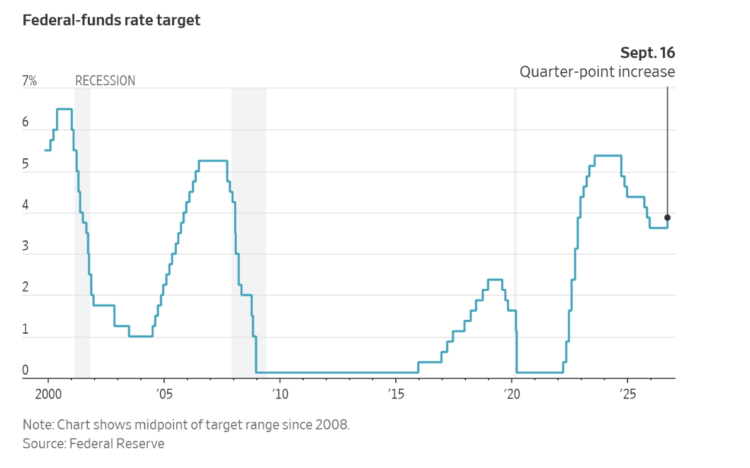
On Wednesday, the Federal Open Market Committee (FOMC) voted unanimously, 12 to 0, to raise the benchmark rate by a quarter point to a range of 3.75% to 4.00%. It’s the first increase since July 2023 and the first policy change under Chairman Kevin Warsh, who took office in May. Markets had the odds of a rate hike above 90%, so the move itself wasn’t a surprise.
The committee’s statement said inflation remains elevated and described their actions as supporting a return to the 2% goal. Warsh has been blunt about the diagnosis. At Jackson Hole last month, he put the responsibility for 65 months of sustained, elevated inflation squarely on the central bank. During Wednesday’s press conference, he said inflation is too high and has been for too long, and that underlying growth is higher while inflation remains the problem.
The Projections Are the Real Story
- Sixteen of the eighteen officials see at least one more increase in 2026, which would set rates slightly above 4%.
- Headline inflation is now projected at 3.7%, up from 3.6%. Core is at 3.4%, up from 3.3%.
- Officials do not see inflation returning to 2% until after 2028.
- The median sees rates holding through 2027, with a single cut in 2028.
I’ve been tracking the Federal Reserve for months, including the July meeting, when three members dissented in favor of raising rates. Their case was too compelling to ignore this time. The decision also came amid public pressure to lower rates, making the unanimity noteworthy because it indicates the committee is in unison on direction.
However, the key takeaway isn’t that rates went up. It’s that the Fed’s research and analysis now describe a multi-year problem. August core CPI came in at 0.3% month over month, an acceleration over the prior two months and faster than the 0.2% many officials said they needed to see. Every planning assumption that depends on cheaper money in 2027 needs an alternate version. Equipment financing, facility debt, corporate revolving credit. Build the one (or ones) where relief doesn’t arrive.
2. Bain Says Holiday Sales Top $1 Trillion. More Than Half the Growth Is Inflation.
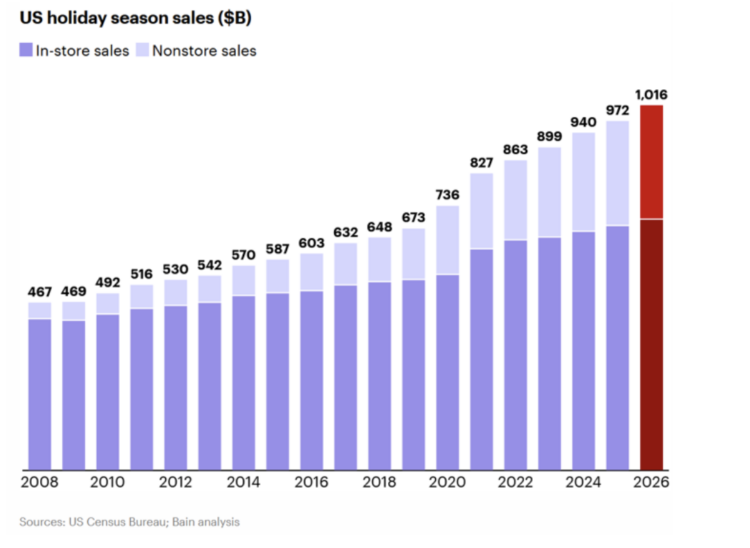
Bain forecasts that U.S. retail sales in November and December will exceed $1 trillion for the first time, with 4.5% nominal growth, up from 3.5% last season. Understanding the data source matters. Bain put last year’s total at $972 billion using Census Bureau data, while the NRF (National Retail Federation) uses a different methodology and already had last season above a trillion. Whose tape measure you use determines whether this is a record.
Bain’s release covers this caveat, which I appreciate. More than half of that nominal growth comes from inflation-driven price increases, not necessarily from people buying more.
The Channel Split Matters for the Supply Chain
- In-store will be roughly 70% of total holiday revenue, growing 2.5%, in line with the last two years.
- Nonstore is projected to grow 9%, up from 7% last year, and will generate 60% of all sales growth, up from 50%.
- Flat categories include furniture and home furnishings, electronics and appliances, and food and beverage.
- Both price and unit growth are in general merchandise, clothing and accessories, and e-commerce.
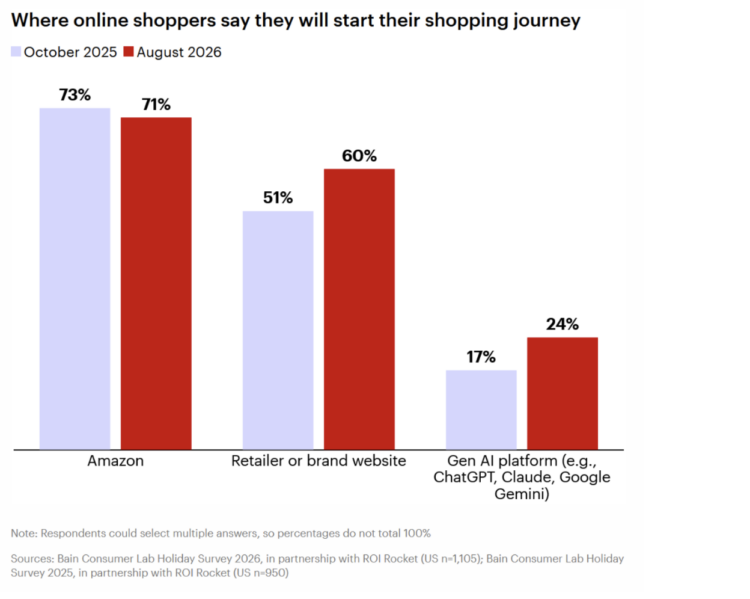
Below is an interesting stat consistent with what we are all experiencing in every aspect of life. 24% of online shoppers plan to begin their holiday shopping on an AI platform, up from 17% last year. Another 60% plan to start on retailer and brand websites, up from 51%, with an additional 13% planning to use a retailer’s own AI agent. That’s a real shift, and it lines up with the Target article I wrote about last week.
This holiday season is sending mixed signals. On the bright side, retail sales are up 5.3% year over year as of July, and the S&P 500 is up 23%, which supports upper-income spending. Tax refunds are up $43 billion, though Bank of America estimates that about half has already gone to gas. Several retailers, most notably Walmart, have announced price cuts in response to the tariff refunds.
Conversely, consumer outlook is low (compared to 2025) due to geopolitical developments and broader uncertainty. Personal savings rates are low, and credit card delinquencies (greater than 90 days) are currently around 13%. Labor force participation fell 0.4 points in August, marking the fourth consecutive monthly decline.
This echoes the same advice I’ve been giving all year, now aimed at the quarter that matters most. Plan against units, not dollars. If half the growth is price, warehouse throughput, pick volume, and transportation demand will not scale with the revenue number.
3. Trucking Executives Are Calling It the Tightest Capacity in Three Years
John Schulz at Logistics Management reports that top executives across both LTL and truckload are predicting tighter-than-normal capacity for the late-fall peak. The piece calls it the first significant tightening of equipment capacity in at least three years, going back to the COVID recovery boom of 2023.
The driver shortage is back. Kent Williams, EVP of sales and marketing at Averitt Express, the nation’s twelfth-largest LTL carrier, said that as the market shifts to robust growth, his immediate concern is finding quality drivers amid tightening driver capacity. Prologis Research reports that active carrier authorities entering 2026 are roughly 12% below their 2022 peak and still falling. LTL rate increases are running in the 6% to 7% range, and carriers have become selective enough that freight outside preferred density profiles face higher rejection risk or surcharges.
We Talked About This in May
On May 22nd, I ran a section titled “It’s Not a Driver Shortage. It’s a Regulatory Reset.” The argument was that English-language enforcement, non-domiciled CDL rules, visa pauses, and the closure of thousands of driver training programs had permanently shrunk the pool of people legally eligible to drive a truck, and that no amount of pay increases could fix a legal eligibility problem. I said it wouldn’t end in six months and might not end at all. In June, Estes told Transport Topics that the developments reducing capacity aren’t short-term, calling it a “double whammy.”
Four months later, it’s the peak season story. And it belongs in this week’s theme because capacity is the foundation. The industry spent three soft years treating driver supply as a given and optimizing everything on top of it. The base shifted, so everything built on it must shift too.
If your routing guide was built during the soft market, it rests on assumptions that no longer hold. Verify your committed capacity now, and expect density and accessorial scrutiny not seen since 2022.
4. Amazon Has a Million Robots, and the Lesson Is About Process
A genuinely excellent Supply Chain Management Review piece looks at what Amazon’s automation program teaches everybody else. The fleet grew from the 2012 Kiva Systems acquisition to more than one million deployed units in 2025, approaching the size of Amazon’s roughly 1.2-million-person workforce.
The piece also hands us the phrase of the week, which practitioners use for the worst outcome of an automation program:
Automating the mess.”
Applying robotics or software to inefficient, inconsistent, or poorly understood processes can cause the technology to reproduce the existing problems faster and at greater cost. Automated, but not fixed.
The mechanics are familiar to anyone who has sat through the pitch. Vendors, consultants, and internal transformation teams routinely propose goods-to-person systems, automated storage and retrieval, robotic picking, and AI-driven planning to operations under throughput pressure. Some create real value, while others consume capital and management attention, leaving the underlying problem untouched.
Amazon’s program shows that successful warehouse automation depends on standardizing the work first. The robots are the visible part. Standardization is what makes them a successful application.
And here’s the detail every 3PL will recognize immediately. Warehouse robotics are designed for predictable throughput. Trucks arrive early, late, or unannounced. That gap between modeled and actual conditions is exactly where automation usually underdelivers.
This is the most straightforward articulation yet of something I’ve been circling since May, when I covered the argument that AI relocates bottlenecks rather than eliminating them. It’s the Gartner finding from August, which diagnosed the issue as change management rather than technology. And it’s the last-mile data from two weeks ago, which showed operators had pushed AI adoption to 66% while trust in AI for real-time operational decisions sat at 1.98 on a four-point scale. The technology is never the hard part.
Standardization is unglamorous, and it is the whole job. Consistent receiving, consistent slotting, consistent labeling, consistent exception handling. Do that and automation compounds. Skip it and automation just makes your variance appear faster. That unglamorous part is the work we signed up to do.
You Can’t Automate a Mess
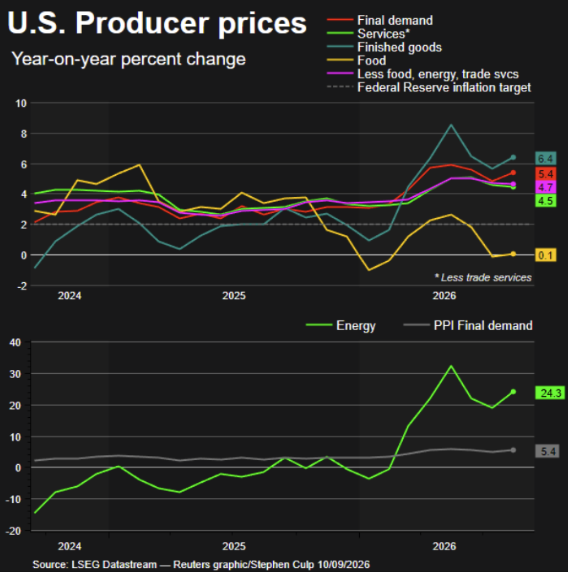
The Fed spent 65 months hoping inflation would resolve on its own and finally did the structural work. Its own projections say the fix may run past 2028. Freight capacity shrank for legal and regulatory reasons that no rate increase repairs quickly. Bain’s trillion-dollar holiday is more about price than demand. And a million robots turn out to teach that you standardize the work before you automate it.
Every one of these is a foundation problem. In all four cases, the temptation is to address the visible layer because it’s faster and simpler. Rates, routing guides, revenue forecasts, robots. The slower work underneath is what truly determines whether any of it holds together.
Dr. Darroch nailed it Monday night at Miami University. We are the bridge. And bridges work because most of the foundation work is the part you don’t see. The pile foundations, steel casings, the rebar. The unsexy, deliberate work that must be done to ensure a smooth crossing over the deck.
Bonus #1: Marc Lore’s Wonder
What initially drew me to this article was the mention of Marc Lore. He’s a serial entrepreneur, and I’m always drawn to his latest venture. The newest one, Wonder, feels like a cross between The Jetsons and the Automat. Using automation, the company aims to make feeding families 21 meals a week. Pretty audacious.
After reading last weekend about the possibility of human extinction, it’s reassuring to read about a positive AI application. The Infinite Makeline technology was designed around a standardized process from the start, the opposite of what the fourth story above warns about. 80% of the process can be completed in 3.5 minutes. Humans handle the balance and finishing touches. Incredible variety and personalization, quick and at scale.
Bonus #2: 360 Cities
So far, halfway through September, we’ve had delightful, sun-soaked, autumn-tempered days in my corner of the supply chain. I appreciate that it hasn’t been everyone’s experience, and I know these days are numbered. It could easily snow here before Halloween, as it has several times in the past. On those days when it’s not so great outside, I offer you a cool bookmark to take your mind off it.
You’re welcome.
Bonus #3: Trade-Offs
Leave it to guru Seth Godin to capture the essence of business so succinctly. I’ve been reading his daily blog for years. A colleague and friend introduced me to his books when I was just starting my professional career (thank you). Godin never disappoints.
One More Thing… Wile E. Coyote and the Road Runner
Looney Tunes. Still love it. I’m of an age when, after a long week at school, we looked forward to Saturday morning cartoons. An all-timer is the classic matchup between Wile E. Coyote and the Road Runner. As a child, I couldn’t resist the silly antics and the poorly built ACME products the Coyote used to try to catch the Road Runner.
Little did I realize that, instead of mortal enemies, they were the only two who could complete each other. If you need the visual proof, here it is.
Remember, it costs nothing to be kind.