By Alex Stark
Change Comes in Sideways: A Three-Year Inflation High, Amazon’s LTL Move, Driverless Trucks Going Mainstream, and the Real Blockbuster Story
The World Cup kicked off this week, and it still feels a little surreal that the biggest sporting event on the planet is happening in our backyard. I have plans to soak up some of the festivities in Philadelphia over the next few weeks. If the group stage matches my excitement level, it’s going to be a memorable summer.
Here’s a cool, quick rundown I received from my friend Kathy Fulton, all things ALAN (American Logistics Aid Network) executive director and human dynamo, on the logistics of the World Cup. This comes compliments of David Shillingford on LinkedIn.
Back in the world of work, this week’s reading had a common shape to it. Every story was about change arriving from an unexpected direction. An economist would call it a structural shift. A Blockbuster franchisee would call it a Tuesday.
Four things to share. Let me know what you’re seeing.
1. Inflation Hit a Three-Year High. Have We Passed the Peak?
May CPI came in at 4.2% year-over-year, the highest reading since April 2023 and the third consecutive monthly acceleration, per this week’s report. Prices rose 0.5% for the month. Energy did most of the damage, accounting for over 60% of the monthly increase. The energy index is now up 23.5% over the past twelve months.
Heather Long, chief economist at Navy Federal Credit Union, put the consumer reality plainly: “Americans are getting squeezed financially by inflation that’s back at a 3-year high.” Gas, food, electricity, and medical care are all running above 3%. Those are the items people buy every single week, which is why sentiment feels worse than the headline suggests.
The Story Underneath the Headline
Here’s where it gets interesting. Core CPI rose just 0.2% for the month, below the 0.3% forecast and down from April’s 0.4%. Core goods prices actually declined 0.1%, and the decline was broad-based: household furnishings, new vehicles, medical care goods. Bank of America economists read that as evidence that tariffs are no longer playing a large role in the sequential inflation data.
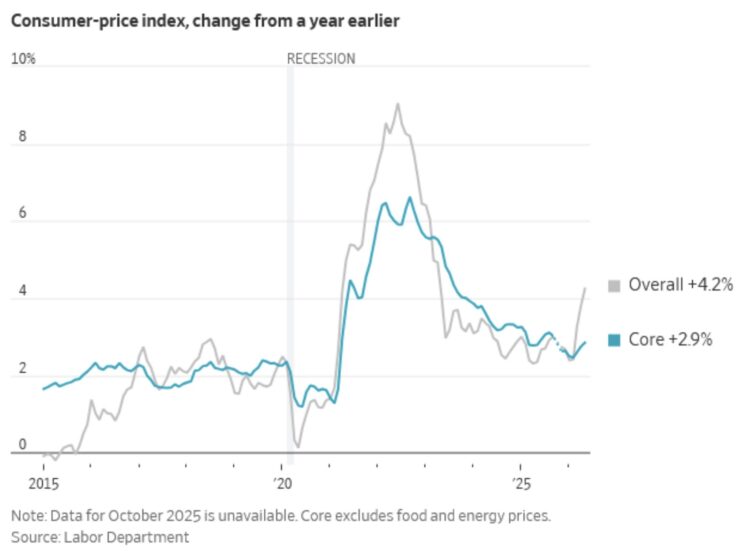
And the forward signals lean encouraging. Gas prices have already fallen about 30 cents a gallon from their late-May peak. Oxford Economics thinks May could mark the 2026 peak for headline CPI. The asterisk worth respecting… roughly a third of the world’s fertilizer supply is produced in the Persian Gulf region, so food inflation is the next shoe that may drop.
The Fed angle is its own story. Futures traders now expect zero rate cuts in 2026, and some analysts have the next move penciled in as a hike. That’s a complete reversal from where expectations sat in January.
I’ve been writing for weeks about leading versus lagging indicators. This report is the cleanest example yet. The headline number is a lagging story about energy. The forward signals (core goods deflating, gas already falling, fertilizer risk building) are where your planning should live.
2. Amazon Just Parked 80,000 Trailers in the LTL Market’s Driveway
Amazon announced this week that it has opened its less-than-truckload network to all businesses and all destinations, including third-party warehouses, distribution centers, and retail partners. Shippers can move one to six pallets, anywhere from 150 to 15,000 pounds, using the same network Amazon built for itself. It’s the latest piece of Amazon Supply Chain Services, the end-to-end logistics offering the company launched just last month.
The scale of these numbers is worth considering:
- 80,000 trailers and 24,000 intermodal containers supporting the network.
- Millions of pallets have already moved annually for Amazon marketplace sellers since the service launched inbound-only in 2019.
- The market’s verdict was immediate. FedEx Freight dropped 4% on the announcement, and UPS fell more than 2%.
An honest caveat keeps this story in proportion. Amazon doesn’t have a traditional network of cross-dock terminals for moving heavy pallets around the country, and analysts expect the offering to start small. This is the beginning of something, with a lot of build-out still ahead.
The Seven-Year Quiet Period
Here’s the part I keep chewing on. Nobody in the LTL industry woke up in 2019 worried about Amazon. The service ran quietly, inbound-only, inside Amazon’s own walls for seven years. By the time the competitive threat announced itself, it was already operational at scale. AWS followed the same script: internal infrastructure first, refined for years, then opened to the world. Their pattern is the playbook.
If you’re a shipper, more capacity options is good news. If you’re a carrier or a 3PL, the moat question got very real this week. What do you offer that a company with 80,000 trailers and world-class tracking can’t commoditize? For us, the answer has been the same for 162 years: relationships, flexibility, specialized handling, and people who answer the phone. That’s the business we’re in. This week was a useful reminder of why it has to stay sharp.
3. Driverless Trucks Went Mainstream This Week, and Almost Nobody Noticed
PepsiCo and Gatik announced a multi-year partnership that now stands as the largest commercial autonomous freight deployment to date. More than 40 fully driverless trucks are live across Texas, Arizona, and Arkansas, serving roughly 250 retail locations including Walmart and Dollar General stores.
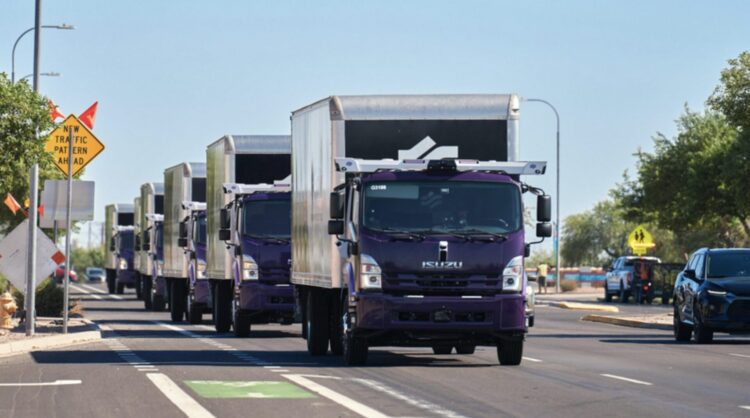
No driver or observer in the cab. Gatik believes it’s the only trucking company that can make that claim today. Human oversight comes from remote supervisors who make high-level go/no-go decisions and never drive the truck remotely. The partnership began in 2022, and driverless operations started in June 2025. The company reports a 99% on-time record and more than $600 million in contracted revenue. CEO Gautam Narang called the PepsiCo deployment “one of the proof points that autonomous trucking is mainstream.”
The Revolution Took the Boring Route
The driverless future didn’t arrive the way the 2018 hype promised. No robotaxis on every corner, no coast-to-coast autonomous lanes. It arrived on fixed, repeatable, middle-mile routes hauling chips and soda between distribution centers and dollar stores. Predictable corridors, controlled conditions, the same runs repeated thousands of times. The technology showed up first in the least glamorous part of the network, which, if you think about it, is exactly where it should have.
There’s labor tension here worth calling out. A few weeks ago, I wrote about the regulatory reset shrinking the pool of people legally allowed to drive a truck. That contraction is unfolding at the same time automation is scaling on middle-mile routes. Those two lines are going to cross. There’s a reasonable version of this story in which automation absorbs the shortage on the most repetitive, least desirable routes while drivers move to work that genuinely needs a human. There’s a less comfortable version, too. Anyone who tells you they know which one we get is selling something.
The takeaway for operators… autonomous freight is no longer a pilot-program curiosity. It’s a procurement question with a timeline. The right question for 2026 (and beyond) isn’t whether this is real. It’s which lanes in your network look like Gatik lanes.
4. The Blockbuster Story Myth is Inaccurate. The Real Story is More Useful.
You know the legend. In 2000, Netflix founders Reed Hastings and Marc Randolph flew to Dallas and offered to sell their struggling company to Blockbuster for $50 million. They got laughed out of the room. The arrogant giant ignored the upstart and paid for it with its life.
Greg Satell, a Wharton lecturer and the author of Cascades, published the correction this week, and the real story is far more useful than the fable.
What Actually Happened
- Netflix in 2000 was hemorrhaging money, losing more than $50 million that year, with no working subscription model yet. Passing on the deal wasn’t obviously foolish at the time.
- Blockbuster did respond. CEO John Antioco abolished late fees, recruited a genuine digital team, and built an online platform that was gaining ground on Netflix.
- The stakeholders defected. Franchisees revolted over losing late-fee revenue. Earnings turned to losses, and the stock sagged. Carl Icahn arrived, made life miserable, and forced a bonus dispute that led to Antioco’s 2007 ouster.
- His successor reversed everything. Late fees came back, the subscription investment and innovations got cut, and the focus returned to retail stores. Bankruptcy followed in 2010.
Satell’s core argument is that change is neither top-down nor bottom-up:
It goes side-to-side as it propagates through networks.”
Antioco had the right strategy and full formal authority, and it still wasn’t enough, because transformation lives or dies with stakeholders. Franchisees. Shareholders. Middle managers. The people on the dock. Every supply chain transformation I’ve watched up close (a WMS migration, an automation rollout, a network redesign) fails on stakeholder alignment far more often than it fails on strategy.
Antioco saw the disruption coming, clearly and early. The lesson sits elsewhere. Bring your stakeholders with you, or the best strategy in the world dies in the hallway between the boardroom and the docks in your distribution center.
Four Stories. One Pattern.
Inflation arrived sideways, through the energy line item. Amazon arrived sideways, through seven quiet years inside its own network. Driverless trucks arrived sideways, through the boring middle mile. And Blockbuster didn’t die from one bad decision at the top. It died sideways, through franchisees and shareholders, one defection at a time.
The next disruption in your business probably won’t come through the front door either. It’s worth asking who’s quietly building next door. And when you’re the one driving the change, it’s worth knowing whether your stakeholders are actually in the truck with you.
What’s moving in sideways in your corner of the industry?
Bonus #1: How Playgrounds Reinvented Childhood
Maybe it’s because my youngest is getting ready to start high school in the fall, but I’ve been on a nostalgia kick lately. Last week it was the “grandfather toys” article. This week, a Big Think piece on how playgrounds reinvented childhood sent me right back to the playgrounds of the 1970s. Man, those metal slides could get scalding in the July sun.
The piece traces the surprisingly recent origins of the playground. They’re a reform-era invention, built to pull kids out of dangerous streets, and they ended up quietly redesigning childhood itself. New norms about play, supervision, risk, and public space all flowed out of a piece of civic infrastructure most of us never think twice about. Even childhood, it turns out, got changed sideways.

A cool thought piece, and worth your time. Sunscreen recommendations from last week still apply.
Bonus #2: Social Pool (I’m 12 Years Too Late)
Well, I’m a dozen years late to this one, but I stumbled across Social Pool this week and haven’t stopped thinking about it. It’s an art installation that doubles as an enlightened thought experiment. Kind of out there. Literally.
In 2014, Austrian artist Alfredo Barsuglia placed a small white minimalist swimming pool, eleven feet by five, in a remote stretch of the Mojave Desert. Anyone could use it, free of charge. The catch? You had to pick up one of four keys and the GPS coordinates from an art center in West Hollywood, drive for hours, hike in from the nearest road, stay no longer than 24 hours, keep the location secret, and top off the pool with a gallon of fresh water before you left.
A luxury good that demands real effort. Quietude is the scarcest commodity. And, for those of us in the industry, possibly the only amenity on earth where the last mile is the entire point.
Since you can no longer visit this cool pool (it was destroyed by a fire during maintenance work in 2016), check out the link for videos and photos. There are plans to rebuild. If that happens, I may need to take a detour during a future visit to Southern California.
You’re welcome.
Remember, it costs nothing to be kind.