By Alex Stark
Oil Prices, Supply Chain Disruptions, AI Noise, and the Data Center Backlash
It’s hard to stay focused on the tasks and goals for the year when you find yourself constantly looking over your shoulder. I’m continually drawn to the oil situation in the Middle East and think about how it’s affecting every facet of life.
Economists describe higher gas prices as a regressive consumption tax. This “oil tax” transfers wealth from consumers to energy producers and foreign oil-exporting nations—draining liquidity from consumers and businesses while offering no public service in return.
1. The Ripple Effect of Rising Oil Prices on Consumer Spending
The trickle-down danger starts when gas prices drain people’s disposable income. Gasoline is an inelastic good—meaning demand doesn’t change significantly when its price rises. Most people can’t stop driving to work or school overnight.
Research shows that for every $0.01 increase in the price of gas, roughly $1 billion in consumer spending is diverted from other sectors of the economy—retail, dining, and travel—annually.
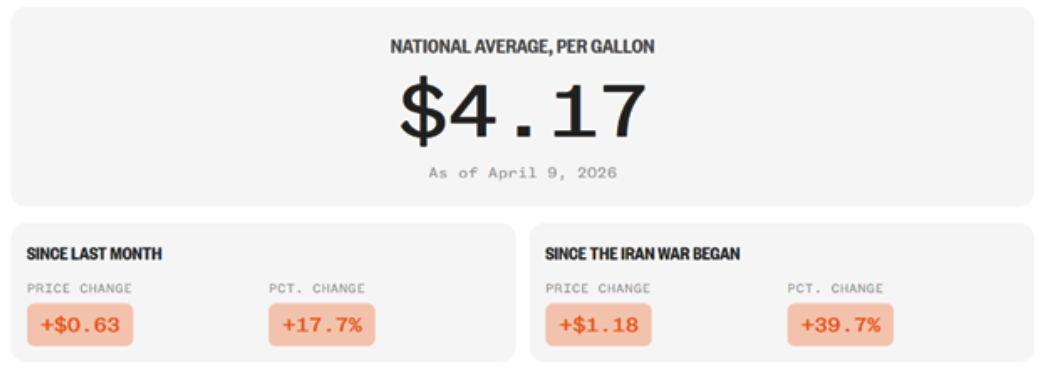
Lower-income households feel this the most. Because they spend a larger share of earnings on energy, higher gas prices reduce their ability to purchase essential goods and services.
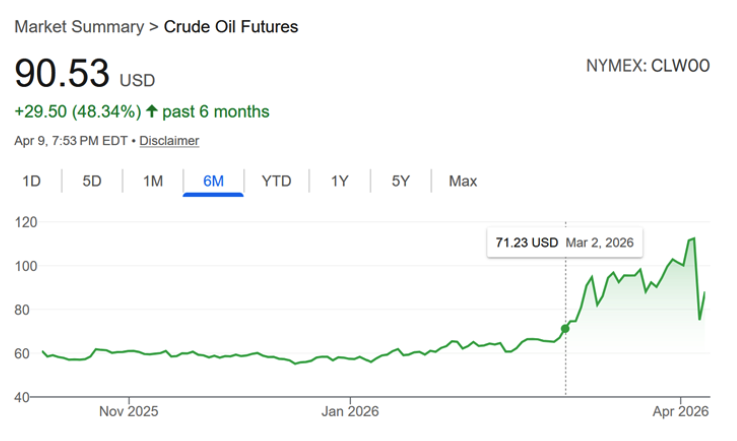
When global markets are stable, the cost per barrel of oil remains consistent and predictable. Industry experts describe the “sweet spot” for a barrel of oil in the $60–$70 range. This allows major oil companies to stay profitable and encourages steady investment. Much higher prices? People cut back on consumption, and long-term demand declines.
2. How Fuel Costs Create a Domino Effect in Supply Chains
In my corner of the world in logistics and supply chain, rising fuel prices trigger a domino effect that significantly increases the cost of moving goods while slowing global delivery. When there’s a kink in the chain, that bottleneck throws the system out of rhythm.
That opens up a whole can of consternation surrounding ways to mitigate transportation costs. This is where it’s good practice to leverage freight providers’ knowledge and capacity. Key strategies include:
- Route and mode optimization – find the most efficient paths and transport methods
- Shipment consolidation – combine loads to reduce per-unit costs
- Leveraging technology – use data and automation to drive smarter decisions
- Exploring dedicated power – secure consistent capacity for predictable shipping
Do your homework to find the best fit for reliability coupled with excellent, value-added service.
Why SMEs Feel the Pain More Than Anyone
When disruptions rock the boat in supply chains, the organizations that often feel a disproportionate impact are small- and medium-sized enterprises (SMEs). The industry tends to be optimized and tilted toward the largest enterprises. The result? Misalignment, broken promises, and dissatisfied customers in the SME space, which encompasses CPG brands, industrial manufacturers, and businesses spanning multiple sectors.
In a piece in Supply Chain Brain, the contributor clearly laid out the dilemmas SMEs face:
- 86% have experienced supply chain disruptions
- 45% lose nearly half their monthly revenue after a single disruption
- $1.2 trillion in sales are erased annually due to stockouts alone
- 37% year-over-year increase in supply chain disruptions—and still climbing
This happens when SMEs need solutions but can’t find them—even as larger operators force them into standardized processes and systems that don’t account for their unique SKU profiles and handling. The result is a solution that works “well enough” but never truly optimizes operations.
The best practice is to do your homework. Find an expert who gets it, sees the business before proposing a solution, and—maybe crucially—shares a cultural understanding of what you care about the most.
3. Cutting Through the AI Noise: Focus on What Matters
Most pondering centered on optimization tends to lead down the path toward AI-land. Which in turn can lead to handwringing, self-doubt, and anxiety, all while asking yourself: “How the heck am I keeping up with AI?”
In a thought-provoking piece entitled “The AI Signal-to-Noise Curve,” Casey Winters states:
“AI doesn’t change every week. Capabilities change a few times a year. Everything else is noise.”
It’s a helpful way to reframe the question from “how do I keep up” to “where should I be paying attention?”
Instead of getting bogged down trying to do too many things, focus on two or three areas that will deliver the highest ROI in productivity. Get comfortable with the tools and build the skills to deliver exceptional results. Everything else? Give yourself the grace to ignore the noise.
4. The Growing Backlash Against Data Centers—and What It Means for AI’s Future
An interesting development in the AI arms race is the slow, steady murmur of opposition. A recent WSJ article reported that Maine could become the first state to effectively freeze construction of new data centers. Backlash is spreading. In my home state of Pennsylvania, many communities are saying “no, thank you” to building proposals. States want the time to properly assess the impact data centers have on local environments, water consumption, and electricity use.
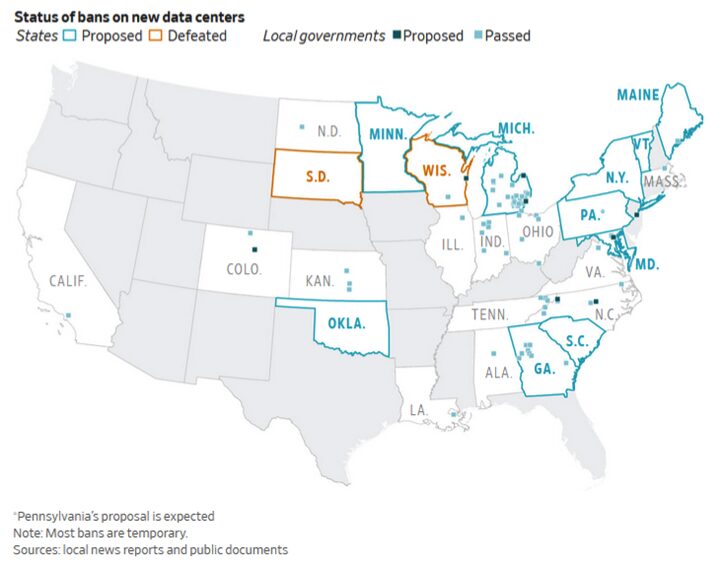
This friction between AI’s digital growth and the physical world is reshaping how tech companies handle NIMBY resistance. The national movement to curb data center construction is forcing developers to rethink their strategies:
- Requiring data centers to build their own power sources instead of burdening the community’s grid
- Investing in local infrastructure and using recycled water for cooling
- Employing creative methods to reduce noise pollution
Many communities are simply fed up with big business’s empty promises and are holding their policymakers to a standard that benefits all parties.
Bonus: The “Goldilocks” Theory of Performance
With the (somewhat) warmer weather popping in the Northeast, I’ve come out of hibernation to get back to jogging. Like many of us, as we get older, I’m in a daily battle to stay fit. I can’t say I enjoy it, but I do get to listen to podcasts and music I like. I sometimes catch myself wondering—would my workout be “better” if I just ran with no distractions?
Then I read an article by Jason Feifer (One Thing Better) and thought, nah. I’m a believer in the “Goldilocks” theory of performance. This is a real thing, better known as the 1908 Yerkes-Dodson Law. There’s a balance between performance and stress, and when the mind is doing something without overthinking, you actually do it better.
I’m talking about this in the context of my personal fitness challenges, but it’s applicable to almost anything—including how you run your supply chain.
 And one final thing… I love this find. When you crave a little 2–3 minute me-time to be creative and just jam, check out Synthsational. The tunnel visualizer is hypnotic.
You’re welcome.
Remember, it costs nothing to be kind.
Looking for a Supply Chain Partner Who Sees Your Business First?
At Holman Logistics, we’ve spent 160 years helping businesses navigate disruption with hands-on expertise and a service-first approach. Whether you’re an SME looking for a 3PL that understands your unique needs or an enterprise seeking operational efficiency—let’s start a conversation.