By Alex Stark
I heard last night on the weather report for my area that we are on a “roller coaster.” Temps are getting whipsawed daily. One day it’s 70 degrees and sunny, and then 36 hours later it’s 40 degrees colder. It’s hard to get a good handle on it.
Well, this chart was disappointing. All the positive momentum and trend line that was pushing the 30-year fixed mortgage rate toward a sub-6% level have now reversed. Mortgage rates have increased for the fourth consecutive week and are now at their highest point since September 2025. The spring home-buying season, which looked promising a month ago, is now under threat.
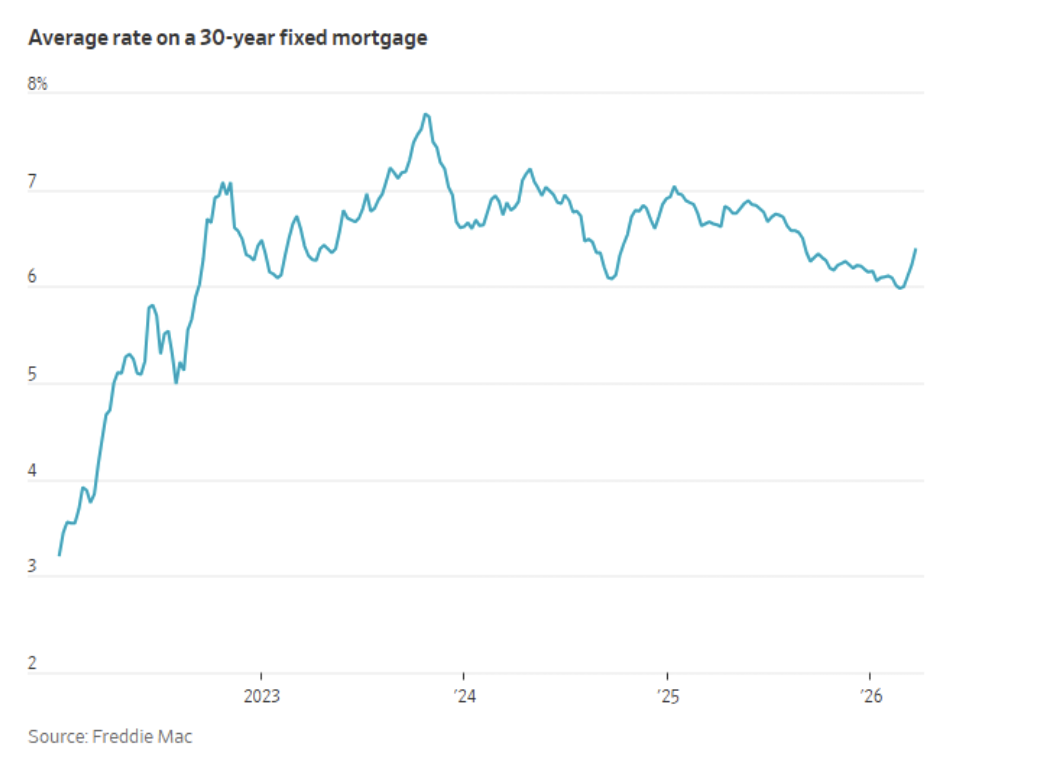 Rising oil prices are driving Treasury yields higher. Mortgage rates follow the 10-year Treasury. The Fed kept its benchmark rate steady in the March meeting. As inflation pressures return, the likelihood of a rate cut seems slim at best.
All of this impacts the housing market, which was poised for a rebound. Now, the spring buying season is once again confronting affordability challenges.
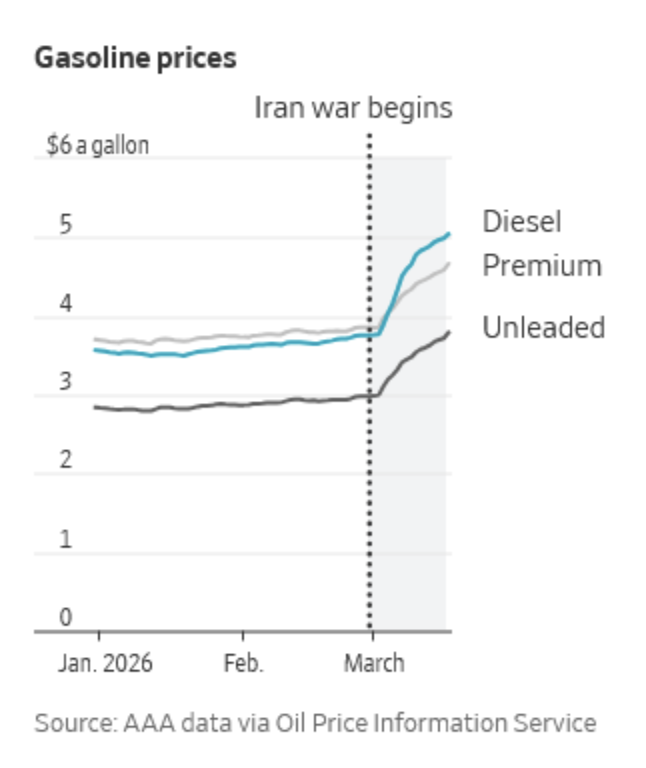
Energy, as we all know, is under threat when we fill up our gas tanks. The question everyone is asking… how bad will this get? Markets have declined overall since the war began in the Middle East. The Nasdaq and Dow have entered correction territory.
Chaos is shaking the global markets.
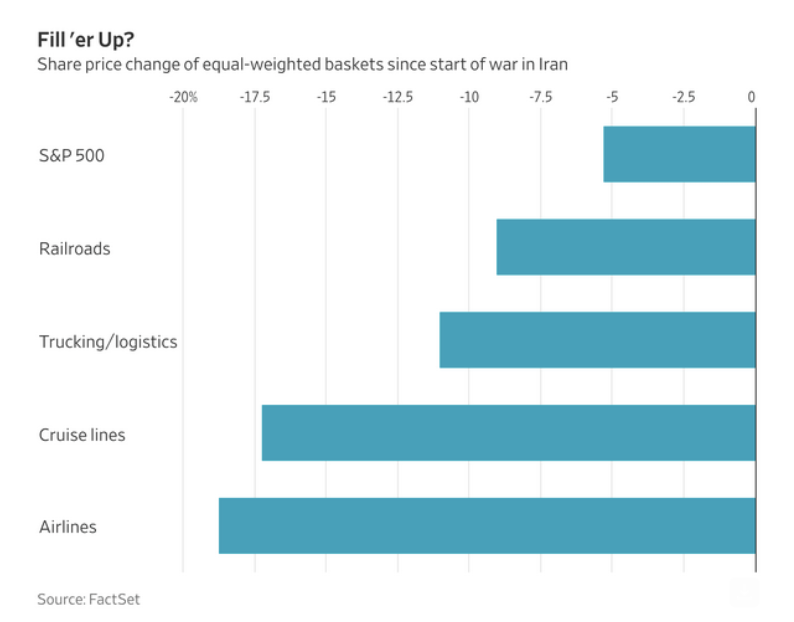
How long will this uncertainty continue to affect businesses? Additionally, jobless claims increased slightly last week.
With all the churn and uncertainty, the most important trait for business leaders and their organizations is agility. An excellent article published in the HBR highlights four capabilities that propel operational improvement in organizations.
The Discovery capability is the first one. Companies that undertake this have the ability to systematically sense, scan, and interpret internal operations and external environmental signals. It enables firms to identify inefficiencies, blind spots, and emerging trends early, before they escalate into performance gaps. These companies focus on finding friction points in their operations. Using these insights, they can make well-informed business decisions that align with the organization’s overall strategic goals.
The second is Improve. Companies that have a structured process for acting on customer insights enhance their operations. This is where strong programs like continuous improvement and customer experience (CX/NPS) truly pay off. Companies committed to uncovering root causes and learning tend to solve problems faster and build more trust with their customers. When this becomes standard practice, it becomes a key differentiator.
The third capability is Align. This refers to the ability to connect operational improvements to long-term strategic goals. The researchers note: “Rather than creating isolated fixes, aligned organizations design their systems so that practices, processes, and knowledge developed in one part of the business can be adapted and applied elsewhere. This makes the entire improvement engine more agile, efficient, and strategically relevant.”
I really like the simplicity of a question posed in the article for this alignment step:
“Will this help us adapt and grow, or is it just a local fix?”
Finally, the fourth capability is Transform, which is a company’s ability to codify adaptability, reconfigure models, and lead disruptive change to develop market insights. By practicing this, companies essentially change how they work. They rethink operations to respond to changing markets.
This is a straightforward scorecard on the true strength of operational excellence. The research determined that the real power comes from compounding capabilities. It’s not enough to adopt operational improvement practices. Companies that will succeed in the future develop the capabilities to evolve.
- Companies that only used Discover had some environmental awareness but remained laggards.
- Companies with Discover + Improve achieved competitive parity.
- Companies with Discover, Improve, and Align gained a competitive advantage.
- Companies with Discover, Improve, Align, and Transform capabilities maintained their competitive advantage.
When I think about being better or doing things more efficiently for a customer, my thoughts inevitably turn to technology-enabled processes. That, in turn, leads me down the rabbit hole of “Will AI take all our jobs?”
And I know, I know, I just can’t quit AI.
When I find myself in times of hand-wringing about technology, I like to go to Stratechery by Ben Thompson for a healthy dose of information to clear up my doubts. First and foremost: Are we in an AI bubble?
He puts together short videos that capture his thoughts on the subject. It’s worth the view.
Don’t forget the <insert your preferred allergy medicine>.
It’s that time of year for some of us. Sneezing, runny nose, itchy eyes.
Researchers have found that North American pollen seasons have lengthened by about 20 days since 1990, now ranging from approximately 4.5 months in the U.S. South to around 8 months in the Northern Rockies and Plains. Overall, pollen concentrations in North America have risen by 21% over the same period. Yikes.
There are a few reasons. Warmer weather and fewer freeze days are lengthening growing seasons across the U.S., giving plants more time to bloom and release pollen. Higher carbon dioxide levels over the years have also increased pollen levels and worsened allergy symptoms.

The weather is turning, so do whatever you need to do to get out there and enjoy. For us Easterers, a sure sign of spring is the incredibly beautiful cherry blossoms in Washington, D.C. The Tidal Basin, near the Jefferson Memorial, is the premier spot. According to the experts, peak bloom officially hit on March 26th. Peak is defined as 70% of Yoshino trees in bloom. Depending on the weather, it can last several days.
Go find and enjoy your flowering trees.
And remember, it costs nothing to be kind.