By Alex Stark
What a difference a couple of days makes.
An already “functional but fragile” economy is being tested by the events in Iran that started this past weekend. There have been some less-than-cheerful news items that have rolled up this week.
The two sobering articles came from the Wall Street Journal. The first, just released today, presents a shaky outlook on the U.S. job market. In February, 92,000 jobs were lost. Economists had expected a gain of 50,000. Additionally, unemployment increased to 4.4% from 4.3% in January.
Gregory Daco, chief economist at EY-Parthenon, said he is concerned that a flagging labor market could threaten consumer spending. Consumer spending in the U.S. accounts for nearly two-thirds of the GDP, therefore the very backbone of the economy. Daco stated, “Especially after adjusting for inflation, income growth is under pressure, and therefore people’s ability to spend is constrained.”
A grim statistic is that the U.S. has lost jobs in three of the past six months.
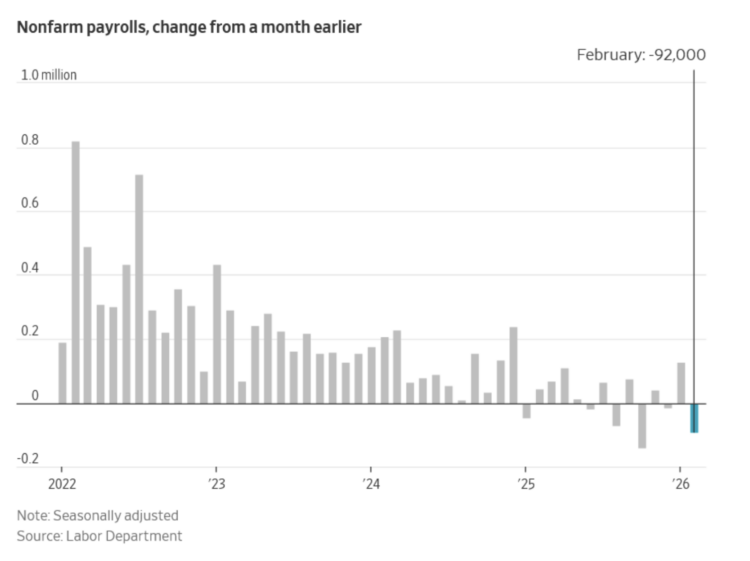
According to the report, job losses were spread across multiple sectors. Healthcare, the main driver of job growth over the past couple of years, lost 18,600 jobs in February. Construction lost 11,000 jobs. This sector had been supported by the recent data center growth. Manufacturing lost 12,000 jobs. Additionally, leisure and hospitality, which accounts for approximately 10% of the U.S. workforce, lost 27,000 jobs.
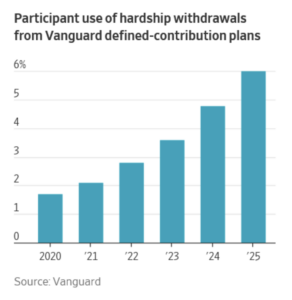 I found the updated employment numbers interesting in relation to another WSJ article from earlier in the week. According to Vanguard, the largest provider of mutual funds and the second-largest provider of exchange-traded funds (ETFs) globally, it stated that in 2025, a record 6% of workers in 401(k) plans made a hardship withdrawal.
“The uptick in hardship withdrawals marks the sixth straight year of increases since 2018, when Congress made it easier to take a hardship distribution by eliminating the requirement to take a 401(k) loan first, according to Vanguard, which administers 401(k)-type accounts for nearly five million people.”
The silver lining is that more Americans are saving and staying invested than ever before. The downside is participants withdrawing money from their accounts as they fall behind on debt obligations. With the easing of federal regulations, people appear to be utilizing 401(k) accounts as a financial cushion when money gets tight.
Trying to make sense of where things are (possibly) headed as it concerns my industry, logistics and supply chain, is the rub.
An insightful article published by Supply Chain Brain sheds light on how leaders in the industry can not only survive but also thrive. The key takeaway is having an operating system that can respond quickly and efficiently under continuous pressure. Having a strategy and focus is, of course, essential. However, recognizing that volatility is now a feature, not a flaw, of daily operations offers a competitive advantage.
Work is being done to absorb the increasing list of disruptions, including labor constraints, weather, capacity imbalance, and policy changes, without failure. Those are the organizations that will succeed.
The article did an excellent job of capturing the recent dialogue on AI in logistics and supply chain.
“Most AI failures aren’t really AI problems at all. They come back to governance. Inboxes fill up with unstructured emails; documents arrive in every format imaginable, and data looks clean right up until real-world conditions expose the gaps. Automation can perform well when everything behaves as expected, but it starts to wobble as soon as those assumptions break.”
The key to success is determining the correct balance between human judgment and automated processes.
And certainly, something I often find myself thinking about (and writing about) is what the author called – “the strength and limits of collective wisdom.” I’m a big supporter of the philosophy of being fully committed to showing up and doing the work. The team’s effort to make decisions, learn from missteps, and find collaborative solutions to challenges and constraints is a sign of a wise operation.
Finally, on a somewhat positive note, I found this chart insightful as we think of the U.S. economy in broad, global terms. This is a ranking of the world’s economies with the added wrinkle of individual U.S. states being listed as ‘individual countries.’ (marked with blue stars below)
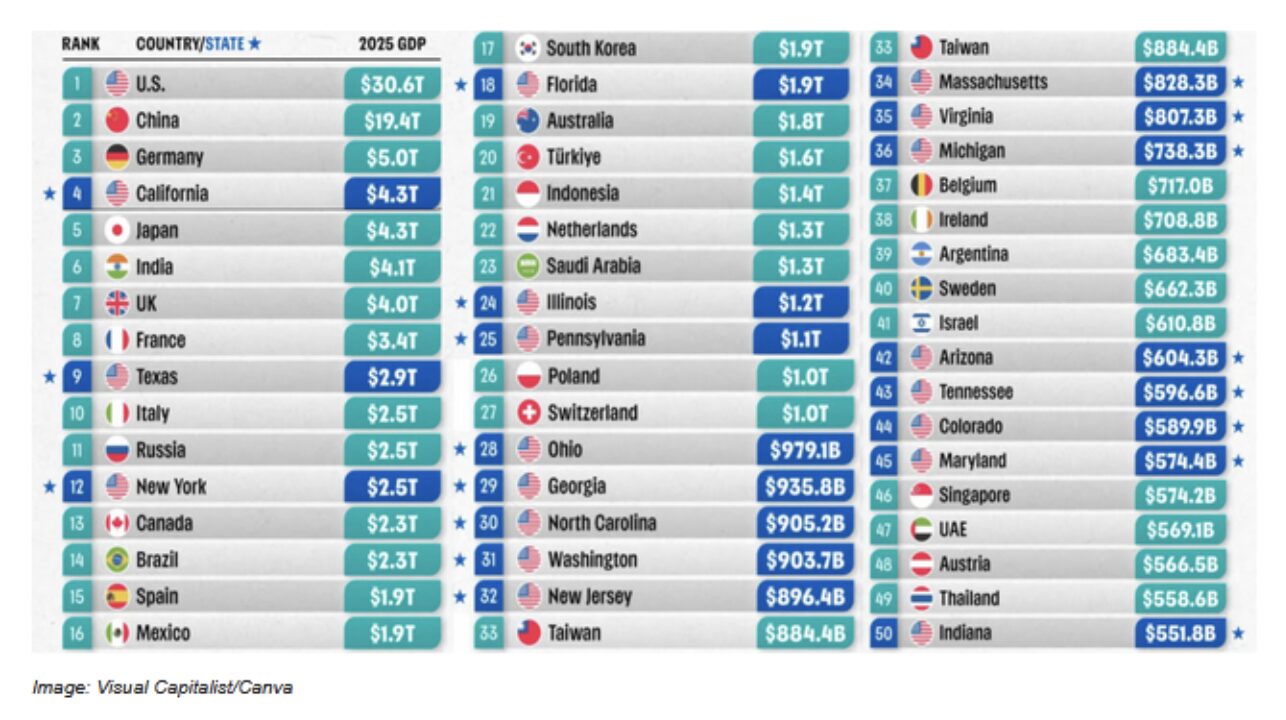
19 U.S. states rank among the world’s 50 largest economies, according to research by the International Monetary Fund (IMF) and the U.S. Bureau of Economic Analysis (BEA). The chart clearly shows how powerful some of America’s states have become. California passed Japan to become the world’s fourth-largest economy.
And here’s to more sunlight. After this week, I think we could all use it. To me, this always feels like we are psychologically moving out of winter. Longer days, warmer temps equals spending more time outside. Not many things can liven the soul like a good walk.
“All truly great thoughts are conceived by walking.”
— Friedrich Nietzsche
Spring forward, my friends.
It costs nothing to be kind.