By Alex Stark
Well, I made a mistake. Winter is still bearing its teeth in the northeast.
Luckily, I live west enough that our region only picked up 2” of snow from the most recent nor’easter, while places like Providence, RI got hammered with close to 40”. Yikes. Now, they did say that 50s are in the forecast this week, so maybe I wasn’t too far off. However, all that said, there is usually a March snowstorm that punches us in the face one last time.
The latest consumer sentiment reports showed neither good nor bad news. I’ve often heard the U.S. economy described as “functional but fragile,” and that seems accurate. With uncertainties in the labor market, the impacts of AI, and geopolitical tensions, it feels like people are holding their collective breath.
Much has been written about the “K-shaped economy,” where higher-income individuals benefit from the bullish stock market, while lower-income families face higher inflation, utility costs, and rising debt. The analysis of the current economy combines these different consumer behaviors into an average.
Trouble is, there is no average U.S. consumer. That person doesn’t exist. And it makes sense that, while it feels like spending is healthy, consumer sentiment remains low.
There was an interesting statistic I read from an article published by Retail Dive. The writer stated that, “Nearly 40% of U.S. consumers say they’re shopping for goods on sale, using coupons or discount codes or cooking at home, according to research from Numerator. A third say they’re spending less overall.”
Another lingering question mark in the economy is AI. Between the points, counterpoints, apocalyptic takes, and benevolent co-working-productivity partnerships, it sometimes takes up all the air in the room.
My favorite video clip diversion this week is from The Female Quotient. This is right on the button.
Piling on, but this one is in the same neighborhood…

2026 may be the year when AI needs to show its operational ROI.
It seems like the technology is advancing more quickly than the models to support it. Many companies have piloted AI tools without achieving the transformative ROI initially promised. The landscape is shifting from a period of high-cost experimentation (“pilot purgatory”) to a “show me the money” stage.
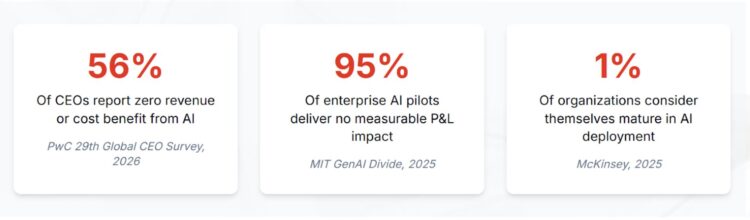
Companies are increasingly faced with two choices. One: use AI as a cost-cutting tool by reducing human labor for short-term gains. Or two: use AI to augment human capabilities to unlock productivity and new long-term value. The winning formula will be those organizations that move from “pilot-to-production” to “production-to-profit” by focusing on high-impact and auditable workflows.
“Productivity gains are widespread. Transformation is not…Organizations are deploying increasingly autonomous AI systems into environments that lack unified context, organizational memory, and the human judgment to govern them. The investment-impact gap isn’t closing. It’s about to widen for organizations that don’t address both halves of the equation: the technology foundation and the human capability to leverage it.”
There has been extensive coverage of the pile of money ($2.5T, according to Gartner) that will be spent on AI in 2026. However, how will that be impacted if there is an issue with the AI buildout?
Sightline Climate tracks the data and produces a quarterly update to provide a transparent view of the market. According to their data, it’s conceivable that 30-50% of the data center pipeline may not come online by the end of 2026.
“We’re tracking 190GW across 777 large data centers and AI factories (>50MW) announced since 2024. At least 16GW of capacity is slated to come online in 2026 across roughly 140 projects. Yet only about 5GW is currently under construction. Around 11GW remains in the announced stage with no visible construction progress, despite typical build timelines of 12–18 months.”
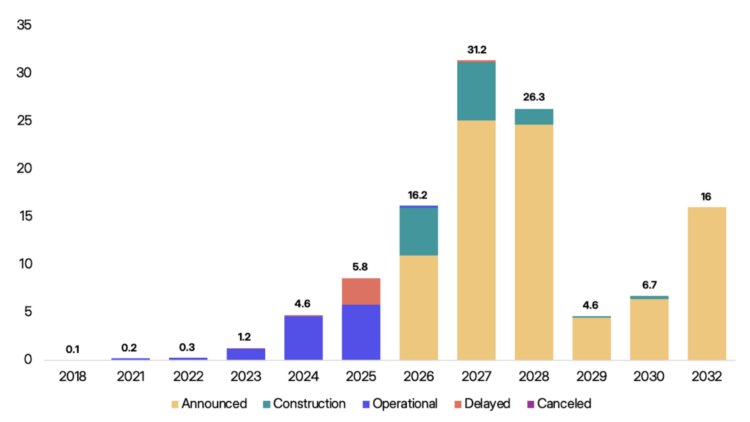
Even if this construction is delayed slightly, the economy will figure out how to integrate AI as the technology matures and becomes part of professional practice.
As I think about my children and those just beginning their careers, an article I read in the WSJ was helpful. It explains what AI leaders advise their children about future jobs. Since these people have a front-row seat, I found some of their insights reassuring.
One that especially resonated came from Jaime Teevan, chief scientist and technical fellow at Microsoft, a Yale trustee, and mother of four. She said, “Metacognitive skills will be very important—flexibility, adaptability, experimentation, thinking critically, being able to challenge things. Developing critical-thinking skills requires friction, doing things that are hard, doing deep thinking…Think of what AI does. It used to be that communicating with a computer was deterministic: You press this button, and this thing happens. Now it’s based on natural language, providing context, expressing intent and thinking critically.”
I have faith in humanity. I believe that people have an innate desire to create meaning, to discover, and to push themselves.
My teenage daughter is fascinated by the Eighties and therefore loves Stranger Things. I’m generally not a science-fiction fan, and certainly, the older I get, the more I seem to have lost all my taste for scary things. But she wants me to share the experience. So I’m with her. I’m watching. It is actually good.
The thing I think of most of all is my daughter’s fondness for the slowness that came with that time. She’s mentioned more than once that it had to be great before smartphones and the hyper-connectivity we have today.
So, it makes sense when I read an article about why people are buying iPods again. People are looking for a break from their smartphones. They want to interact with a single-purpose device, such as an iPod. Also, I really like this idea of “friction-maxxing.” In a world curated by streaming TV, movies, music, and more, people want to explore. They seek hands-on experiences and the challenge of discovering things on their own.
Here’s to friction. May it provide a gateway for the younger generations to quiet the chaos.
It’s the small victories that are sometimes the sweetest.
We made it to March, people. Bring on spring, and remember, it costs nothing to be kind.