By Alex Stark
It’s been a busy week. Historically, this has been a calm period in logistics and supply chain, but it feels like so much is hinging on the first few months to set the tone for the rest of the year.
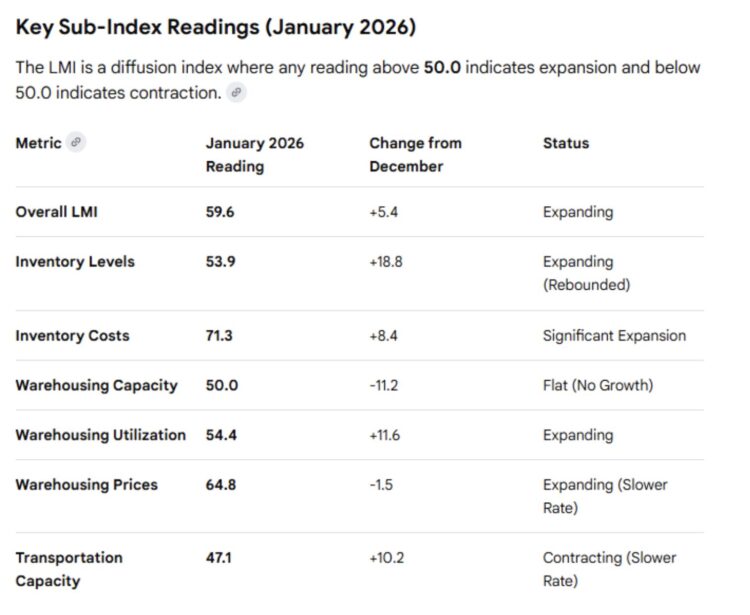
The most recent Logistics Managers Index (LMI) was released for January 2026. Like much of the news so far in 2026, it is a mixed bag, making it hard to get a clear sense of where the U.S. economy is headed.
The overall result is 59.6, which is an increase of 5.4 points from December 2025. This could involve resetting inventories and recalibrating the typically slowest part of the logistics calendar. Warehouse capacity dropped, while warehouse utilization increased. Transportation remains tight and is in the midst of a multi-year downswing. However, the LMI stated that “capacity reductions have cooled in the seasonally weakest part of the year.” That said, the industry appears bullish and anticipates growth.
Even though there is some optimism in the sector, the specter of a gloomy labor market is making 2026 a bumpy start. In a WSJ article, the writer stated that, “U.S. job openings dropped by 386,000 roles in December to their lowest level since September 2020, the Labor Department reported…For months, labor economists have wondered to what extent—and when—advances in artificial intelligence will lead to wider cuts throughout the white-collar workforce. While that era might be approaching, it has yet to forcefully arrive.”
The great AI experiment is working its way through corporations.
Like most of us who experienced changes in middle school and high school, AI is likewise maturing. Sometimes, it’s not that attractive. In a Fast Company article, the line “The advent of AI is accelerating the entry-level apocalypse” resonates with me.
Earlier this week, I had the chance to speak with educators at Miami University’s Farmer School of Business. We will be working closely with a supply chain management class of seniors on a semester-long project. I cannot help but think of the world these impending graduates are facing.
In the not-too-distant past, recent grads could secure entry-level positions and gain real-life practice honing their skills. The knowledge transfer from middle and senior management to those just starting their careers has been essential. I worry that this practice might begin to erode in the AI era. Unless there is a deliberate plan, it could lead to suboptimal performance across all industries.
The article did an excellent job of painting this potential “demographic time bomb.”
From 2024 to 2032, 18.4 million experienced workers age 55 to 64 with postsecondary education are expected to retire, but only 13.8 million younger workers (currently age 16 to 24) are entering with equivalent qualifications. Even in an AI-powered economy, where certain jobs will be automated, companies still need humans with judgment-, context-, institutional-, and sector-specific insight.
I was not a math major, but that doesn’t add up. How are enterprises planning to turn beginners into experts?
So, to bring it all back to logistics and supply chain, it seems that all this churn, all this turbulence, all this uncertainty equates to permanent volatility. There is no peak season. There is no slowdown. It’s all hands on deck all the time.
Winning partnerships between 3PLs and their customers will depend on endurance, which is more important than speed. That means shifting the mindset from just surviving the peaks and valleys to creating a culture of constant readiness, where volatility becomes an opportunity to demonstrate value.
And this fluidity knows no bounds. In an Inbound Logistics article, several long-tenured 3PLs show that being intellectually curious and willing to question the status quo may be key to longevity. Quoted in the article is Mike Gardner, President and COO of Holman Logistics. Mike stated, “We try to anticipate and provide new service offerings that meet customers’ needs and respond to the environment.”
Bonus: I’ve been seeing this in too many places lately. I decided to check it out. “Burping” your home is a German practice that most people do, even during winter. The main idea is to open a window briefly each day—say, 10-15 minutes—to let out the stale air and bring in fresh air.
According to the article, “We spend around 90 percent of our time indoors. With that in mind, it’s essential to recognize that our homes, offices, and other indoor spaces play a crucial role in our well-being.”
Extreme cold, snow, and ice remain firmly in place in the northeast U.S.
Here are some amazing pictures of frozen Niagara Falls.

Stay warm and remember to be kind.