By Alex Stark
Right Number, Wrong Question: Walmart’s Robot Reality Check, Electric Rigs Versus $8 Diesel, the Holiday Returns Collision, and the Planner’s Most Important Skill
Earlier this week, I traveled to one of our nationwide facilities in Maryland and joined our President and COO to celebrate the team’s one-year safe milestone. It’s a dynamic, vibrant operation of more than a million square feet, so our Journey to Zero safety commitment runs strong there.
Speaking of vibrant, the colors in my little corner of the supply chain are nearing spectacular. We’re right at the edge. I’d say one more week, and we’ll be entering prime color explosion. Hopefully the weather will cooperate in your little corner. Get out and enjoy it. For me, once the leaves are gone, it’s six months of brown.
Four things this week, and they share a theme. In each one, someone has the right number but asks the wrong question.
Let me know what you’re seeing.
1. Walmart’s Robots Ran into Turkeys, Cardboard, and the Power Bill
For years, Walmart has relied on more than 140,000 warehouse workers to unload trucks, move pallets, sort and store goods on towering racks, and then reverse the whole flow to send merchandise out to stores and homes. The work isn’t especially complicated for people. Teaching robots to do it, as the WSJ reported this week, is another matter.
Walmart is a decade and several billion dollars into automating that work, with the transition now underway at most of its roughly 200 U.S. supply chain buildings. Rob Montgomery, head of supply chain operations for Walmart U.S., described where things stand:
We are kind of in this peak complexity.”
What Peak Complexity Looks Like
- Years of searching. Walmart and its robotics partners tested technology that either didn’t work or cost too much before settling on small, wheeled robots with motion and obstacle sensors. Those are now going into more than a dozen warehouses.
- Breakdowns. The small robots break down too often.
- Turkeys and cardboard. Sorting machines struggled with cardboard boxes and frozen turkeys, so Walmart has switched to box designs that work better with the equipment.
- Rebuilding without closing. One of the hardest parts is re-engineering a warehouse while it keeps shipping.
- The power bill. According to the Journal, automated grocery warehouses can run monthly utility bills above $800,000 at peak, against about $250,000 when operations were mostly manual.
On jobs, executives told the Journal that automation will eventually mean fewer warehouse workers, but that high turnover means no layoffs, and sales growth could keep headcount near today’s level. Walmart’s main automation partner for nonperishable goods is Symbotic, in which Walmart holds a 12.6% stake.
Three weeks ago, I wrote about Amazon’s million warehouse robots and the SCMR piece on automating the mess. The lesson was to standardize the work before automating it, because robots are built for predictable conditions, not for buildings where trucks arrive early, late, or unannounced. Walmart’s turkeys, big bags of dog food, and cardboard boxes are that lesson in practice.
Ask whether a robot can do a given task, and the answer is often yes. Ask what it would cost to run the whole building that way without shutting it down, and Walmart has spent a decade finding out. If you’re evaluating automation, the robot’s productivity number is the easy one. Dig into the details about uptime, utility bills, the packaging you’ll need to change, and how you’ll keep shipping while you rebuild. Unless you are Amazon and take facilities out of service.
2. Electric Big Rigs Still Struggle, Even at $8 Diesel
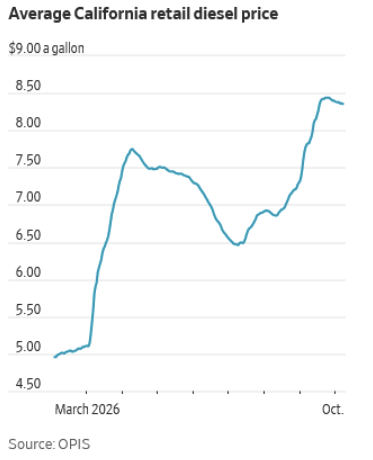
The WSJ reports that electric trucks are struggling to compete even with
diesel at $8 a gallon. That number comes from California. AAA puts the state average at $8.35, up more than 60% from a year ago. The national average is $6.32, up from about $3.75 in February.
In August, I wrote about distillate inventories hitting the lowest seasonal level on record, with retail diesel above $5.60 in many markets. Prices have kept climbing since. California truckers now describe a tank that cost $1,000 at the start of the year running past $1,600.
Why the Per-Mile Math Looks So Good
Tesla started mass production of its Semi in late September. Its own launch materials put diesel at roughly 80 cents a mile and electricity at 20 to 30 cents. PepsiCo, the same company running Gatik’s driverless trucks that I wrote about in June, already has about 50 Tesla Semis operating in California.
Why That’s the Wrong Question
It feels similar to the Walmart article. Per-mile energy cost is one input. The total cost of moving freight also includes battery weight, which reduces payload and range, a much higher upfront price, and sparse charging along freight corridors. Many experts don’t expect long-haul electric trucks to beat diesel on total cost until the 2030s. Driverless technology could pull that timeline forward, giving the Gatik story a second chapter.
The useful question isn’t whether electricity costs less per mile. It’s what it costs to move a specific load on a specific lane and schedule. For short, repeatable routes near charging, that answer is changing quickly. For long haul, it isn’t yet.
3. Holiday Fulfillment and Returns Are About to Collide
A SupplyChainBrain Think Tank piece describes how peak season used to work. Fulfillment volume climbed through November and into December, and returns took over once the rush ended. That predictable playbook is no longer available.
Peak season is no longer a relay race between fulfillment and returns.”
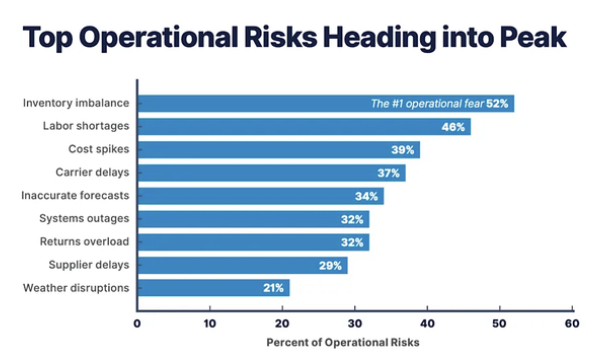
Promotions start earlier and run longer, and consumers expect instant refunds and easy returns. Returns now arrive while fulfillment is still running at full intensity, leaving less time for networks to recover.
Where the Pressure Lands
- Warehouse space. Returns occupy room that would normally support outbound, and that squeeze gets tighter every week volumes stay elevated.
- Labor. More competition for workers, at a moment when there are fewer to go around.
- Systems. Both peaks are live at the same time.
The line from the piece that nails this week’s theme: a facility can accurately predict overall holiday demand yet still be overwhelmed if returns arrive early, concentrate in certain product categories, or place unexpected pressure on specific functions.
Last week, I wrote about Prime Big Deal Days on October 6 and 7. Returns from those October purchases will start arriving in November, right as December fulfillment ramps up. That’s the collision that needs to be addressed.
This is where flexible space and labor earn their keep, so returns don’t crowd out outbound during the weeks that matter most. It’s the kind of planning we do with customers heading into peak.
“How much will we ship?” has a straightforward answer. “When will it come back, and where will it pile up?” is the question that determines December and operational agility.
4. The Rise of the End-to-End Planner
Supply Chain Management Review argues that as AI takes on more planning analysis, planners need four skills:
- Frame problems.
- Guide decisions across functions.
- Turn insights into action.
- Exercise judgment under uncertainty.
Skill number one is framing the problem, and that’s the thread running through this entire post. Every story above is the right answer to the wrong question. AI is getting very good at producing an answer. Deciding which question it should answer is still a human job.
The other three skills connect to threads from this year. Guiding decisions across functions is the translator role from Kimberly-Clark’s talent model in July, the person fluent in both the work and the technology. Last week’s theme was exercising judgment under uncertainty, and Cornelia Walther’s line that human agency begins before certainty. It’s also the last-mile operators from September who let AI predict but not decide.
The Uncomfortable Follow-Up
SCMR has also been asking whether supply chain AI is shrinking the first rung of the career ladder too fast. That question deserves more attention than it gets. I think about it constantly and talk with leaders (both in supply chain and other industries). If AI handles the analysis work that used to train junior planners, where does the next generation learn to frame problems in the first place? How do young professionals learn? I fear that as we introduce more and more technology (which becomes a shortcut), we are short-circuiting the next generation. We had the benefit of failing, repetition, mentorship, training. I’m no Luddite, but if we aren’t doing this deliberate work, can we be confident in tomorrow’s leadership?
When you hire or develop planners, test for the question they’d ask before you test for the answer they’d produce.
Right Number, Wrong Question
Robots can handle the task, and Walmart is still working out the cost of running the building that way. Electricity costs less per mile, but electric trucks still struggle. Holiday demand can be forecast perfectly, while returns overwhelm the building. And SCMR says the planner’s most important skill is deciding what to ask.
The numbers are rarely wrong. They answer whatever you ask. Most of the expensive mistakes I’ve seen came from a correct number answering the wrong question, not from bad data.
Bonus #1: Water From Data Center Heat
With all the negative stories surrounding AI and data centers, I’m always drawn to stories that show some good can come of it. A California startup developed technology that can make water using data centers’ waste heat. It’s not drinkable water (yet), but the technology could be a breakthrough as data centers and climate change strain water supplies worldwide.
The company, Atoco, is based in Irvine, CA, and was founded by Omar Yaghi, who won the 2025 Nobel Prize in Chemistry for the materials it uses. Its machines pull moisture from very dry air without electricity, running on the low-grade heat that data centers already pay to get rid of. The demonstration used simulated data center heat, and the company is targeting its first orders by the end of this year. Water in the West keeps showing up in this blog. I’m glad it’s good news this time.
Bonus #2: Write It by Hand
I loved this story, and it gives me hope. Dumb.co, a company that sells $20 flip phones to people trying to spend less time online, got nearly 900 applications for four internship roles. So many cover letters read like generic AI that the company changed the rules partway through and required handwritten letters.
About 70% of applicants sent one. The company interviewed about 60 and hired 10. One hire wrote about the flip phones he already owned. A handwritten letter… imagine that.
Demand better, people.
Bonus #3: Cancel Your Subscription
This one was right up my alley. How many of us are exasperated by the awful chore, and sometimes scavenger hunt, of canceling services? It can be maddening. No wonder apps exist to help you remember forgotten subscriptions. Give this one a whirl. The goal is straightforward: cancel your subscription. Bonus points for the old-school internet aesthetic.
Back in July, I used one click to subscribe and ten steps plus a phone call to cancel, as the textbook example of bad friction. Somebody turned it into a game.
You’re welcome.
One Last Thing… The Fall Foliage Map
I talked about the changing leaves at the beginning of this post. Here’s an interactive map of predicted fall foliage across the U.S. Find your corner and plan accordingly. Best wishes, and stay safe, friends in the Gulf region affected by Hurricane Isaias.
And to our lovely neighbors to the North, have a Happy Thanksgiving.
Remember, it costs nothing to be kind.