By Alex Stark
When the Story Meets the Operating Reality: The AI Jobs Walk-Back, a Super El Niño, FedEx Freight’s Fresh Start, and a $5 Billion Twinkie
A quick bit of housekeeping before we start. Today, July 9th, is the birthday of Donkey Kong, which makes it, sort of, Mario’s birthday too. I spent a truly indefensible number of quarters on that machine in pizza shops as a kid. More on that at the very bottom.
This week’s reading had a common shape to it. In every story, someone was discovering that the tidy narrative they’d been telling didn’t survive contact with the operating reality. The AI job apocalypse got quietly walked back. The weather stopped being a footnote. A freight giant admitted its old structure was holding it back. And a jam company found out the hard way that a Twinkie is a logistics problem wearing a snack-cake costume.
Four things to share. Let me know what you’re seeing.
1. The AI Job Apocalypse Got Quietly Walked Back
A year ago, the message from the top of the AI industry was blunt: a large chunk of your job is about to vanish. Dario Amodei warned that AI could eliminate half of entry-level jobs. Ford’s CEO said it could replace “literally half” of white-collar workers. This month, per the WSJ, the same founders are singing a noticeably softer tune.
The Pivot, in Their Own Words
- Sam Altman, in late May: “We’ve been roughly right on technological predictions and pretty wrong on the social and economic implications.” Soon after: “Our industry underestimated how much we’re going to be able to keep people at the center of everything.”
- Amodei, a year after the “half of entry-level jobs” warning, now stresses that AI-adopting businesses “can do more with the same amount of resources. But that requires creativity.”
- The data behind it: an EY-Parthenon survey found the share of CEOs expecting AI to cut headcount fell from 46% in January 2025 to 20% in May 2026.
MIT economist David Autor had the sharpest read on why the tune changed:
They may have realized it was simply bad business to say that your great new product will destroy the economy.”
Here’s the caveat, though. The softer rhetoric does not match the layoff numbers. Tech layoffs through the first half of 2026 have surpassed 115,000, with AI cited in roughly 101,000 of them. Challenger, Gray & Christmas called AI the leading reason for cuts in June. So, the story got sunnier while the spreadsheet did not. And the timing is worth noting. The AI backlash I wrote about in May (the booed commencement speaker, the data center fights) gave these founders a strong incentive to stop describing their product as a job destroyer, right as they court their next round of funding (or pending IPO).
This is the same lesson as the Kimberly-Clark talent piece last week and the workforce-mismatch piece back in May. The useful truth was never “AI eliminates jobs” or “AI creates jobs.” It’s “AI redesigns jobs.” Fewer backfills, combined roles, higher productivity expectations, and a real premium on people who build AI fluency. An Oxford Internet Institute experiment this spring found that listing AI skills raised interview callback rates by 8 to 15 percentage points across several fields. The displacement-versus-augmentation debate is mostly noise. Redesign is the signal.
Here’s the takeaway for operators. Watch what companies do with headcount and role design, not what founders say in interviews. The rhetoric now tracks the fundraising cycle. The operating reality tracks the org chart and the team hired to the job. Plan with that top of mind.
2. A Super El Niño Is Coming, and It Is Not a Footnote
NOAA officially declared the start of the El Niño season on June 11. The concerning part, per SupplyChainBrain, is that forecasters put the odds of it escalating into a “Super El Niño” by winter between 63% and 80%. That’s the version where equatorial Pacific sea-surface temperatures run 2 degrees Celsius or more above normal, and the usual heat waves, droughts, and floods get kicked into high gear worldwide.
Where the Exposure Lives
- Agriculture is the obvious one. The last Super El Niño (2015-16) drove drought and forest fires that devastated Southeast Asian farming. Forecasters are already talking about premiums up to 40% above spot on at-risk agricultural goods.
- The Panama Canal is the one that ties to my running theme. The canal depends on freshwater lake levels, and the 2023-24 drought already forced transit restrictions and vessel queuing. Another drought throttles it again. Layer that on top of the ongoing Hormuz and Suez disruptions, and you get simultaneous slowdowns across three of the world’s most vital shipping corridors. As one analyst put it, “it’s just going to continue to snowball.”
- Data centers are the new wrinkle. A single large facility can consume as much as 1.8 billion gallons of water a year, making the semiconductor fabs and AI data centers that depend on it newly vulnerable to drought.
This is the “every operation has a Hormuz” lesson from April, arriving as weather. A Super El Niño isn’t a single point of failure. It’s a synchronized, multi-region disruption that hits agriculture, shipping, energy, and technology at once. The right response is the same one seasoned operators are already running for geopolitical risk. Best practice is to map your vulnerable SKUs to their sourcing regions, stress-test alternative origins, and build a planning window, just in case. Here’s a handy detail for your prep. Food-price inflation typically lags a climate event by up to eight months, so the companies watching the signal today have a real head start.

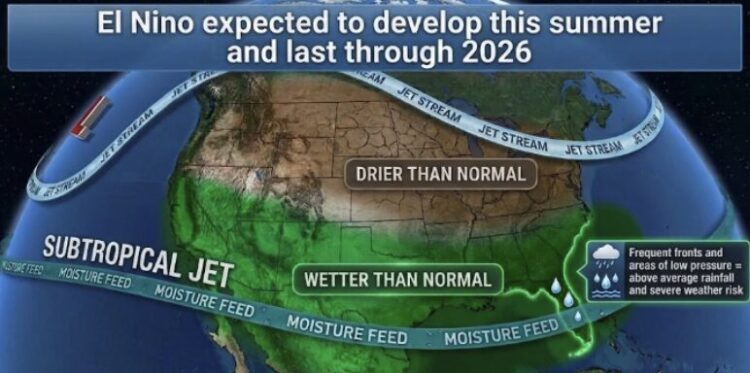
Weather has quietly graduated from a footnote to a baseline planning factor if you live in the supply chain world. If your risk model still treats it as an act-of-God footnote rather than a line item, the model is out of date. Map the exposure now. Don’t wait for it to impact your business.
3. FedEx Freight Cut the Cord, and the Reason Is a Lesson in Focus
FedEx spun off FedEx Freight into a separate public company (NYSE: FDXF) on June 1, and CEO John Smith spent the past few weeks explaining the strategy at industry conferences and on the first standalone earnings call. It’s now the largest pure-play LTL carrier in North America: 365 locations, roughly 30,000 vehicles, about 40,000 employees.
Here’s the angle, and it’s the whole story. Smith described the old arrangement, being bundled inside the broader FedEx parcel-and-air system, as a competitive “disadvantage.” The back-office technology was parcel-centric, and the LTL business was left to bolt itself onto systems built for a different job. Unwinding all of that was, in his words, “a massive effort.”
The Strategic Pivot
- From “chasing volume” to “chasing the right volume.” A tiered service model (Priority, Economy, Direct) aimed at high-value verticals where precision beats commodity pricing: healthcare, aerospace, automotive, and the data center and energy market.
- A dedicated LTL salesforce, “unburdened by selling small-parcel services,” targeting small and mid-sized businesses.
- An interesting data point: despite lower freight volume, revenue per shipment rose 11.5% year over year, driven by heavier shipments, higher fuel costs, and improved backhaul efficiency from tighter truckload capacity. That last point ties directly to the supply-driven freight reset I keep writing about.
To drive the point home, on July 1, CMA CGM Group announced it had reached a deal to purchase FedEx Supply Chain for $1.4 billion. I’ve read this as a win for CMA CGM’s subsidiary, Ceva Logistics, and maybe it is. However, I read it as a shrewd move by FedEx to build momentum for its corporate strategy.
There’s a lesson here about focus that extends well beyond FedEx. A business optimized to be part of a larger system is rarely optimized to serve its own customers best. FedEx Freight is betting that independence lets it serve LTL shippers the way an LTL-first company can, rather than the way a parcel company’s freight division can. It paid roughly $80 million in separation costs to regain that focus.
It’s also an argument for choosing partners whose core business is yours. An asset-based 3PL that exists to move and store freight brings a different kind of attention than a division bolted onto something larger. That focus is the whole idea for us. So, the question worth asking of any logistics partner is a straightforward one. Where does your product sit in their business? Are you a core customer, or a rounding error inside a bigger system? FedEx Freight just spent a year and $80 million answering that question for itself.
4. Smucker Paid $5 Billion for Twinkies and Learned a Painful Logistics Lesson
In 2023, J.M. Smucker (jams/jellies, Folgers, Meow Mix, Milk-Bone) paid about $5 billion for Hostess, the maker of Twinkies and Ding Dongs. CEO Mark Smucker took the stage at a conference, bit into a Twinkie, and declared, “tastes like growth.” Three years later, per the WSJ, the company has written off nearly $3 billion of that purchase, the snack division has declined for six straight quarters, and the stock is down about 14%.
Here’s the logistics punchline. Twinkies have a shelf life of about 65 days. Smucker’s core products (fruit spreads, canned coffee, pet food) last a year or more. The entire Smucker distribution and inventory model was built for slow-moving, long-shelf-life goods. Hostess products need quick delivery, tight inventory turns, and constant replenishment. Smucker imposed its own operating model on a business that required the opposite, and degraded the engine it had paid $5 billion for.
The second miss compounded the first. Smucker separated its grocery and convenience-store sales teams, even though about 40% of Hostess sales run through convenience stores, a channel Smucker barely knew. The distribution model was wrong, and the sales coverage was, too.
This wasn’t purely an own goal (still sad about the USMNT). The category itself is under real pressure. Sweet baked goods consumption has fallen roughly 3% per year since 2022, driven by GLP-1 drugs and the broader shift away from ultra-processed snacks. That’s the same GLP-1 force I wrote about in the whey and protein pieces, now showing up from the other direction. It lifts protein demand while suppressing snack-cake demand.
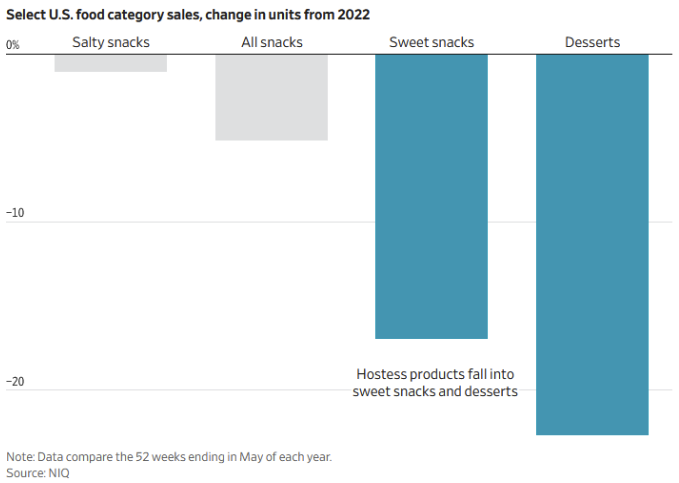
Still, the shape of the story is unmistakable. The narrative Smucker told itself was “we are buying a beloved growth brand.” The operating reality was “we are buying a fast-perishable, convenience-store-dependent product that our entire logistics and sales model is wrong for.” Due diligence modeled the brand and the margins. It did not fully account for the supply chain, and that’s where the deal stumbled.
The takeaway is the sharpest one available this week. In an acquisition, the logistics fit is not a footnote to the strategic rationale. Sometimes it is the strategic rationale. The most expensive thing Smucker overlooked was not a growth projection. It was shelf life.
The Story Meets the Operating Reality
AI founders discovered that the job-apocalypse pitch had gotten ahead of the data, and quietly softened it. A Super El Niño is about to remind everyone that weather is a line item, not a footnote. FedEx Freight paid $80 million to escape a structure that made it worse at its own job. And Smucker learned that a $5 billion narrative cannot outrun a 65-day shelf life.
The story you tell about your business is not the same as the way it truly runs, and the gap between them is where the expensive surprises live. The useful discipline, in a week that produced four striking examples of it, is to keep checking the story against the operating reality. Watch the company’s financials, don’t get caught up in the interviews. Model the weather, not just the market. Ask where you sit in your partner’s business. And never, ever underestimate the seemingly invisible mechanics of logistics and supply chain.
Where is the story getting ahead of the operating reality in your world?
Bonus #1: For My Grandmother, and for Rafa
My late grandmother, who was German and emigrated to the U.S. in 1959 with my then 10-year-old father, loved tennis. Especially Rafa Nadal. Some of my fondest memories of her are how passionate she would get watching tennis, and really all sports. (I know for a fact she had a crush on Broadway Joe.) Johnny Carson, Frank Sinatra (who taught her English through the way he enunciated words), jazz, tennis. So many of her loves rubbed off on me.
With Wimbledon just wrapped and the U.S. Open around the corner, she would have flipped for the limited four-part Netflix series on Rafa. It would have kept her tennis level at its peak. Even if you’re not a fan of tennis, this is a terrific watch for the sheer professionalism and dedication to craft.
Bonus #2: A Two-Minute Coffee Break
Need a two-minute coffee break? I stumbled into this fun puzzle game, but I cannot seem to get past level 7. My reflexes are not as sharp as they used to be. Enjoy…
You’re welcome.
One Last Thing: Happy Birthday, Donkey Kong
As promised at the top. July 9th is the anniversary of one of the best video games of all time. I spent far too many quarters in pizza shops and arcades on this one. Donkey Kong.
Even though the game is named for the “villain,” the real winner of the story is the plucky plumber from the Mushroom Kingdom. When the console was released, he was known as “Jumpman.” The popularity of this game made Nintendo one of the dominant players in the market and turned Mario into a gaming and movie superstar. A little business-history nugget hiding inside a nostalgia trip, which is very much my kind of thing.

Remember, it costs nothing to be kind.