By Alex Stark
The Wrong Instinct: Why the Freight Reset, AI Bottlenecks, Transparency Theater, and a 183-Year-Old Factory Closing Are All the Same Story
There’s a particular rhythm to mid-quarter weeks. The big quarterly noise has settled, the next big push hasn’t fully started, and you finally have a little breathing room to catch up on all those articles (and open tabs) you earmarked. I had one of those weeks, and my research turned into a master class in how often the obvious move turns out to be the wrong one.
Looking out my office window, the woods are green again, and that’s a meaningful upgrade from a week ago. Still, it seems like we’re bumping along. Recent overnight lows have me draping burlap over the flowering trees in the backyard to protect them from frost.
Spring sometimes arrives the way industry shifts often do. Slowly, quietly, and then all at once.
In my corner of the supply chain, this is a useful frame for this week’s learning. The stories I gravitated toward were about the freight market, AI in supply chains, AI transparency, and an 183-year-old Stanley factory closing in Connecticut. Four different pieces that all kept circling back to the same uncomfortable pattern.
In a high-pressure environment, our default instincts often point in exactly the wrong direction.
Here’s what I mean.
1. The (Unpresented) Freight Market
A new monthly survey of supply chain managers, reported in FreightWaves this week, found something the freight industry has never seen before. Transportation has never been simultaneously this tight and this expensive at the same time. Capacity is plummeting, prices are skyrocketing, and the Strait of Hormuz disruption supercharged a market that was already on an upward trajectory coming into 2026.
The Numbers Worth Knowing
- Transportation utilization hit 69.6, the highest reading since November 2021.
- Tender rejection rates held above 14% through April.
- The 12-month forward pricing index is reading 93.9. Anything over 50 is expansionary. 93.9 is unprecedented.
- Truckload costs are now projected up 16–17% year-over-year for 2026 (according to C.H. Robinson).
- Diesel surged over $1 a gallon in early March from the Iran conflict, and it hasn’t come back down.
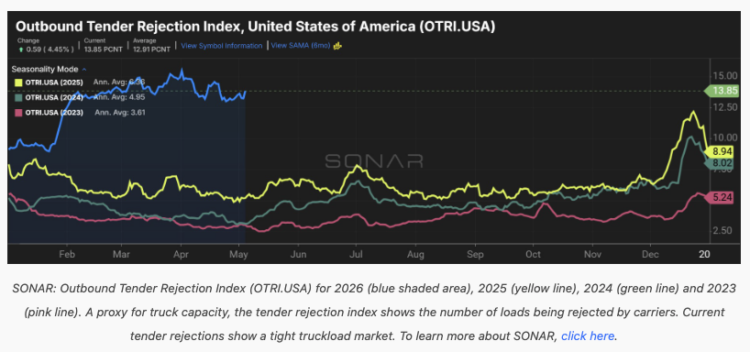
The wrong instinct here is the classic one: “This will pass. We’ve seen tight markets before. Hold the line on rates and wait it out.”
That instinct doesn’t align with the data. Three structural factors are stacked on top of one another in a way we haven’t seen before. Carriers exited the market in droves during the soft cycle of 2023–2025, and that capacity isn’t coming back because record-high equipment prices, coupled with tighter lending, are keeping them out. Regulatory enforcement (English-language proficiency requirements, scrutiny of non-domiciled CDLs) has permanently squeezed the available driver pool. Oh yeah, and the Iran conflict has added a fuel-cost shock on top of it all.
That’s not a cycle. That’s a reset.
The right instinct, I’d argue, is to lock in capacity now. Build longer relationships with asset-based carriers. Stop chasing spot discounts that have already evaporated. The shippers who are sleeping well right now are the ones who locked in dedicated capacity 12 months ago. The shippers who are scrambling are the ones who assumed the soft market would last another quarter.
This is exactly the conversation Holman has been having with customers for a while now, and our service philosophy was built around showing up reliably in markets that don’t cooperate. Asset-based carriers were built for moments like this.
2. AI Doesn’t Fix Bottlenecks. It Relocates Them.
An interesting piece in SupplyChainBrain this week makes an argument I haven’t been able to stop thinking about. Organizations deploying AI function-by-function are getting impressive node-level wins, only to watch their bottlenecks quietly migrate to whichever node isn’t yet using AI.
Stated plainly, a supply chain is a network of interdependent flows. When you accelerate one node, you change the pressure on the adjacent ones. The system’s overall performance is still bound by its weakest link. It just becomes a different weakest link.
Two examples from the piece really landed for me:
- AI demand sensing reduces forecast error by 30%. That’s a win, but suppliers built around the old demand-signal rhythm can’t absorb the new velocity. The constraint has migrated from your forecast accuracy to your supplier’s production flexibility.
- AI dynamic routing reduces cost-per-mile in transportation, but the same dynamic assignments create instability for drivers, warehouse teams, and receiving docks that depend on predictable arrival windows. You saved at the line-item level but lost at the network level.
The wrong instinct: “Pick the function with the biggest pain point. Deploy AI there. Move on to the next.”
Node-level optimization is not network-level optimization. You can spend a fortune deploying tools that improve specific KPIs while the overall system gets more fragile, not less. From the article, this line stuck with me:
“For AI in supply chains, the node-level wins are already here. The network-level work has barely begun.”
The right instinct is to start every AI deployment with a constraint map. Where does the bottleneck currently live? Where will it migrate when this function improves? Fund integration infrastructure at the same level as model development, because the value of a better forecast is zero if it can’t positively and effectively influence the functions that act on it. Also, value building leadership capability to manage at the network level, which requires a different skill set than managing functions well.
This dovetails with the Wharton persona-prompting research I wrote about a couple of weeks back. Both stories say the same thing. Durable gains in AI come from systems thinking and sound fundamentals, not from layering clever individual tactics.
3. When AI Transparency Becomes Theater
Speaking of clever tactics that don’t work, a piece from Knowledge@Wharton makes a sobering case that AI interpretability tools (the dashboards and visual model explanations that boards and regulators love) can be manipulated to appear fair, even as the underlying model continues to produce biased decisions.
Transparency, it turns out, is performable.
Research by Fei Huang (UNSW) and Giles Hooker (Wharton) showed that partial dependence plots, which are one of the most common interpretability tools, can be tuned to hide discrimination in a model. The dashboard looks clean, but the output isn’t. Anyone reviewing the visualization would walk away reassured.
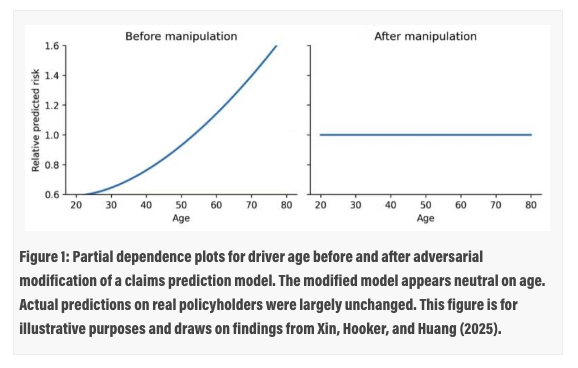
Their bottom line:
“Accountability for AI decisions has to rest on what those models actually do to real people. A clean plot is not evidence of that. It is, at best, a starting point.”
The wrong instinct: “We built an interpretability dashboard. We’re transparent. We’re done.”
A transparent-looking AI system isn’t the same as a fair one. Cleanly visualized doesn’t mean cleanly behaving. Boards and regulators have been treating interpretability outputs as proof of compliance, but every visualization is downstream of choices about which features to show, which aggregations to use, and which slices to highlight. Each of those choices can hide more than it reveals.
Spidey-senses tingling? Follow your instincts. Audit AI systems on what they do to real people, not on how they look in summary plots. Treat interpretability as one input among many. Make sure someone outside the team building the model is checking the outputs against demographic and outcome data. Don’t outsource your governance to a chart.
If your operation uses AI in any decisioning workflow that touches customers, partners, or pricing, this is one of those signals worth paying attention to before regulation forces the conversation. Make sure the governance is doing the actual work, not just producing artifacts that look like the work.
4. Stanley Closing a 183-Year-Old Factory in Connecticut
Stanley Black & Decker is closing its New Britain, Connecticut factory after 183 years. The factory is the last remnant of a Stanley manufacturing behemoth that once employed more than 5,000 across multiple facilities in the city. Once it shuts down, roughly 287 jobs will be lost.
Most news outlets reach for the same instinct on this one: it’s a tariff story. It’s an offshoring story. It’s a “manufacturing in America is dead” story.
But the WSJ reporting tells a different story. The factory wasn’t killed by tariffs. Stanley navigated the tariff environment reasonably well. They raised prices, absorbed an $800M tariff hit in 2025, and still beat earnings. The factory was shut down because consumer preference shifted from single-sided to double-sided tape measures, and the New Britain plant specialized in single-sided tape measures. Management said the New Britain factory couldn’t be retooled to make the double-sided version. So, the work is going to facilities globally that already produce it.
Read that one more time. A 183-year-old plant didn’t get killed by geopolitics. It got killed by a slightly better tape measure.
The Lesson Hiding Underneath the Headline
While everyone was arguing about steel tariffs and reshoring, the underlying customer demand curve quietly shifted. A two-sided tape measure is more useful. You can hold either side up and read it correctly. Once enough end users had tried one, single-sided tapes became obsolete in the markets Stanley serves.
Customer preference shifts are quieter than tariff news. They’re also far more dangerous to long-tenured products because they don’t announce themselves. They show up years later in a layoff notice.
Heritage businesses that have survived for over a century do so by paying attention to how customer needs are evolving, not just to the macro headlines. The wrong instinct in 2026 is to assume that all threats are in the news cycle. The right instinct is to keep asking…
What do our customers want now that they didn’t want five years ago?
And are we still building/providing/servicing it?
Tariffs make the front page. Two-sided tape measures don’t. Guess which one closed the factory.
Bringing It Together: The Wrong Instinct
Four very different stories. One uncomfortably consistent pattern.
- We assume tight freight markets will normalize. They might not.
- We assume optimizing one function helps the whole system. It might not.
- We assume transparency proves fairness. It might not.
- We assume the threat is whatever’s in the news. It might not.
This isn’t a “be smarter” lecture. It’s a “be slower, more disciplined, and more curious” lecture. The fundamentals don’t reward clever shortcuts.
Companies endure for a long time because they distrust the obvious move. They keep asking what I might be missing, even when the obvious move feels obvious. Being in business since Lincoln was in office has taught us that the wrong instinct usually shows up right when you need to be sharpest. Not as a brag. As a discipline.
Bonus #1: You Have 47 Seconds Before You Lose Them
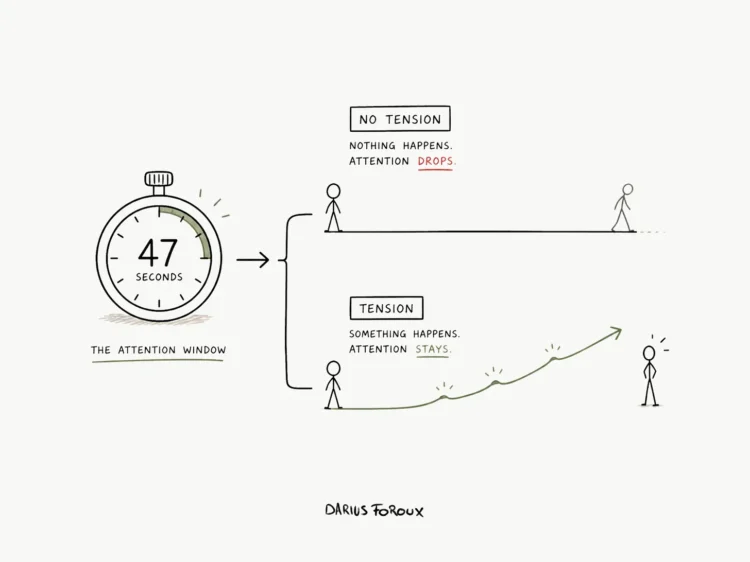
A great companion piece for anyone who writes, presents, or sells for a living. Darius Foroux’s essay this week pulls apart one of the most-quoted statistics… humans have an “8-second attention span, shorter than a goldfish.”
 Ted Lasso, love you, and that’s a solid life philosophy for a TV show; however, that stat is fabricated. Made up. Fiction.
A 2015 Microsoft report cited a nonexistent source. The goldfish comparison was simply not accurate. It’s never been backed by peer-reviewed research.
The number that is real comes from Gloria Mark at UC Irvine, who tracked attention using computer logging software for 20 years. The number is 47 seconds. That’s the average time someone stays focused on a screen task before switching.
And just to make you feel uneasy, 20 years ago, that number was two and a half minutes.
It’s something to be cognizant of while writing or speaking. People drift after too long. Mark it up to the phones, Netflix loading the next watch, or the constant barrage of notifications. Constant stimulation is becoming expected.
So, what happens if you want to be heard?
Practice: Setup → Buildup → Payoff.
Bonus #2: One Last Thing… Gail.com
This one is pure delight. If you’ve ever fat-fingered “gmail.com” and accidentally typed gail.com, you may have stumbled onto one of the great quiet treasures of the internet.
Gail’s husband bought her the domain as a birthday gift in 1996, which is eight years before Gmail even existed. When Gmail launched, and millions of mistyping users started landing on her page, she didn’t monetize it. Didn’t sell it. Didn’t plaster it with ads. She wrote a charming, no-nonsense FAQ explaining that yes, you probably meant to go to Gmail and, no, she’s not interested in selling. She even successfully fought off a domain takeover attempt in 2006.
According to the site’s stats, the website receives millions of accidental visits a year. It’s plain text. No graphics. No pictures of cats. Just a person being patient (and having a little fun) with the rest of us. It references 2020 and nothing more recent, so I’m hoping Gail is retired on a beach somewhere sipping Mi-Tahi’s.
In an internet that has become almost entirely transactional, gail.com is a small, stubborn act of grace. Worth two minutes of your day. Absolutely punk rock.
You’re welcome.
When the Obvious Move Isn’t the Right One, Choose a Partner Who’ll Tell You
At Holman Logistics, we’ve spent 162 years helping shippers see past the obvious move, the spot rate that looks cheap, the optimization that creates a new bottleneck, the assumption that the next quarter will look like the last one. If you’d like a partner who asks the hard questions before disruption forces them to, let’s start a conversation.
Remember, it costs nothing to be kind.