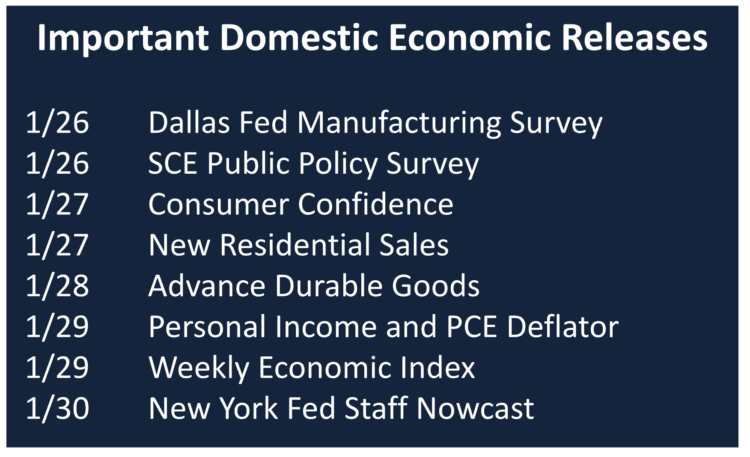
US Domestic Economic Items
The Ripples and Changes Coming At Us at Light Speed.
It feels like we are on the cusp of a business climate driven by AI disruption and evolution. Just what exactly that means for leaders and enterprise strategy is still hard to tell. One thing is for certain. There will likely be challenges ahead in navigating this new landscape.
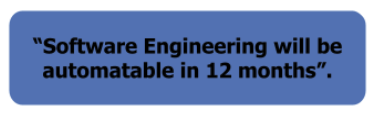 Here are a few data points on AI’s impact:
- McKinsey and other analysts estimate generative AI could automate 20–45% of activities inside the software engineering function, mostly repetitive coding, refactoring, and debugging.
- Surveys show that over 80% of active developers now use AI coding assistants weekly or daily, enabling experienced engineers to accomplish more with fewer junior helpers.
- Large companies report significant automation of routine tasks, and AI-assisted teams generate more code and complete more projects with the same number of employees.
- Cognizant estimates that AI could currently perform tasks worth about 4.5 trillion dollars of US labor annually, with roughly 93% of jobs at least partially affected and an average task “exposure” near 39%, though a large share of tasks still require human judgment.
- Forrester projects that AI and automation could directly replace about 6% of U.S. jobs by 2030, highlighting that it mostly substitutes tasks within jobs rather than entire occupations.
Most global forecasts point to economic positives, driven primarily by productivity improvements.
Supply Chain News
WEF Outlines Some Key Factors For Surviving in the 2026 Supply Chain
The World Economic Forum (WEF) laid out a key set of observations for what it sees as key survival thinking for supply chain managers in a world of volatility.
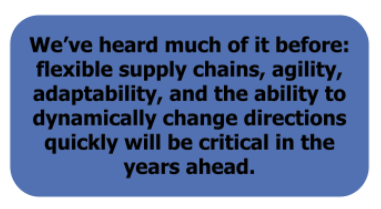 Global supply chains are shifting from short-term disruptions to long-term or permanent structural volatility, pushing both companies and governments to rethink how and where they invest, produce, and trade. This volatility is now regarded as a lasting condition, caused by geopolitical fragmentation, rapid technological change, energy transitions, labor shortages, and resource limitations.
Nearly three in four executives prioritize resilience, with 74% viewing it as a key driver of growth rather than just a cost or defensive measure. The competitive edge is shifting from lean efficiency to foresight, flexibility, and ecosystem coordination across both public and private sectors.
The corporate supply chain playbook should shift from linear, cost-focused chains to adaptable networks based on orchestration, distributed scale, and sourcing and production options. Leaders need to redesign operating models to function under constant uncertainty rather than trying to predict disruptions. Additionally, they should use data-driven tools to compare locations based on logistics, digital readiness, workforce, and ecosystem maturity, and rely on that information for making key decisions.
Important U.S. Economic Reports in the Coming Days