Inflation Readings Mixed at the Producer Level
The headline Producer Price Index showed prices came in at 3.0%, above estimates of 2.7-2.9%.
When stripping out some of the volatile categories to get to Core PPI (less food and energy), they were 2.8% (still ahead of the 2% Fed target range) – there is also a basic core that grew 3.5% and is well outside of the Fed’s target.
In general, this was considered to be a little “hotter” than expected, and the stock market initially reacted negatively, assuming that this would put a Fed rate cut on hold indefinitely pending new data visibility.
Tariffs appeared in some PPI data, but they were “firm-to-hot” across categories. In other words, it seems the tariff costs are still being passed on to customers sporadically and over a longer period. However, the evidence was that (as the Fed had predicted) some firms were finally passing on higher input costs to intermediate and finished goods customers.
Important U.S. Economic Releases in the Coming Days
| 1/15/2026 | Empire State Manufacturing |
| 1/15/2026 | Imports and Exports |
| 1/15/2026 | Initial Claims for Unemployment |
| 1/15/2026 | Philadelphia Fed Index |
| 1/15/2026 | Business Inventories |
| 1/16/2026 | Business Leaders Survey |
| 1/20/2026 | Household Spending Survey |
| 1/21/2026 | New Residential Construction |
U.S. Economic Items – Retail Sales
Retail Sales Come In Goldilocks
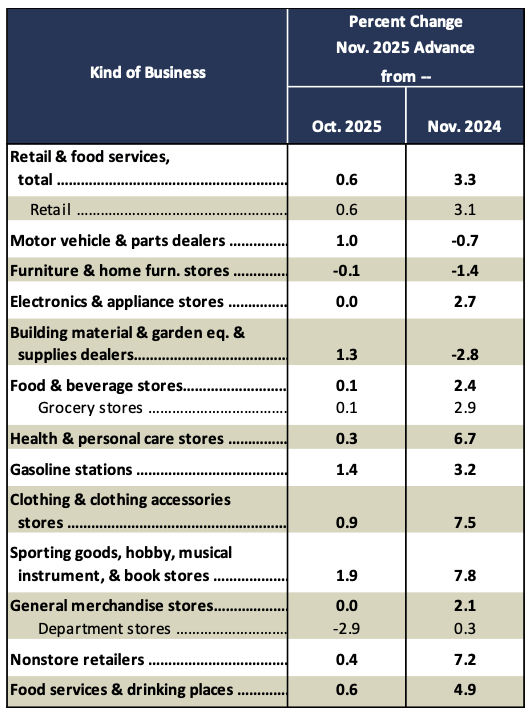 The latest Advanced Retail Sales data comes at an interesting time because it covers November, which was still in the midst of the government shutdown. The data shows some volatility.
Top-line sales were average, coming in at 3.3%, and stripping out food and fuel, it was 3.1%. When stripping out the impact of inflation, retail sales likely remained at 0.5% or less, almost flat.
Anecdotal evidence suggested that many consumers left early to take advantage of product discounts, as the data showed.
Sales were strongest in sporting goods, apparel, and to a lesser extent, electronics and appliance stores, items that were typical gift categories.
Other categories, such as general retail, were flat (down when adjusted for inflation), and department stores were flat.
Although e-commerce was slightly lower than expected, it came in 7.2% higher Y/Y after rising by 9% or more in the prior couple of months.
Seasonal issues hit other categories. Automotive took a big hit with sales down 0.7% Y/Y. Home improvement was also lower with sales off 2.8% (down nearly 5% after adjusting for inflation).
What to expect in 2026? Will there be improvements or not?
There are four economic concerns that have preoccupied analysts for the last year (and longer) and will doubtless be top of the agenda in 2026. To the surprise of nobody, these will be inflation, GDP growth, trade and tariff policies, and employment. All are related to one another.
- Inflation is what happens when demand exceeds supply. That creates scarcity, and producers respond by raising prices to control demand. There are also artificial shortages created by factors such as supply chain breakdowns, tariff policies, and various interventions. Right now, most of the inflation surge can be attributed to these inputs, but labor costs are also a mounting driver of inflation.
- The second issue is growth. Last year, GDP gains exceeded almost every prediction. Growth in the third quarter was above 4.05%, and Q4 growth only slowed slightly. The expectation is that 2026 will see GDP closer to the twenty-year average of 2.5%, but there could be upside surprises. Consumer spending will remain the major contributor, but all eyes will be on non-residential construction, which was a major factor last year (over 18% of total GDP). The emphasis on data centers and energy development will drive growth. This kind of expansion brings its own challenges.
- Tariffs affect the U.S. economy in broad, interconnected ways, some intended, many unintended. At a high level, they function like a targeted tax, reshaping prices, trade flows, and investment decisions. Most companies believe tariffs may be the new normal and are building their processes around them.
- Labor is a complicated picture. The labor shortage is becoming more acute by the month as more Baby Boomers retire. At this point, an additional 16,000 to 19,000 people receive Social Security benefits each day. Finding replacements is a challenge. The issue is further complicated by the need to find qualified people. Those who lack the needed skills and education are struggling to find work, and those who have these skills are in a position to demand higher wages. That drives labor market inflation. Bottom line, replacing 72 million workers over the next several years will not be simple.