By Alex Stark
Like many of you, I’m a bit behind on mailing my Christmas cards and buying gifts. The music is soothing, which is a plus. Vince Guaraldi is the connection that ties my youth to the present during the holidays. There’s something deeply comforting about a nearly perfect, timeless Christmas special and soundtrack that makes us pause, even if only for 30 minutes.
As an industry that functions best when it’s invisible, logistics and supply chain have faced their fair share of uncertainty this year. We all need to regroup, reflect on our successes, and, as professionals, chart a course toward a positive future. This industry is remarkably resilient.
That was succinctly summarized in an article from Supply Chain Brain. The central theme is that uncertainty is here to stay and should be a priority in all our decisions. Tariffs, ongoing conflicts worldwide, access to resources such as labor and rare earth minerals, and tensions in places like Taiwan will all influence the flow of goods.
In the Supply Chain Brain article, John Paxton, CEO of the Materials Handling Institute (MHI), is quoted as saying, “2026 marks a turning point where supply chains are not just reacting to disruption — they’re anticipating it.” MHI published a list of Top Supply Chain Trends for 2026. Some of the highlights include:
- Workforce and Talent Gap: As AI and automation scales, the demand for tech-savvy supply chain professionals is surging.
- Artificial Intelligence and the Demands for Real-Time Data: AI is no longer a luxury—it’s a necessity. From agentic AI to predictive analytics and scenario planning, AI is now embedded across supply chain functions.
- Automation and Emerging Technology: Companies are turning to automation, robotics, and AI-driven insights to build efficient supply chains.
- Cybersecurity, Risk and Data Security: As supply chains become more automated and interconnected, they face increasing cyber threats.
Zero100 added their take on the AI. Their position is that AI is, effectively, “better tools, for better work” and will be a “multiplier of human capital.” The article draws an analogy between the AI revolution and the 20th-century rollout of electrification.
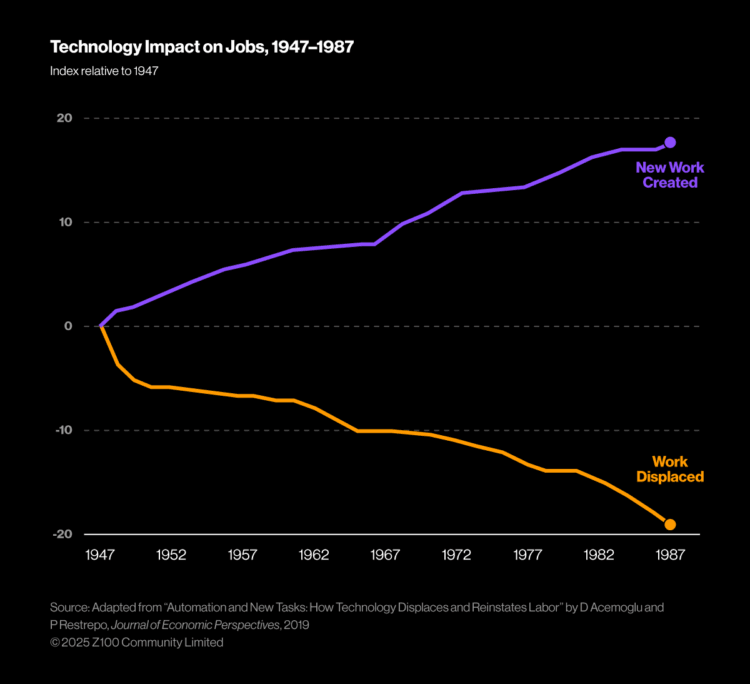
In a specific example of AI’s value, several mid-market 3PLs discussed technology (infios) that improves chargeback management with business partners. The president of one of the 3PLs said they “had no intention of eliminating the position of the person handling chargebacks. Their experience, now enhanced with AI, has made them even more effective at not only disputing chargebacks but also performing root cause analysis to understand why they were occurring in the first place, thereby improving the entire process.”
Regarding uncertainty, I found an interesting statistic. About one million people under 40 are returning to school for undergraduate and graduate degrees. However, 4-year colleges show a 2.5% growth rate, compared with 11.7% for 2-year technical school programs. More individuals are pursuing skilled trades, partly because it’s cheaper than some higher-level degrees. Additionally, many are questioning the future of work and the impact of automation.
Bonus: There are several excellent documentaries available. If you find yourself having your fill of holiday movies and want to check out something with a music angle, do yourself a favor and settle in with a true one-of-one from the 1990s – Jeff Buckley. It’s Never Over, Jeff Buckley explores the life and legacy of the American singer-songwriter and masterful guitarist.
Make the time to spend with family and friends this holiday season. Best wishes for a joyous and happy time and all goodness in 2026.
Remember, it costs nothing to be kind.